What Is an EV Charging Schedule?
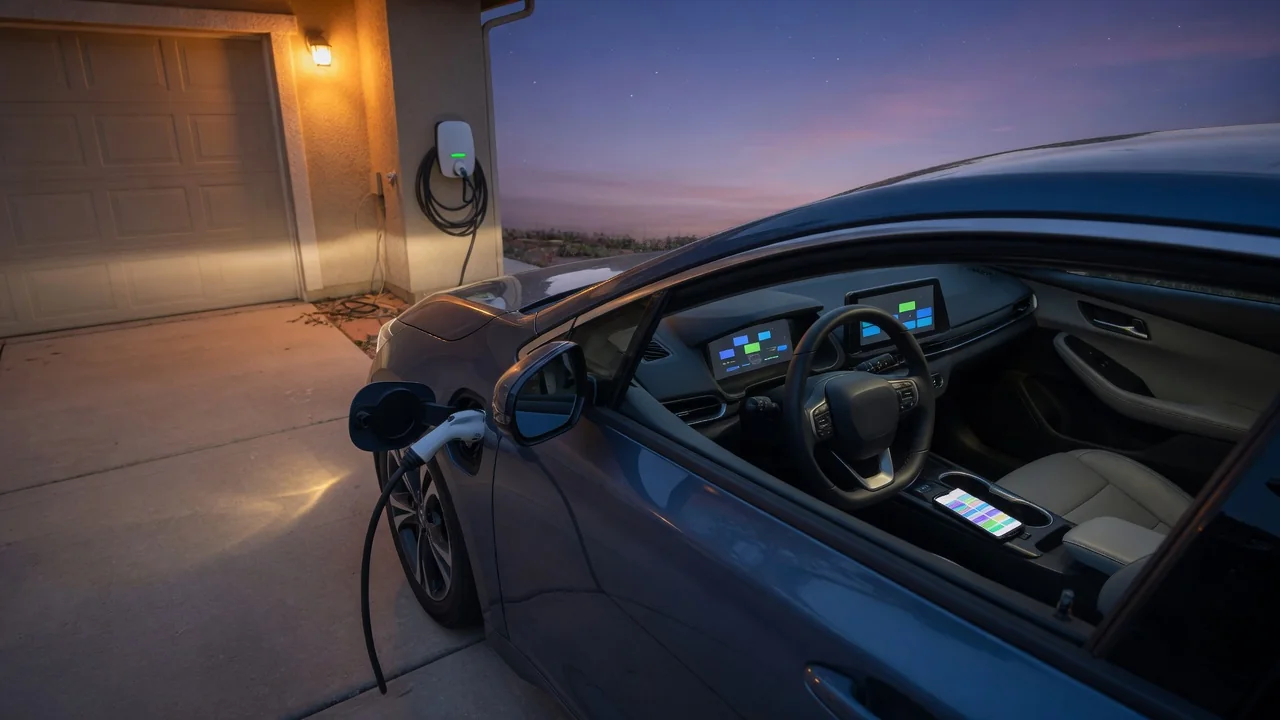
What is an EV charging schedule? It is a setting, found in the vehicle, the home charger, or a companion app, that tells a plugged-in electric car when to draw power rather than starting the moment the connector latches. Drivers use it to delay charging until cheaper overnight hours or to have the battery ready for a planned departure time.
Set time window
A time window is the simplest form of scheduled charging: you choose a start time, an end time, or both, and the car waits until that period before accepting energy. Someone on a time-of-use electricity plan might plug in at six in the evening but set the window to open late at night, when rates are typically lower. The cable stays connected the whole time, yet the battery sits idle until the clock reaches the programmed start.
Where the window is set varies by vehicle and equipment. Many cars place it in the charging menu of the central touchscreen, others rely on a phone app, and some wall-mounted chargers carry their own timer. Setting schedules in two places at once can cause conflicts, because the car and charger may each wait for the other. Some systems also let you tie a schedule to a specific location, so the delay applies at home but not at a public station.
Check completion
A schedule is only useful if the charge actually finishes, so it is worth confirming the result rather than assuming. Most electric vehicles show an estimated completion time on the instrument display or app once charging begins, calculated from the current state of charge, the target level, and the power the charger delivers. If the window closes before the target is reached, the car may stop short, leaving less range than expected for the morning drive.
Departure-based planning works the other way around. You enter the time you intend to leave, and the vehicle calculates backward to decide when to start, sometimes also warming or cooling the cabin and battery while still plugged in. In the morning, compare the displayed charge level against your target. A consistent shortfall suggests the window is too short for the charger's output, which is common with a standard household outlet, and the schedule or the charge limit may need adjusting.
Override when needed
Plans change, and nearly every scheduling system offers a way to bypass the timer. An unexpected evening trip, a low battery after a long day, or a forecast power outage are all good reasons to charge immediately. The override is often a charge-now button on the touchscreen or in the app, and some vehicles respond to a physical action such as pressing a button near the charge port or reconnecting the plug in a certain way.
How an override behaves differs between manufacturers. On some cars it applies to a single session and the regular schedule resumes the next time you plug in; on others the schedule stays off until you re-enable it. That distinction matters, because a forgotten override can quietly move your charging back into expensive peak hours. The owner's manual describes the exact method, and a glance at the charging screen after overriding confirms that power is really flowing.
Everyday Use and Observations
In daily use, a working schedule looks uneventful. You plug in, the charge port light or dashboard message indicates that charging is scheduled or waiting, and nothing else happens until the set time. New owners sometimes mistake this pause for a fault, especially when the charger shows it is connected but delivering no current. Checking for a scheduled-charging message before suspecting the cable, the outlet, or the charger saves a great deal of unnecessary worry.
Seasonal habits also shape how a schedule performs. Cold weather can slow charging and increase the energy used for battery conditioning, so a window that comfortably covered a summer commute may fall short in winter. Public stations are another situation to watch: a home schedule that is not location-specific can delay a session you are paying for by the minute. Reviewing the settings when your routine, electricity plan, or the season changes keeps the timing aligned with real needs.
Limits and Next Steps
Scheduled charging has limits. It depends on an accurate vehicle clock, a stable connection, and, for app-controlled features, a working data link. A power interruption, a tripped breaker, or a software update can interrupt or reset a session, and utility-managed programs may shift charging times on their own. The schedule also cannot make a slow power source faster; if the available hours and charging rate cannot deliver the energy needed, the timer will simply end with a partial charge.
If a schedule repeatedly fails, start with the simple checks: confirm the clock and time zone, look for competing timers in the car, the app, and the charger, and try an immediate charge to see whether the equipment works without the delay. A warning message or stored fault code is a clue that needs interpretation for that specific vehicle, not proof that a component has failed. Persistent problems are best taken to a dealer or qualified EV technician.