What Is an EV Charging Cable Holder?
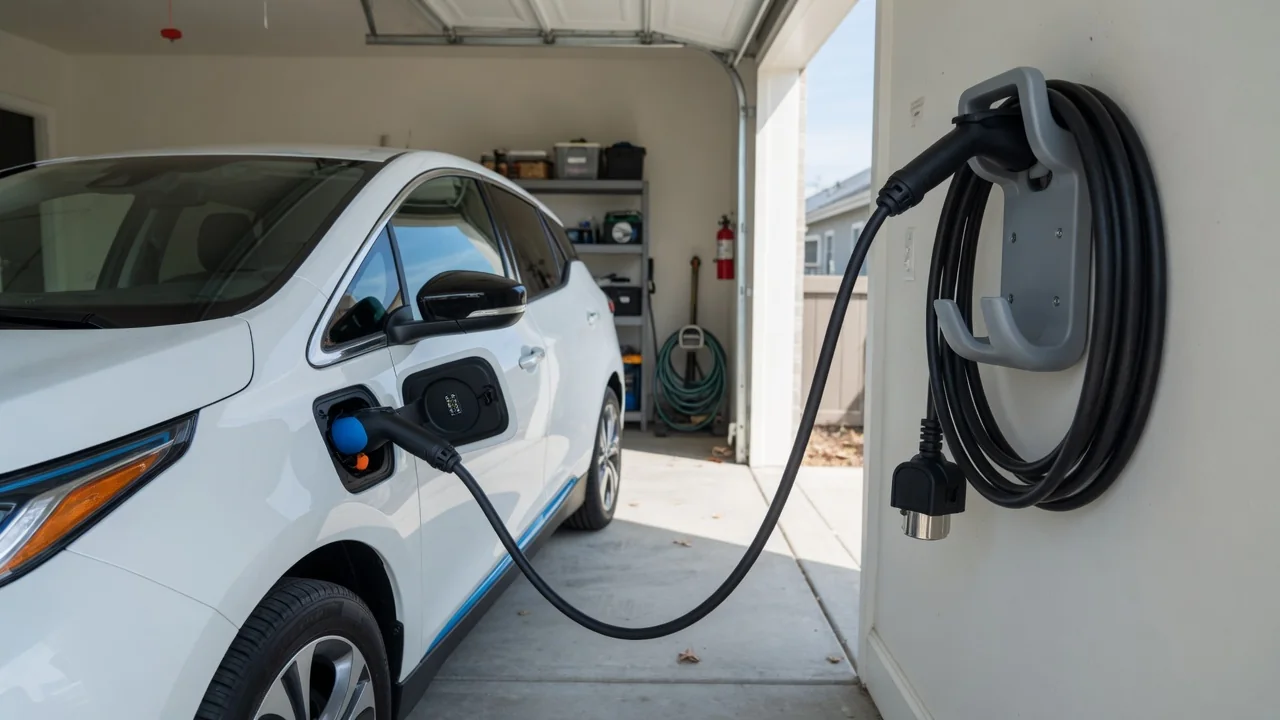
Anyone asking what is an EV charging cable holder is usually looking at a tangle of heavy cord on a garage floor. It is a wall-mounted hook, cradle, or bracket that stores the charging cable off the ground and supports its weight, so the cord, the plug, and the wall unit are not carrying loads they were never meant to bear.
Coil loosely
A charging cable contains several thick copper conductors, smaller signal wires, and a tough outer jacket, which makes it heavier and stiffer than a household extension cord. A holder gives that bulk a rounded surface to rest on, so the cable hangs in wide, relaxed loops. Wrapping it tightly around a narrow peg or bending it sharply at the same point every day concentrates stress in the conductors and jacket. A broad, curved hook spreads the load across a longer section of cable instead.
Cables behave differently with temperature and construction. In a cold garage the jacket stiffens and resists coiling, while a warm cable drapes easily, so loop size often changes with the season. Following the natural curve of the cable, rather than forcing it flat or twisting against its lay, keeps the loops from kinking. Owners can usually see the difference: a loosely coiled cable hangs evenly without corkscrew twists, and it pays out smoothly toward the charge port when the car is plugged in.
Protect connector
The connector is the most delicate part of the charging setup. Its face carries power pins, communication contacts, and a latch that must seat cleanly in the vehicle inlet. Left on the floor, it can collect grit, sit in meltwater dripping from the car, or get stepped on or driven over. Many holders include a dock or holster that receives the plug, keeping the contact face shielded from dust and moisture and the housing away from tires and feet.
A dock also provides strain relief where it matters most. When the plug simply dangles, the full weight of the hanging cable pulls on the point where the cord enters the handle, a common spot for jacket wear over time. Supporting the handle and letting the cable approach it in a gentle arc takes that pull away. Connector shapes vary by charging standard and region, so a holster must match the plug on a given vehicle or charger; checking the fit before buying avoids a loose or forced seat.
Keep walkway clear
A cable stretched across a garage floor is a trip hazard, particularly in dim light or when someone is carrying groceries past the car. It also sits in the path of tires, bicycles, trash bins, and lawn equipment. Being run over repeatedly can flatten the jacket and damage the conductors inside without leaving obvious marks. Hanging the cable on a holder beside the charger returns the floor to open space and removes those everyday crushing and snagging risks.
Placement determines how well this works. A holder mounted near the wall unit and on the same side as the vehicle's charge port lets the cable reach the car along the wall rather than across the walking route. Port locations differ widely, with some at the front fender, some at the rear quarter, and some in the nose, so the best mounting spot depends on the car and how it is parked. Outdoor driveways raise the same concerns, with added exposure to rain and passing foot traffic.
Everyday Use and Observations
In daily use the routine is simple: lift the plug from its dock, unwind only as much cable as the distance requires, charge, then return the loops and the connector when finished. A well-placed holder makes this a few seconds of effort, which is what keeps people using it. If hanging the cable feels awkward, because the hook is too high, too small, or too far from the car, the cord tends to end up back on the floor.
The holder also turns each charging session into a quick visual check. As the cable passes through the hands, cuts, flattened sections, stiff spots, or discoloration near the handle become noticeable. The connector face can be glanced at for debris or bent contacts before it goes into the inlet. Some wall chargers have a cable wrap and plug dock built into the housing, while portable cords supplied with a vehicle usually have none, so a separate holder is more often added for those.
Limits and Next Steps
A holder is an organizing and protective accessory, not an electrical component. It does not change charging speed, repair a damaged cable, or correct a charging fault. A cord that shows exposed conductors, cracked insulation, a loose handle, or signs of overheating should be taken out of service and assessed by a qualified person, however neatly it is stored. Likewise, a charging error on the dashboard or the wall unit is a prompt for investigation, not something tidier storage will resolve.
Choosing one comes down to a few practical checks. The hook should be deep and wide enough for the full length and thickness of the cable, the dock should suit the connector type, and the mounting hardware should be appropriate for the wall material and the combined weight. Units intended for outdoor use need materials that tolerate sun and weather. The charger and vehicle manuals often include guidance on cable storage, and following that guidance alongside a sensibly placed holder is the logical next step.