What Is an EV Battery Heat Exchanger? Coolant, Refrigerant and Service
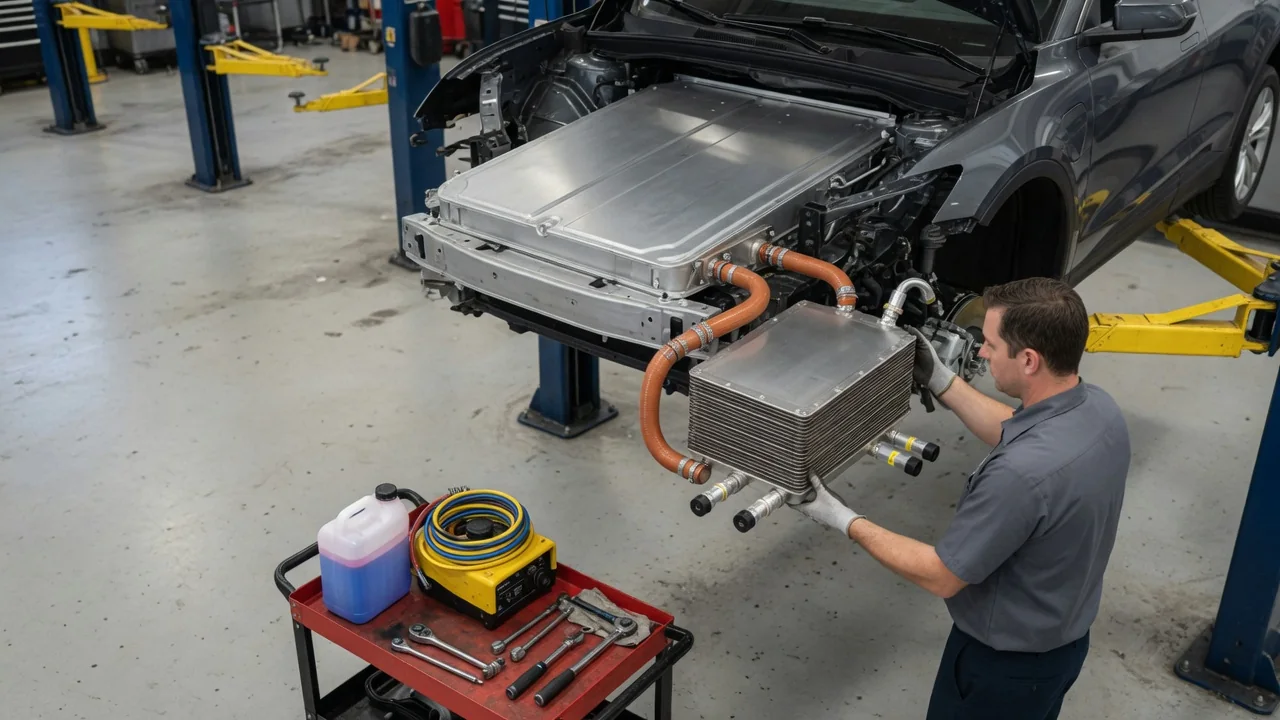
An EV battery heat exchanger is a component that moves heat into or out of a battery pack's thermal loop without letting the fluids involved mix. The term can describe several parts, but it most often refers to the battery chiller, which links the coolant flowing through the pack to the vehicle's air conditioning refrigerant. Knowing what this part does helps explain how an electric car manages battery temperature while driving, charging and parked.
Coolant and Refrigerant: The Two Fluids It Connects
Many electric vehicles with liquid thermal management circulate a coolant, usually a water and glycol mixture, through passages or cold plates in contact with the battery modules. This loop runs at relatively low pressure and carries heat away from the cells or delivers heat to them. An electric pump moves the coolant, and valves send it to different parts of the system depending on what the control software requests. Not every EV uses this approach, and some designs have relied on air cooling. Liquid systems are widespread because liquid carries heat far more effectively than air.
The refrigerant circuit is the same basic system that cools the cabin. It has a compressor, a condenser, an expansion device and one or more evaporators. In a chiller-type EV battery heat exchanger, refrigerant passes through one side of the unit and battery coolant passes through the other, separated by thin metal walls. The chiller works as a second evaporator dedicated to the battery loop. A valve, often electronically controlled, meters refrigerant into it so the system can cool the battery, the cabin, or both.
Other heat exchangers can sit in the same loop. A front-mounted radiator exchanges heat between coolant and outside air. Cold plates exchange heat between cells and coolant. Vehicles with heat pumps may use a refrigerant-to-coolant exchanger that adds heat instead of removing it. Parts catalogs and service manuals may label any of these as a heat exchanger, so the exact component depends on the vehicle's documented layout.
How Heat Transfer Works Inside the Exchanger
Heat always flows from a warmer substance to a cooler one, and a heat exchanger gives that flow a large, efficient path. Four things set how much heat moves: the temperature difference between the two fluids, the surface area they share, the conductivity of the material between them and how quickly each fluid flows. Compact plate-style designs stack many thin channels together to create a large contact area in a small space. Internal patterns that disturb the flow help break up the slow-moving layers of fluid along the walls, which would otherwise insulate them.
In cooling mode, liquid refrigerant entering the chiller boils as it absorbs heat from the coolant. This phase change absorbs a large amount of energy while the refrigerant stays at a fairly stable temperature. That is why a chiller can bring coolant below the outside air temperature. A radiator cannot do that, because it can only move coolant toward ambient temperature. The difference matters during fast charging, in hot weather and under sustained high power, when the battery may produce more heat than outside air alone can remove.
In cold conditions the goal often reverses. A battery that is too cold accepts charge more slowly and may deliver less power. To warm it, the thermal system may heat the coolant with an electric heater, waste heat from the drive unit or a heat pump, then circulate that coolant through the pack. The heat exchange principle is the same, and only the direction changes, depending on which fluid is warmer. Between the cells and the cold plate, a thermal interface material usually fills tiny gaps so heat can pass efficiently through the pack structure.
Service and Maintenance Considerations
The heat exchanger itself has no moving parts, so it is rarely a scheduled maintenance item. Service usually involves the fluids and components around it. Each manufacturer sets the battery coolant type and replacement interval. Using a coolant other than the specified formulation can weaken corrosion protection and may not suit the system's materials. Refilling is also more involved than on many gasoline engines. Because the loop contains several valves and pumps, many systems need a scan tool or service routine to cycle them and purge trapped air.
The refrigerant side is a sealed, pressurized system. Recovering, evacuating and recharging it requires dedicated equipment, the refrigerant type listed for the vehicle and the correct quantity. Electrically driven compressors generally use an oil that also acts as an electrical insulator. Contaminating the system with an incompatible oil can cause problems for the compressor's high-voltage components. For these reasons, refrigerant work on an EV belongs with technicians who are trained and equipped for it.
Several signs can point to a thermal management problem: battery temperature warnings, unusually slow charging, reduced power, a falling coolant level or weaker air conditioning. None of these points to the heat exchanger alone. Diagnosis normally relies on fault codes and live temperature and pressure data. An internal leak in a chiller could let fluids cross between circuits, which would need more than a simple top-up to fix. Cold plates are often inside the battery enclosure, so work there involves high-voltage safety procedures and should not be attempted without proper training.
Practical Implications and Limits
For drivers, the heat exchanger is mostly invisible, but its effects are noticeable. A compressor or cooling fan may run while the car is parked and charging. Energy spent conditioning the battery reduces the energy available for driving. Battery preconditioning before a fast charging session uses the same hardware to prepare the pack. When the system cannot keep the battery in its preferred range, the vehicle may limit charging rate or power to protect the cells. This is a designed response, not necessarily a fault.
Any battery heat exchanger has finite capacity. Repeated fast charging on a hot day, for instance, can still lead to lower charging rates once heat builds faster than the system can remove it. In many designs the battery and cabin share one compressor, so the control software balances their demands, and how it prioritizes them varies from vehicle to vehicle. This article describes general architecture. Whether a specific car uses a chiller, a heat pump or air cooling, and how its software behaves, is covered in that vehicle's owner's manual and service information.