What Is an EV Battery Chiller? How It Cools Electric Car Batteries
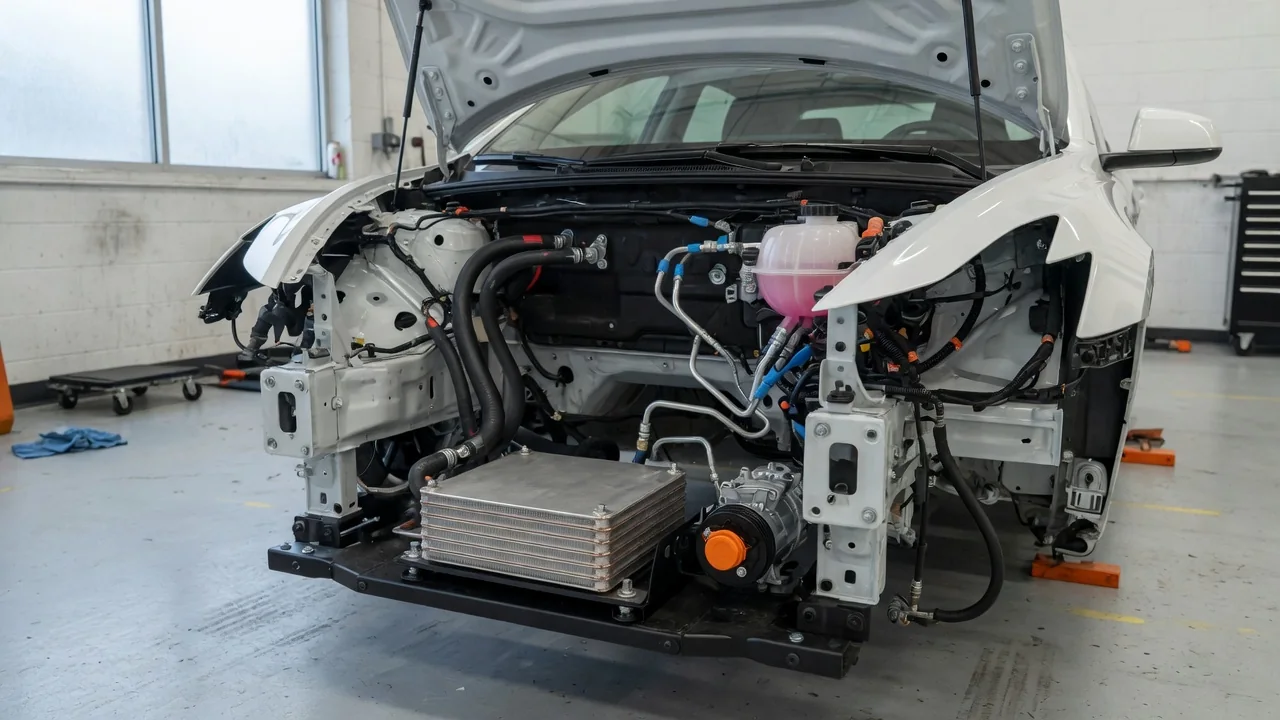
An EV battery chiller is a heat exchanger that lets a vehicle's air-conditioning refrigerant pull heat out of the liquid coolant that circulates through the battery pack. In a battery chiller electric car setup, it links two separate loops: the refrigerant circuit used for cabin cooling and the coolant circuit that runs around the cells. Knowing what an EV battery chiller does explains how many electric cars keep their batteries cool on hot days and during fast charging.
Refrigerant Loop: Where the Chiller Gets Its Cold
The refrigerant side works much like a conventional A/C system. An electrically driven compressor squeezes refrigerant vapor, raising its pressure and temperature. The hot gas flows to a condenser, usually at the front of the vehicle, where airflow from driving or electric fans removes heat and the refrigerant condenses into a liquid. That high-pressure liquid then passes through an expansion device, and its pressure drops sharply. As the pressure falls, the refrigerant becomes cold and ready to absorb heat by evaporating.
In a car without a chiller, that cold refrigerant goes only to the cabin evaporator behind the dashboard. In a vehicle with a battery chiller, the refrigerant circuit has an additional branch. The chiller acts as a second evaporator, except that instead of cooling air, it cools liquid. Inside the chiller, refrigerant and battery coolant flow through separate, sealed passages, commonly in a compact plate-style heat exchanger, so the two fluids never mix. Heat moves through the metal walls from the warmer coolant into the evaporating refrigerant.
Because the cabin evaporator and the chiller usually share the same compressor and condenser, the vehicle's thermal controller decides how refrigerant flow is split between them. Valves in the refrigerant lines, often electronically controlled expansion valves or shutoff valves, open and close the chiller branch as needed. Some vehicles integrate this into a heat pump system, where the same hardware can move heat in different directions, but the basic chiller function stays the same: refrigerant absorbs heat from the battery coolant.
Coolant Cooling: How Heat Leaves the Battery
In most liquid-cooled designs, the battery is not cooled directly by refrigerant. Instead, a coolant, typically a water and glycol mixture, is pumped through cooling plates or channels in contact with the battery modules or cells. As the battery delivers or accepts energy, it produces heat from internal resistance. The coolant picks up that heat and carries it out of the pack through hoses to wherever the system chooses to reject it.
There are generally two ways to remove that heat. The first is a low-temperature radiator that uses outside air. This path is energy efficient because it needs only a pump and possibly a fan, but it has a basic physical limit: a radiator cannot cool coolant below the temperature of the surrounding air. On a hot day, outside air may be too warm to keep the battery in its preferred range. The second path is the chiller. Because the refrigerant evaporating inside it can be colder than ambient air, the chiller can bring coolant temperature below ambient, something a radiator alone cannot do.
Control valves in the coolant circuit direct flow through the radiator, the chiller, a heater, or a bypass depending on conditions. Temperature sensors in the pack and coolant lines feed the battery management and thermal control software, which decides when the chiller is needed. When moderate cooling is enough, a system may rely on the radiator; when the heat load is high or ambient temperature is elevated, it can bring the chiller into the circuit. Exact strategies differ between manufacturers and models.
Charging: Why the Chiller Matters at High Power
Charging is one of the situations where battery heat generation can rise quickly. During DC fast charging, high current flows into the cells, and heat can build faster than during typical driving. Lithium-ion batteries have a temperature window in which they accept charge well and age more slowly. If the cells get too hot, the battery management system will typically reduce charging power to protect them. The chiller helps keep the pack within that window, so the vehicle can sustain higher charging power for longer than it otherwise might.
This is why owners sometimes hear the compressor and front fans running hard at a fast charger, even with the cabin empty and the A/C switched off. The thermal system is not cooling the cabin; it is cooling the battery coolant through the chiller. On some vehicles, battery preconditioning before arriving at a fast charger may also use the chiller if the pack is too warm, although in cold weather preconditioning more often means warming the pack instead.
Slower AC charging at home or at public Level 2 stations generally produces much less heat, so the chiller may run briefly or not at all. Whether it activates depends on battery temperature, ambient conditions, and the vehicle's own control logic rather than on the charging method alone.
Practical Implications and Limits
Running the chiller costs energy. The electric compressor draws power from the high-voltage battery, or from the charger while the car is plugged in, so heavy battery cooling can reduce driving efficiency on hot days or add to the energy drawn during a charging session. The system accepts this tradeoff to protect battery health and preserve charging capability.
Shared hardware also means shared capacity. When the cabin and the battery both demand cooling at the same time, such as after hard driving on a hot day followed immediately by fast charging, the compressor's output has to be divided. How a vehicle prioritizes passenger comfort versus battery protection is a design decision that varies, and the owner's manual is the best source for model-specific behavior.
Not every electric vehicle uses a chiller; some designs rely on passive or air cooling, and others use different thermal layouts. In vehicles that do have one, a problem in either loop can affect battery temperature control. Low refrigerant charge, a failing compressor, a stuck valve, a weak coolant pump, or degraded coolant can all reduce cooling performance, which may show up as warning messages or limited charging power. Service on these systems involves refrigerant handling and high-voltage components, so it should follow the manufacturer's procedures and be done by qualified technicians. Using the specified coolant and refrigerant types also matters, because incorrect fluids can damage components.