What Is an EPDM Car Weatherstrip? Material, Uses and Aging
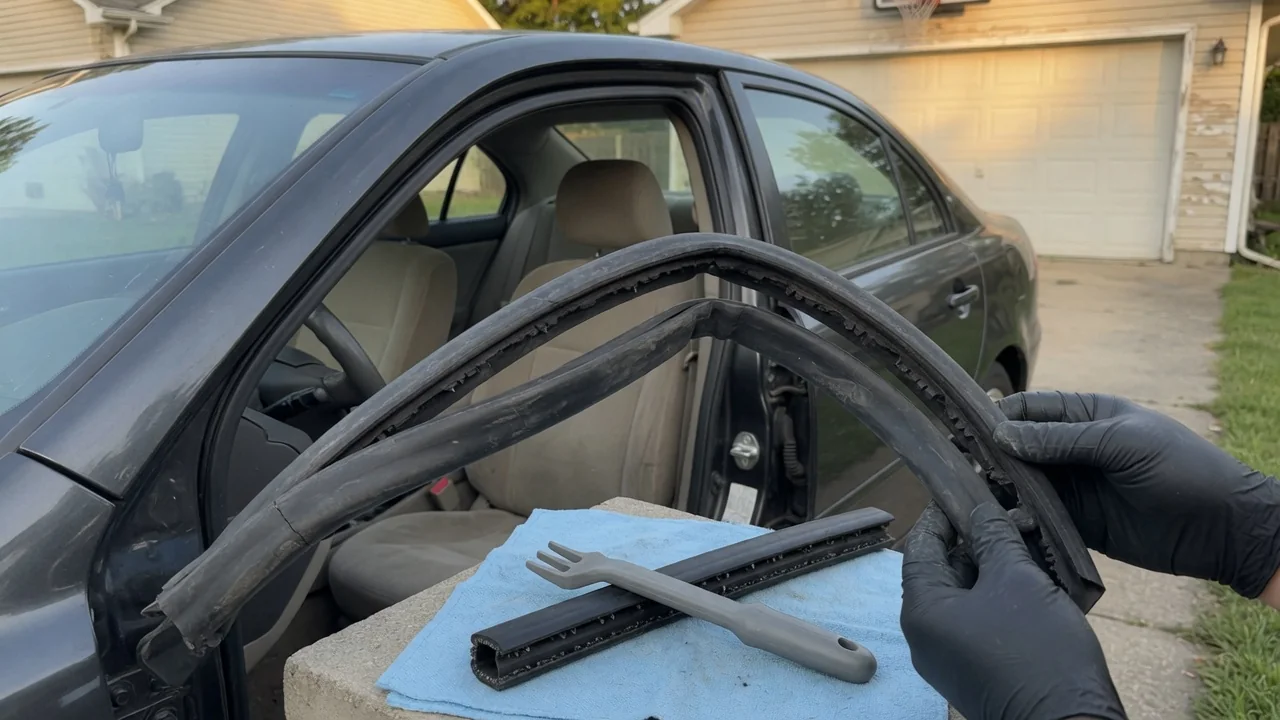
An EPDM car weatherstrip is a rubber seal made from ethylene propylene diene monomer, a synthetic elastomer widely used around doors, trunk lids, hoods and windows. Its job is to close the gap between moving panels and the body so that water, dust, air and noise stay outside. This guide explains what makes EPDM suited to that job, where it is typically found on a vehicle, how it ages, and what those facts mean for owners inspecting or replacing seals.
Material properties of EPDM rubber
EPDM is a synthetic rubber built from ethylene and propylene, with a small proportion of a diene added to the polymer. The ethylene and propylene units form a saturated backbone, meaning the main chain has no reactive double bonds. The diene sits on side groups and provides the sites that allow the compound to be cross-linked, or vulcanized, typically with sulfur or peroxide systems. That arrangement is the key to the material's reputation: because the backbone itself lacks double bonds, it is far less vulnerable to attack by ozone and oxygen than rubbers such as natural rubber or SBR, whose backbones are unsaturated.
In practical terms, EPDM offers good resistance to sunlight, ozone, weathering and temperature swings, and it stays flexible across a broad range of hot and cold conditions. It also tolerates water, steam and many polar fluids, including glycol-based coolants. Its main weakness is petroleum: oils, gasoline, grease and hydrocarbon solvents can swell and soften it. Compounded EPDM is rarely pure polymer. Manufacturers blend it with fillers such as carbon black, which improves strength and UV protection and explains why most seals are black, along with processing oils and curing agents. The exact recipe varies widely, so two EPDM seals can behave quite differently.
Weatherstrips usually combine two forms of the material. Dense, or solid, EPDM is firm and holds its shape, so it is used for mounting sections that grip a flange or channel. Sponge EPDM contains closed cells that make it soft and compressible, so it forms the hollow bulb that squashes against a closing door. The two are often co-extruded into a single profile, sometimes around a metal or wire carrier that helps the seal clamp onto a pinch weld.
Where EPDM weatherstrips are used on a car
The most familiar EPDM car weatherstrip is the door seal. Depending on the design, a vehicle may have a seal mounted on the body opening, a second seal on the door itself, or both, creating layered barriers against wind and water. Similar bulb-style seals surround trunk lids, liftgates, hatches and sliding doors, and many vehicles use a hood seal along the cowl or front edge to limit water, debris and engine-bay noise.
Glass contact areas are another major application. Glass run channels guide a moving door window and seal around its edges, while beltline seals, sometimes called window sweeps, wipe the glass where it enters the door. Because glass slides against these parts, their contact surfaces are often flocked or given a low-friction coating to reduce drag and squeaking. Sunroof surrounds, fixed-window gaskets and various body-panel gap seals may also use EPDM. Beyond weatherstripping, the same polymer appears in other EPDM automotive rubber seal and hose applications, such as cooling system hoses, because of its compatibility with coolant.
Not every seal on a vehicle is EPDM. Some manufacturers use thermoplastic elastomers, including thermoplastic vulcanizates that themselves contain EPDM, for certain profiles, molded corners or glass-related parts, and material choice can differ by model, location and production period. A service manual or parts catalog is the reliable way to confirm what a specific vehicle uses.
How EPDM weatherstrips age
EPDM resists weathering well, but it does not last indefinitely. The most important aging mechanism for a weatherstrip is compression set: after being squeezed repeatedly or continuously for years, the rubber gradually takes on a permanent deformation and no longer springs back fully. A hollow sponge bulb that once pressed firmly against a door may flatten, leaving a smaller contact patch and less sealing force. Heat speeds this process, which is why seals in hot climates or sun-exposed positions may lose resilience sooner.
Other changes accumulate alongside compression set. Over time, heat and oxidation can harden the compound, and some of its processing oils may migrate out, leaving the rubber stiffer, less elastic and sometimes chalky or faded on the surface. Fine surface cracking can still develop despite EPDM's ozone resistance, particularly where the seal is stretched or tightly bent. Mechanical wear adds to the damage: people climbing in and out abrade sill sections, window glass wears through flocking and coatings, and sharp objects or cargo can tear a bulb.
External contamination plays a role too. Petroleum-based lubricants, solvents and some general-purpose dressings can swell or soften EPDM, and fuel spills near a filler door can affect nearby seals. Adhesives and clips that hold the weatherstrip in place can also loosen independently of the rubber, so a seal that looks intact may still have pulled away from its mounting.
Practical implications and limits
For owners, the main takeaway is that an aging weatherstrip usually reveals itself through symptoms rather than appearance alone: increased wind noise at speed, water stains or dampness inside, a door that closes with noticeably less resistance, or squeaks where glass meets the seal. A simple visual and touch check can reveal flattened, torn, hardened or detached sections. However, these symptoms are not proof of a bad seal. Misaligned doors or latches, clogged body drains, failed windshield bonding and loose trim can produce similar complaints, so diagnosis should consider the whole system.
Care practices follow directly from the material's chemistry. Cleaning with mild soap and water is generally safe, while petroleum-based products are best avoided. Some owners use silicone-based or rubber-specific conditioners to reduce sticking and friction; the vehicle manufacturer's recommendations, where available, take precedence over general advice. Such treatment may improve surface feel but cannot reverse compression set or rebuild a collapsed bulb.
When replacement is needed, the label EPDM tells only part of the story. A seal works because its profile, bulb size, mounting method and installed position match the opening it closes, so a correctly shaped part matters as much as the polymer. Universal trim-to-fit strips can help in some low-demand locations but may not reproduce the original sealing geometry. Compound quality also varies between suppliers, and claims about lifespan cannot be judged from the material name alone.