What Is an Engine Block Deck? Cylinder Sealing, Head Gaskets, and Repair
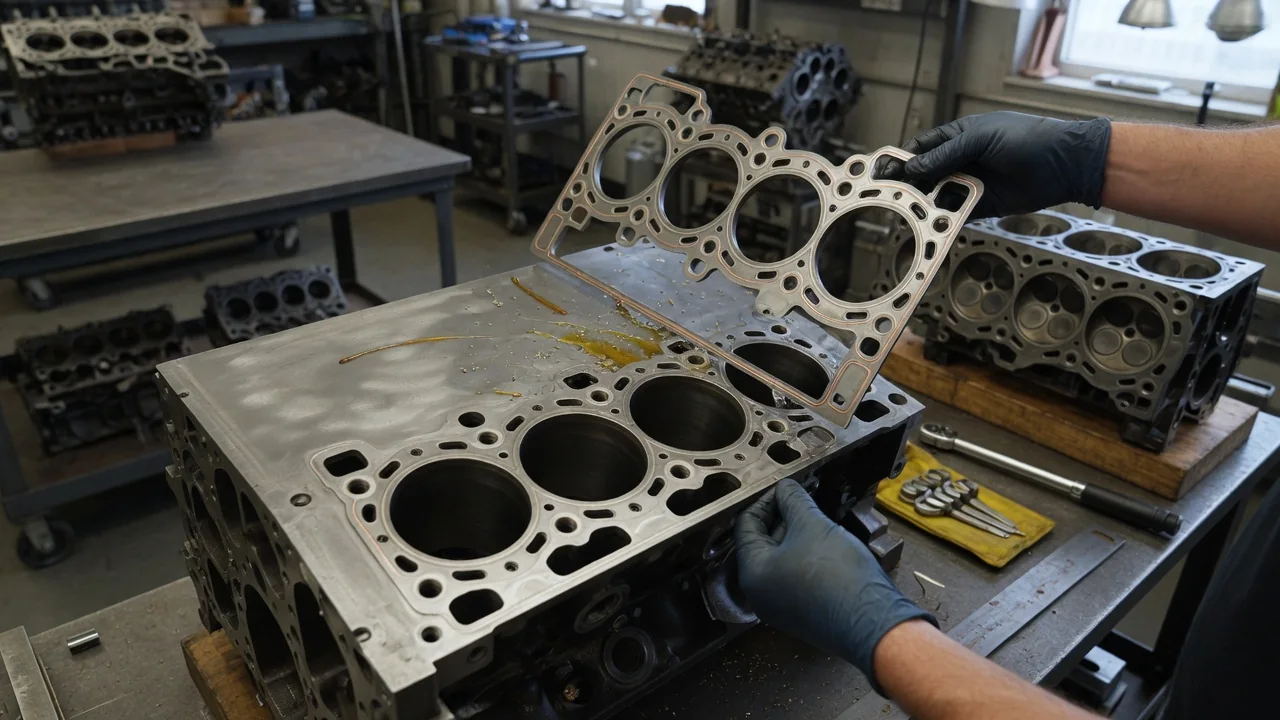
The engine block deck is the flat, machined top surface of the cylinder block where the cylinder head bolts on. An inline engine has one deck, while a V-type engine has two, one for each cylinder bank. The engine block deck surface contains the openings of the cylinder bores, the head bolt holes, and the passages that carry coolant and oil up to the head. Its flatness and finish largely decide how well the head gasket can seal the engine.
Cylinder sealing at the deck
Every power stroke pushes combustion pressure against the top of the cylinder, and that pressure tries to escape through the joint between the block and the head. The deck is one half of that joint. When the head bolts are tightened, they clamp the head, gasket, and block together, and the gasket is compressed between two surfaces that must be flat, clean, and correctly textured. If the deck is warped, pitted, or scratched, the clamping force is no longer spread evenly, and gas, coolant, or oil can find a path through the low spots.
Block designs differ in how the deck supports the cylinders. In an open-deck block, the coolant jacket surrounding the cylinder tops is open at the deck, so the bores are joined to the outer block wall mainly at the bottom. A closed-deck block carries the deck surface across most of the water jacket, leaving only smaller coolant holes, which stiffens the cylinder tops. Semi-closed designs use bridges or partial supports between the two approaches. These choices involve trade-offs among casting simplicity, cooling around the upper bore, and how much the cylinder tops can move under load, which in turn affects how consistently the gasket stays sealed.
The deck also defines deck height, the distance from the crankshaft centerline to the deck surface. Together with the connecting rod, crank stroke, and piston dimensions, deck height determines how close the piston comes to the top of the block at top dead center. That relationship influences compression ratio and the clearance between the piston and the cylinder head.
How the head gasket works with the deck surface
The head gasket fills the small imperfections between the deck and the cylinder head and keeps three things separate: combustion gases, coolant, and oil. Around each bore it usually has a reinforced sealing area, often called a fire ring or combustion seal, that handles the highest pressure and temperature. Elsewhere it seals the coolant and oil passages that cross from the block into the head. Modern engines commonly use multi-layer steel gaskets, while older or some other designs use composite gaskets with fiber or graphite facing over a metal core.
Gasket type and deck condition are closely linked. Multi-layer steel gaskets generally rely on embossed metal layers and thin coatings, so they typically call for a smoother and flatter deck finish than softer composite gaskets, which can conform to slightly rougher surfaces. The gasket's compressed thickness also adds to deck height in setting piston-to-head clearance, which is why gasket selection matters after any machining. Common sources of trouble at this joint include distortion from overheating, corrosion or erosion around coolant passages, and fretting, where small relative movement between the head and block, particularly when they are made of different materials, wears the surfaces over time.
Inspecting and repairing a block deck
Deck inspection normally happens with the cylinder head removed. After the old gasket material is cleaned off without gouging the surface, the deck is checked with a precision straightedge and feeler gauges, laid lengthwise, across, and diagonally. The readings are compared with the limits in the engine's service manual, since acceptable flatness and finish vary by design and gasket type. The technician also looks for cracks, corrosion around coolant ports, erosion near the bores, and damaged or pulled threads in the head bolt holes. The cylinder head's mating surface is inspected the same way, because a perfect deck cannot compensate for a distorted head.
If the deck is out of specification, a machine shop can resurface it, a process often called decking. The block is mounted in a milling machine or surface grinder and a minimal amount of material is removed to restore flatness and the correct finish. Decking has consequences: it lowers deck height, which can raise compression and reduce piston-to-head or piston-to-valve clearance. On V-type engines, removing material can affect intake manifold alignment, and on overhead-cam engines it can change timing chain or belt geometry. Some manufacturers limit how much material may be removed or do not support block resurfacing at all, and a thicker service gasket may or may not be offered.
A complete repair usually includes more than machining. Bolt holes are cleaned and checked so torque readings are accurate, damaged threads may be repaired with inserts, and head bolts are replaced when the manufacturer specifies single-use torque-to-yield fasteners. A cracked deck is a more serious finding that may require specialist repair or a replacement block.
Practical implications and limits
For owners, deck condition usually becomes relevant through head gasket symptoms: unexplained coolant loss, overheating, white exhaust vapor, bubbles in the coolant reservoir, or oil and coolant mixing. These signs are not unique to a deck problem, and several can come from other faults such as a leaking water pump, a failed intake gasket, or a cracked head. Shops typically confirm the cause with tests such as a cooling system pressure test, a chemical combustion leak test, and compression or cylinder leak-down testing before recommending engine disassembly.
Because the block deck cannot be measured or machined with the engine assembled, its condition is only fully known once the head is off. That affects repair planning: a quote for a gasket replacement may change after inspection if the deck or head needs machining, and resurfacing a block generally means removing the engine and taking it apart. Installing a new gasket on a surface that is out of limits can lead to a repeat failure, so skipping the measurement step is a false economy.
The most effective protection for the deck is preventing overheating, since excessive heat is a leading cause of distortion at the head-to-block joint. Keeping the cooling system filled with the correct coolant, repairing leaks promptly, and stopping the engine when the temperature gauge climbs all reduce the risk. Because tolerances, gasket types, and resurfacing limits differ from one engine to another, the factory service manual for the specific engine remains the authority for any measurement or repair decision.