What Is an End-of-Line Brake Test? How Factories Verify New Vehicle Brakes
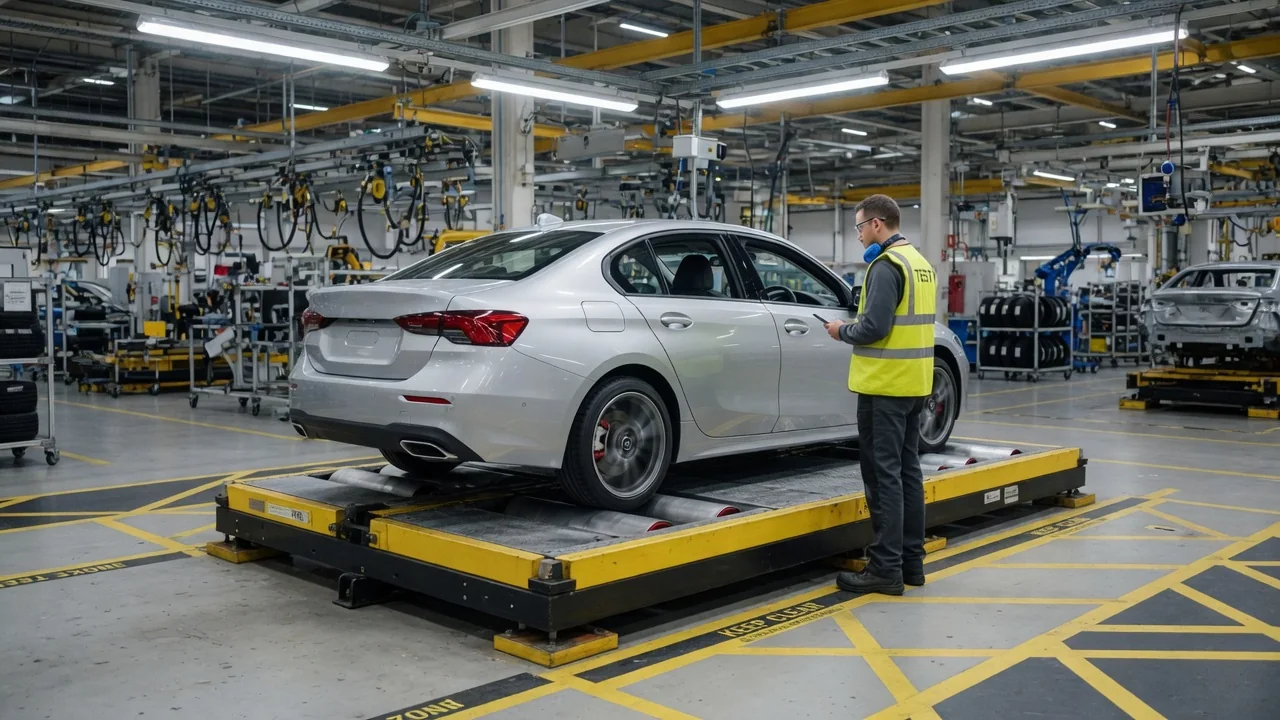
An end-of-line brake test is one of the final checks a new vehicle passes through before it leaves the assembly plant. Engineering validation proves a brake design on prototypes. This factory vehicle brake test is different: it is applied to production vehicles to confirm that each one was assembled, filled, and configured correctly. It usually combines a roller test stand, force measurement, and electronic diagnostics. The result decides whether the vehicle is released or sent for repair and retesting.
System function
The test does not question whether the brake design works. That was settled during development. It asks whether this specific vehicle matches the design. Assembly lines can introduce faults that a visual inspection may miss. Examples include air left in the hydraulic circuit, a misrouted or poorly seated brake line, a caliper that sticks, a parking brake that is out of adjustment, contaminated friction surfaces, or a swapped wheel speed sensor connector. The end-of-line test is meant to catch these before the vehicle reaches a customer.
In a typical plant, the brake test comes after the brake fluid has been filled and the system bled. It is often grouped with other final checks such as wheel alignment and functional testing on rollers. The vehicle is driven onto a test stand where each axle sits on a pair of rollers. Motors turn the rollers, and the rollers turn the wheels at low speed. The brakes are then applied, either by an operator following on-screen prompts or by an automated pedal actuator, and the stand records how the wheels resist rotation.
Modern vehicles also need an electronic check, because braking now depends on control modules as well as hydraulics. The test system usually connects to the vehicle through its diagnostic port. It can then talk to the brake control unit, cycle anti-lock and stability-control valves, check that wheel speed signals are plausible, and operate an electronic parking brake. It also reads and clears stored fault codes. The exact sequence, equipment, and order of steps vary between manufacturers, plants, and vehicle architectures. No single procedure applies to every vehicle.
Measurement
Most end-of-line brake measurement relies on the roller brake tester principle. When the brake is applied to a wheel turning on a driven roller, the roller drive has to work harder to keep turning. The stand measures this reaction, usually with a load cell or by monitoring the drive torque. It converts the reading into brake force at the tire contact patch. Because both wheels on an axle sit on separate rollers, left and right forces can be measured at the same time and compared directly.
Several values are commonly derived from these readings: • Maximum brake force at each wheel. • Left-to-right imbalance on each axle. A pull under braking often shows up here. • Front-to-rear distribution. • Pedal force versus brake force. Where the stand measures pedal input, this shows whether the system responds as expected for a given effort. • Force fluctuation during one wheel revolution. This can indicate runout or uneven rotor or drum geometry, sometimes called ovality. • Residual drag with the brake released. This reveals a dragging brake. • Parking brake force. This is measured separately from the service brake.
Results are normally linked to the vehicle identification number and stored in the plant's quality records. This gives traceability if a question comes up later. Electronic steps are logged as well, including whether each diagnostic routine completed. The measurement also has to allow for new components. Fresh pads and rotors have not been bedded in, so their friction behavior is not yet stable. Test procedures and limits are set with this condition in mind rather than the behavior of a worn-in brake system.
Release criteria
Release limits are defined by the manufacturer for each vehicle variant. They are based on engineering targets and on the braking regulations of the markets where the vehicle will be sold. The criteria are usually tolerance windows rather than a single minimum value. A wheel might need to reach enough brake force, stay within an allowed left-right imbalance, show no more than a permitted amount of drag, and keep force fluctuation inside a set range. Parking brake force has its own threshold. Electronic criteria typically require that every relevant control module responds and that all functional routines complete. Vehicle configuration must also be correct, and no unresolved fault codes may remain.
If every step passes, the result is recorded and the vehicle moves on toward shipping. If any value falls outside its window, the vehicle is held and sent to a rework area. Technicians diagnose the cause, which might mean bleeding the system again, replacing or re-seating a component, or adjusting the parking brake. The vehicle is then retested against the same criteria. A repaired vehicle is released only after a passing result is recorded.
Release decisions also feed back into the production process. If the same failure appears repeatedly, such as imbalance on one particular axle, quality teams can trace it upstream to a specific assembly station, tool, or supplied part. In that sense, the end-of-line test is also a process monitor. Its records help fix the cause of defects, not just individual vehicles.
Practical implications and limits
For an owner, a vehicle that passed its end-of-line test had brakes that met the manufacturer's limits on the day it was built. That does not cover what happens afterward. Transport, storage, and time on a dealer lot can affect a new vehicle. For example, surface rust may form on rotors that sit unused, and it normally wears off once the vehicle is driven. New pads and rotors also need a bedding-in period before braking feels fully consistent. Owner's manuals often give guidance for the first part of a vehicle's life, and it is worth following the manual for the specific vehicle rather than general advice.
The test is a screening tool with clear boundaries. It runs at low speed on rollers. It does not reproduce high-speed stops, heat buildup over repeated braking, fade, wet roads, or the weight transfer of real deceleration. It also cannot reliably catch a fault that appears only intermittently or develops later. Manufacturers therefore pair it with other controls, such as component-level checks during assembly and audit testing of sampled vehicles. The end-of-line test confirms that assembly matches the design; it does not show how well that design performs.
Owners do not usually receive their vehicle's individual end-of-line results. These records are factory quality data. Some periodic vehicle inspection programs use roller brake testers that work on a similar measurement principle. However, their purpose, procedures, and pass limits are set by the inspection authority, not the manufacturer. A dealer's pre-delivery inspection is also a separate process. If a new vehicle pulls under braking, vibrates, or shows a brake warning light, a dealer diagnosis is the appropriate step. The fact that the vehicle passed its factory test does not rule out a problem.