What Is an AWD Coupling and How Does It Work?
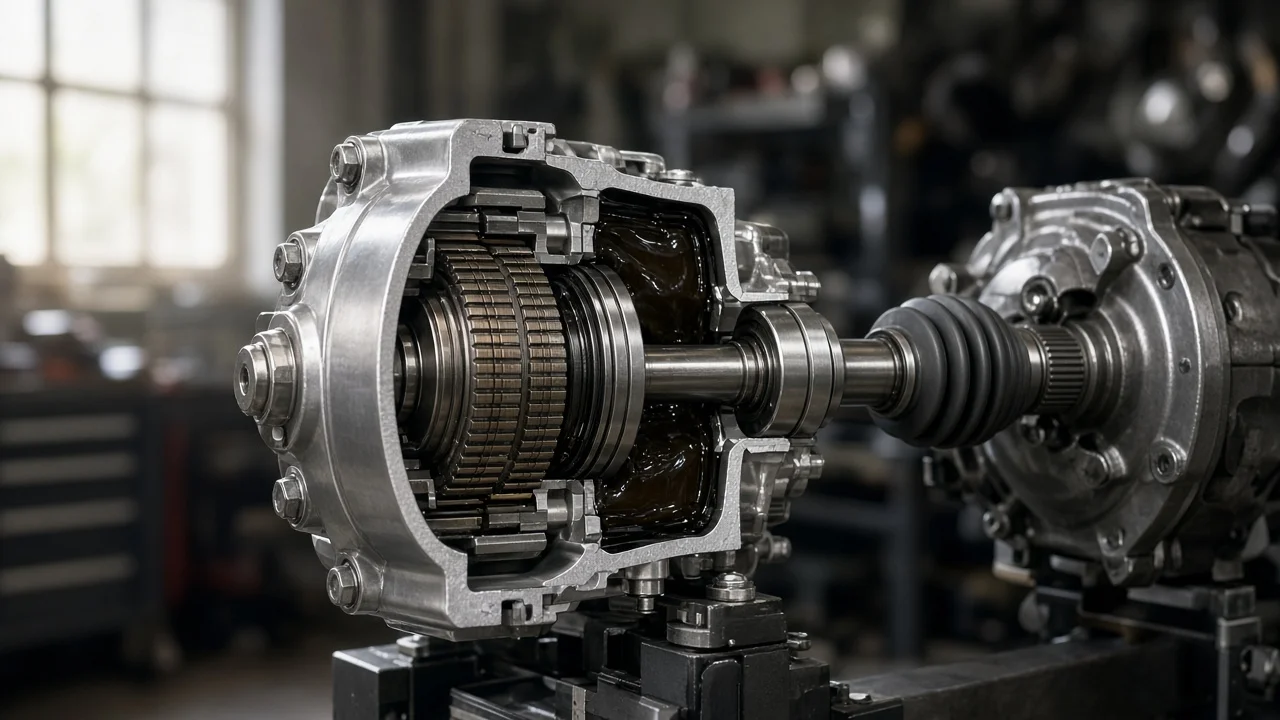
An AWD coupling is the part of many on-demand all-wheel-drive systems that decides how much engine torque reaches the secondary axle. Most crossovers and cars with a transverse engine drive mainly through the front wheels. They use the coupling to bring in the rear wheels when traction, acceleration or stability calls for it. Knowing how it works helps you read symptoms carefully, follow the correct service schedule and avoid replacing parts that are not actually at fault.
What an AWD Coupling Is
An AWD coupling is a controllable clutch placed in the driveline between the primary and secondary axles. In a typical front-biased layout, the transaxle drives the front wheels full time. A power take-off unit turns a driveshaft that runs to the rear, and the coupling sits at or near the rear differential. When the coupling is open, the driveshaft spins but sends little or no torque to the rear wheels. When it engages, it clamps its internal clutch plates together and sends a variable share of torque rearward.
The coupling is not a center differential. It does not split torque evenly at all times, and the torque it can pass is limited by how hard the clutch is clamped. Some rear-biased systems use a similar clutch in the transfer case to feed the front axle instead, so the coupling's location and which axle is primary depend on the vehicle. The principle is the same in both cases: a clutch that can range from fully open to largely locked, controlled either by the vehicle's computer or by mechanical slip.
How the Coupling Transfers Torque
Most modern couplings contain a wet multi-plate clutch pack, similar in principle to the clutches inside an automatic transmission. Alternating plates are splined to the input from the driveshaft and to the output toward the rear differential. With no pressure applied, the plates slide past each other in a film of fluid. As clamping force increases, friction between the plates rises and more torque crosses the pack. The system can therefore deliver anything from a slight preload to near-full lockup.
Electronically controlled units usually generate clamping force in one of two ways. Hydraulic designs use an electric pump to build oil pressure against a piston, and a control module adjusts that pressure. Electromagnetic designs energize a coil that engages a small pilot clutch, and a ball-and-ramp mechanism multiplies that force onto the main clutch pack. In both designs, the module reads inputs such as wheel speeds, throttle position, steering angle and stability-control data. It can preload the clutch before any slip occurs, for example when you pull away from a stop.
Older viscous couplings work without electronics. They contain closely spaced perforated plates in a thick silicone fluid. When the front and rear axles turn at different speeds, the plates shear the fluid, and the resulting resistance transfers torque. These units respond only after slip has started and cannot be commanded by the vehicle.
What Changes the Answer for Your Vehicle
Coupling design, control strategy and service requirements vary widely between manufacturers, model years and even trim levels. Some units have their own fluid reservoir and a replaceable filter, with a specific fluid specification and change interval. Others are treated as sealed or share oil with the rear differential. A fluid that is not approved for that coupling can change how the clutch plates grip and cause shudder or poor engagement. The correct product therefore depends on the exact unit, not just the vehicle brand.
Operating conditions also change the coupling's behavior. Many systems reduce or cut engagement when the fluid runs too hot, when a compact spare is fitted, or when the module detects a sustained speed difference between the axles. Tire fitment is a frequent factor. Mismatched tire size or tread depth between front and rear makes the axles turn at slightly different speeds, which can force the clutch to slip continuously and wear or overheat it. Towing, selectable drive modes and snow or off-road settings can also change how aggressively the coupling engages.
The transmission type determines what else shares the driveline. A conventional automatic, a CVT and a dual-clutch transmission each have their own fluid and failure modes, and the power take-off unit has its own oil. A complaint about harsh or delayed shift behavior points toward the transmission rather than the coupling, even on an AWD vehicle.
What the Owner Can Do
Start by identifying exactly what you have. The owner's manual, the maintenance schedule, or a dealer or parts lookup by VIN can tell you three things: whether the vehicle uses an electronically controlled coupling, a viscous unit or a different AWD layout; whether the coupling has its own service interval; and which fluid it needs. Then check the service history to see whether the coupling fluid, filter or rear differential oil has ever been changed. On units with a scheduled service, correct a missed change even if there are no symptoms.
Next, note any symptoms precisely. Useful observations include an AWD or stability warning light, rear wheels that never seem to help on a slippery surface, binding or hopping during slow tight turns, a clunk when pulling away, or a whine or groan that changes with vehicle speed. Record when it happens: cold or warm, turning or straight, accelerating or coasting. Check that all four tires are the same size and model with similar tread depth, and inflate them to the pressure on the door placard.
A scan tool that reads all modules, not only the engine computer, can retrieve diagnostic codes from the AWD control unit. A code identifies a circuit or condition, such as a pump, solenoid, sensor or temperature fault. On its own, it does not confirm that the coupling is mechanically worn.
Typical Repair Paths
Repair options depend on the confirmed cause. They range from a fluid and filter service to replacing a pump, a control module, wiring or the complete coupling assembly. On some designs the pump or controller can be replaced separately; on others the coupling is serviced only as a unit. New, remanufactured and used assemblies are all possible. Confirm fitment by part number or VIN, because similar-looking units can differ in calibration, splines or mounting. After replacement, some vehicles also require a software setup or adaptation procedure.
Limitations and When to Get Professional Help
This article describes common designs, not the exact procedure for any specific vehicle. Fluid capacity, fill method, torque specifications, relearn steps and diagnostic logic come from the manufacturer's service information, and they differ too much for general guidance to replace it. Binding in turns or a warning light can come from tires, sensors, wiring, software, low or degraded fluid, the power take-off unit or the rear differential. Treat a symptom as a lead to investigate, not proof of a failed coupling.
Have the vehicle inspected if the AWD warning stays on, the vehicle binds or hops in turns, or you hear new driveline noises. Choose a shop that works on AWD systems and has manufacturer-level diagnostics. Avoid extended driving with a dragging or overheating coupling, because it can damage the tires and other driveline parts. Bring your service history, tire details and a clear description of the symptom; this shortens diagnosis and makes it easier to compare repair options.