What Is an Anti-Squeak Tape in a Car Interior?
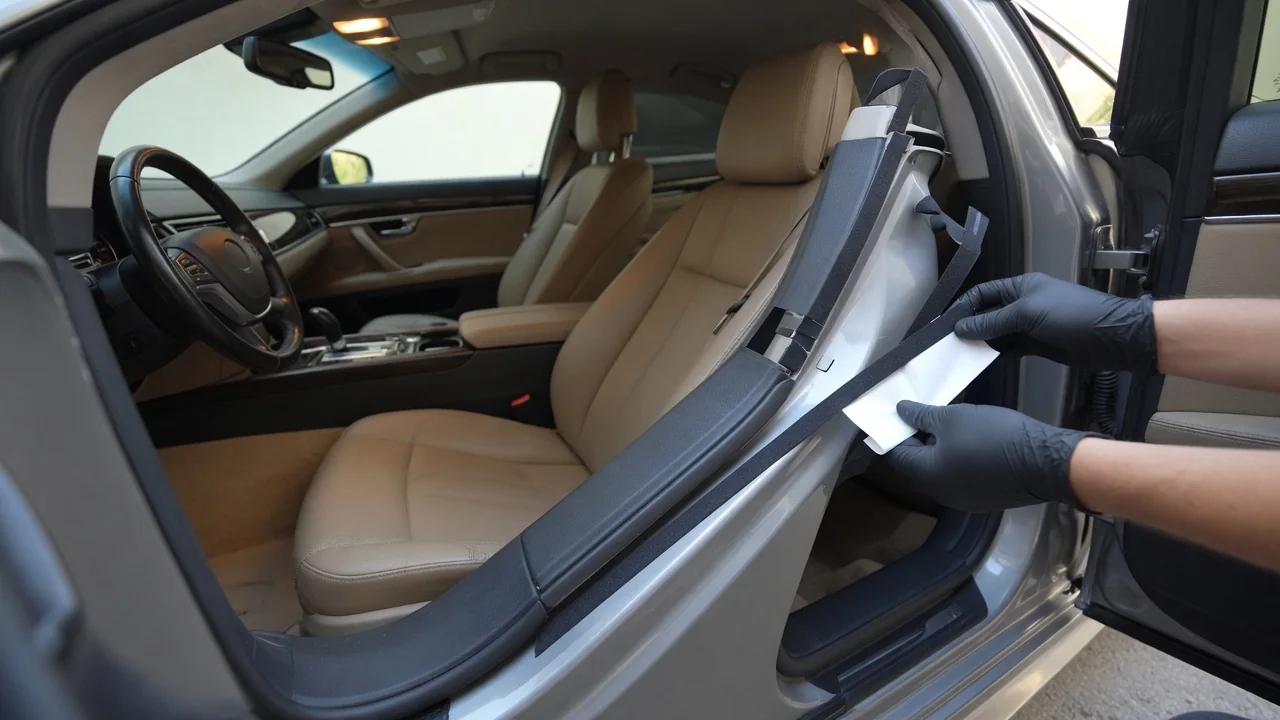
An automotive anti-squeak tape is a thin, adhesive-backed material placed between interior parts that touch, rub or vibrate against each other. Its job is to stop the small movements that turn into squeaks, creaks and buzzes as the body flexes over bumps and responds to temperature changes. This guide explains where the tape is used, how it reduces noise, and what to consider when servicing interior trim that relies on it.
Contact points: where anti-squeak tape is used
A car interior is an assembly of many separate parts: molded plastic panels, metal brackets, fabric-covered trim, wiring harnesses and fasteners. Wherever two of these pieces meet without a fixed bond, there is a potential noise source. Typical contact points include the seams where dashboard sections join, the interface between door trim panels and the inner door structure, the sides of a center console and its mounting brackets, glove box frames, pillar trim, headliner edges, and spots where wiring bundles rest against plastic or metal. Manufacturers often apply tape, felt pads or foam strips at some of these locations during assembly, although the exact placement varies from vehicle to vehicle.
The tape itself comes in a few broad material families. Felt or fleece tapes use a soft non-woven fabric that cushions contact and wraps easily around harnesses. Low-friction film tapes, often made from plastics such as PTFE or UHMW polyethylene, provide a slick surface so parts can slide without grabbing. Thin foam tapes add compressible thickness to fill small gaps. All of them carry a pressure-sensitive adhesive on one side, so they stick to one surface while the other face remains free to meet the mating part. The right type depends on whether the contact point slides, taps or simply needs a buffer.
Noise reduction: how the tape stops squeaks and rattles
Interior noises usually fall into two categories. A squeak or creak comes from stick-slip friction: two surfaces grip each other, build up tension as the body flexes, then release suddenly, and that cycle repeats quickly enough to be heard. A rattle or buzz comes from impact, when a loose part repeatedly taps against a neighbor as the car vibrates. Hard plastics are prone to both because they are stiff, have little internal damping and can change dimension slightly with temperature, which opens or closes the gaps between panels.
Anti-squeak tape addresses these mechanisms in different ways. A low-friction surface reduces the grip that causes stick-slip, letting parts move smoothly instead of jerking. A soft felt or foam layer separates hard surfaces so that any contact is cushioned rather than sharp, and it absorbs some vibration energy instead of passing it along. Where a gap is the problem, a compressible layer can take up the space so the part is held lightly in place. The tape does not make the structure stiffer; it changes what happens at the interface where the noise is generated.
Because the tape works only at the exact point of contact, its effect is local. A strip on the wrong edge may do nothing, while a small piece in the right spot can silence a noise entirely. That is why identifying the true source matters more than covering large areas.
Service: applying and replacing anti-squeak tape
Most work with anti-squeak tape happens while trim is removed for another repair or while tracking down a specific noise. The first step is locating the source, which often involves pressing on panels while the noise occurs, listening from different seating positions, or having a helper drive while someone else listens. Once the area is known, the trim usually has to come off to reach the contact surfaces. Plastic pry tools help avoid marring panels, and the vehicle's service information should be followed for fastener locations, clip types and any components, such as airbags or wiring connectors, that require specific procedures.
Surface preparation largely determines how long the tape stays in place. Pressure-sensitive adhesives bond poorly to dust, oils, protectant sprays and old adhesive residue, so the contact area should be cleaned with a product compatible with the material and allowed to dry fully. Many adhesives also bond better when applied at moderate room temperature rather than to a cold surface. The tape should be pressed firmly along its whole length, and its edges trimmed so they neither lift nor show once the panel is reinstalled.
Placement deserves care. Tape should sit on the surface that actually rubs or taps, not over clip holes, locating pins, connector latches or areas where added thickness would keep a panel from seating. When original tape or felt has worn through, flattened or detached, it can be removed and replaced with a similar type. Reusing broken clips often reintroduces noise, so damaged fasteners are generally worth replacing at the same time.
Practical implications and limits
Anti-squeak tape is a contact-level fix, so it works best when a noise has a single, identifiable source between two parts. It is less effective when the real cause is mechanical: a loose bracket bolt, a broken mounting tab, a cracked panel or a missing clip will keep moving no matter how well the surface is cushioned. In those cases the tape may soften the sound slightly but will not address the looseness behind it, and the noise often returns. Sounds that originate outside the cabin, such as suspension, exhaust or seat mechanism noises, are beyond what interior tape can change.
Thickness is a trade-off. Adding material can tighten a loose fit, but too much can make panels sit proud, strain clips or alter gaps visible from the driver's seat. Heat is another consideration. Areas near the windshield, defroster outlets or sunlit dashboard tops get warmer than the rest of the cabin, and an adhesive not suited to those conditions may soften or release over time. Where a product's temperature rating or intended use is unknown, its durability in those zones should be treated as uncertain.
Owners should also expect that some noises are intermittent and depend on temperature, road surface or load, so a repair that seems successful on one drive may need confirming over several. Interior trim design differs widely between vehicles, and a fix that works on one dashboard may not translate to another. When a noise involves safety-related components, such as airbag covers, seat belt hardware or wiring near restraint systems, following the manufacturer's service procedure or having the work done by a qualified technician is the sensible approach.