What Is an Analog Car Gauge?
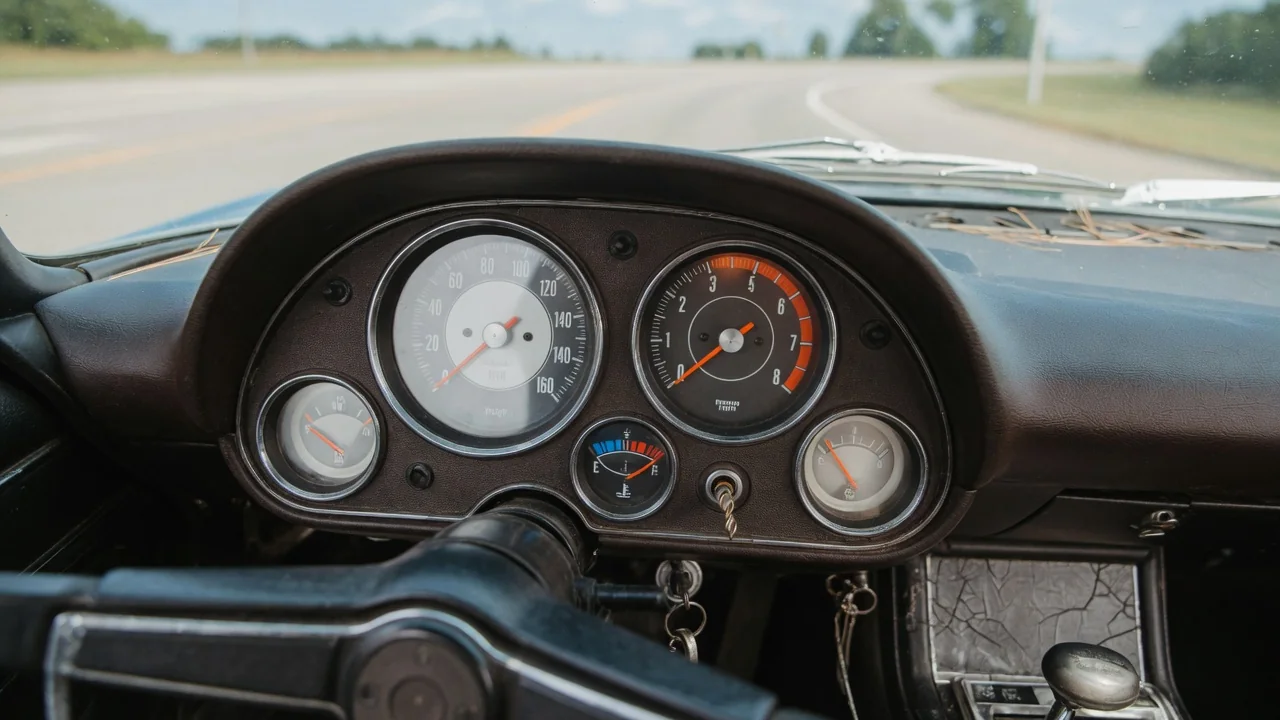
What is an analog car gauge? It is an instrument that shows a measurement, such as road speed, engine rpm, fuel level, or coolant temperature, by sweeping a physical pointer across a printed scale. Rather than displaying a number, it shows position along a dial, which lets a driver judge the reading, and how quickly it is changing, with a brief glance.
Mechanism and signals
Older analog gauges were often driven directly by the thing they measured. A mechanical speedometer used a rotating cable from the transmission to spin a magnet near a metal cup attached to the needle, with a hairspring resisting the drag so the pointer settled at a position proportional to speed. Some oil pressure gauges routed pressure through a small tube to a curved element behind the dial, which flexed and moved the pointer through a simple linkage.
Most later designs are electrically driven. A sender, such as a float-operated variable resistor in the fuel tank or a temperature-sensitive sensor in the coolant passage, changes an electrical signal, and the gauge converts that signal into needle movement using heated bimetal strips, balanced coils, or a small stepper motor. In many modern vehicles the instrument cluster receives data from control modules over a network and positions each needle by motor, so the pointer is analog in appearance while the signal behind it is digital. The arrangement varies by manufacturer and model year.
Readability
The appeal of a pointer is that it communicates by angle rather than by digits. A driver learns where the needle normally sits, so a temperature pointer resting near the middle of its range or a tachometer needle approaching the red zone registers without actually reading a number. Peripheral vision picks up position and movement well, which is why a sweeping tachometer feels natural when timing a gear change in a manual-transmission car.
Rate of change is also easy to see. A needle that rises steadily tells a different story from one that jumps, and the speed of the sweep conveys acceleration in a way a flickering numeral cannot. Readability still depends on design details: scale markings, font size, needle contrast, backlighting, and glare from the lens all matter. Some dials compress a wide range into a small arc, making precise values harder to judge, and markings may be in miles per hour, kilometers per hour, or both.
Digital alternatives
Digital alternatives present the same information differently. A numeric speed readout gives an exact figure, which is useful when holding to a posted limit, and bar-graph or segmented displays replace the needle with illuminated steps. Full-screen instrument clusters go further, drawing virtual dials on a display panel so the layout can change with drive mode, navigation prompts, or driver preference. Many of these screens still render a round dial with a pointer, a sign of how familiar the analog format remains.
Each approach has trade-offs. Rapidly changing digits can be hard to read during hard acceleration, while a physical needle shows the trend clearly but demands some estimation between marks. Screens offer flexibility and can show warnings in context, yet they depend on display brightness and software, and may wash out in direct sunlight on some vehicles. Plenty of clusters combine both, pairing physical pointer dials with a small digital information screen between them. Which combination a vehicle uses depends on its age, trim level, and manufacturer.
Everyday Use and Observations
In daily driving, analog gauges reward familiarity. Many clusters sweep or twitch their needles briefly at startup as a self-check, then settle. The fuel pointer falls gradually over a tank, though not always at an even rate, because tank shape and sender design can make the first or last portion appear to disappear faster. A coolant temperature needle typically climbs during warm-up and then holds steady, and some manufacturers deliberately buffer it so it stays in place across a broad normal range.
Small behaviors are worth noticing. A speedometer needle on an older cable-driven car may waver slightly at low speed, while a motor-driven needle moves smoothly. Voltmeter and oil pressure pointers, where fitted, often shift with engine speed and electrical load, and what counts as normal differs by vehicle. Knowing a car's usual needle positions when it is healthy gives a baseline, so a reading that sits somewhere unfamiliar stands out early. The owner's manual explains what each dial and its marked zones mean for that particular model.
Limits and Next Steps
Analog gauges have limits. A pointer reports what its sender and circuitry tell it, so an odd reading may reflect a wiring fault, poor ground, failing sender, or cluster problem rather than the condition shown. Buffered gauges can hide small changes, and many vehicles have replaced certain dials with warning lights altogether. Parallax, the apparent shift of the needle when viewed from an angle, and normal tolerances also mean a dial reading is an indication rather than a laboratory measurement.
When a needle behaves strangely, such as dropping to zero, pinning at maximum, or sticking, treat it as evidence to investigate, not a verdict. A scan tool can often show the live sensor value the control module sees, which helps separate a real condition from a display fault, and any stored fault code needs interpreting against vehicle-specific information before a part is blamed. A reading suggesting overheating or low oil pressure deserves prompt attention: stop safely and have the vehicle checked by a qualified technician instead of continuing to drive.