What Is Air Cooling for an EV Battery? Airflow, Filters and Limits
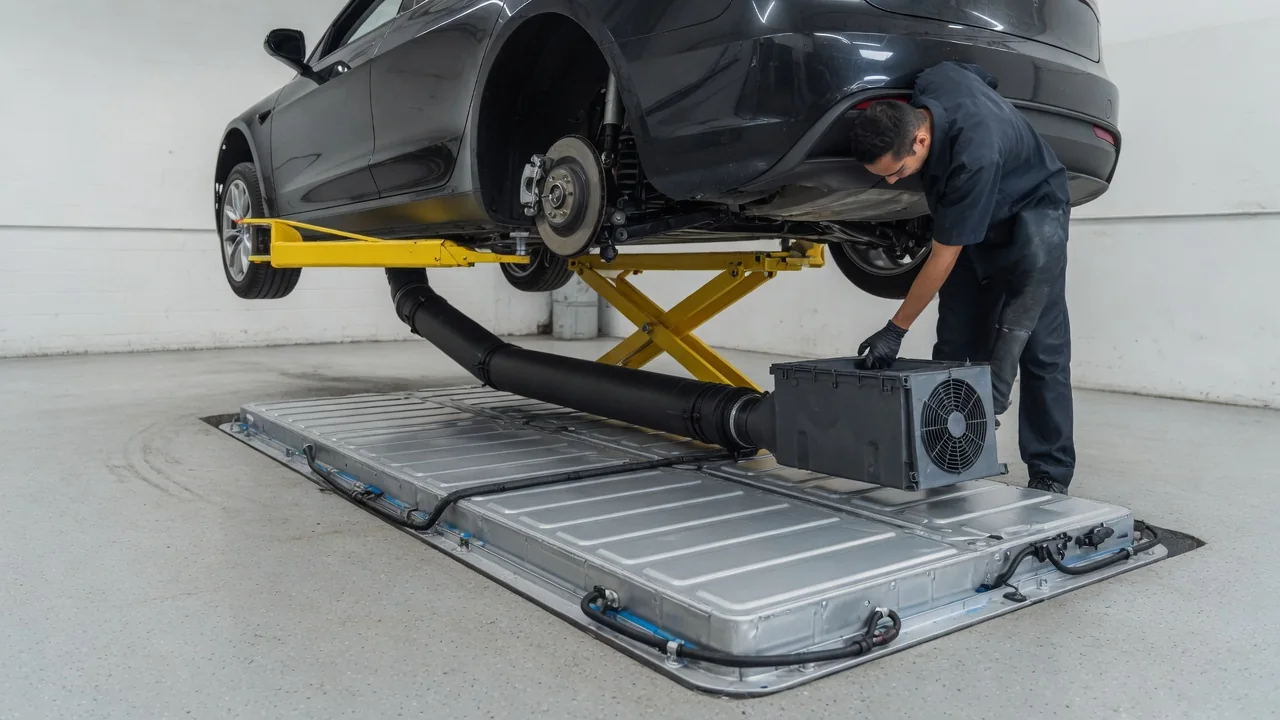
Air cooling for an EV battery is a thermal management method that uses moving air, rather than liquid coolant, to carry heat away from battery cells. It is one of the simplest ways to keep a traction battery within its preferred temperature range, and it appears mainly in some hybrids and in smaller or earlier electric vehicles. Understanding EV battery air cooling comes down to three things: how air travels through the pack, how filters protect that path, and what temperature limits the system has to respect.
Airflow path
An air-cooled battery pack is built around a defined route for air to follow. Air enters through an intake, passes through ducting into the battery enclosure, flows through gaps or channels between cells or modules, and leaves through an outlet. Some systems are passive and rely on natural convection or air pushed by vehicle motion. Automotive designs more commonly use active airflow, meaning one or more electric fans or blowers force air through the pack at a speed the battery control system can adjust. Depending on the design, the intake may draw air from the passenger cabin or from outside the vehicle, and the warmed air may be vented back to the cabin, into a cargo area, or outside.
Air is a much weaker heat carrier than liquid coolant. It holds less heat per unit of volume and transfers heat to and from surfaces less effectively, so an air system needs relatively large flow volumes and enough open space around the cells. Air also warms up as it moves along the pack, which means cells near the outlet tend to see warmer air than cells near the inlet. Designers manage this with features such as manifolds that split flow into parallel paths, carefully sized gaps between cells, heat-spreading fins, and duct shapes that even out distribution. The goal is not only to remove heat but to keep temperature differences between cells small, because uneven temperatures can lead to uneven aging across the pack.
When the intake draws from the cabin, the vehicle's climate control system indirectly becomes part of battery cooling. Air conditioned for occupants can be cooler than outside air on a hot day, which improves the pack's ability to shed heat. In such designs the intake is often a visible grille or vent inside the vehicle, and bags, clothing or loose cargo placed against it can restrict the whole airflow path.
Filters
Because an air-cooled pack constantly moves air through its interior, it also moves whatever that air carries. Dust, lint, pet hair, sand and small debris can collect on fan blades, inside ducts and on the surfaces of cells or modules. A layer of debris acts as insulation and narrows the channels the air must pass through, so the same fan effort removes less heat. For this reason, many air-cooled systems include a filter or screen at the intake to catch particles before they reach the fan and the pack.
A restricted filter reduces airflow in a way the driver may not notice directly. Typical consequences can include fans running faster or longer and becoming more audible, the battery reaching higher temperatures during demanding use, and the control system limiting power or charging speed to protect the cells. Some vehicles display a warning related to battery cooling or the intake, while others may only store a diagnostic code. Inspection or replacement intervals, where a serviceable filter exists, are set by the vehicle manufacturer and can be shorter for vehicles used in dusty conditions or regularly carrying pets.
Not every air-cooled design has a filter that owners are expected to service, and the location and access method differ between vehicles. The owner's manual or service information is the right reference for whether a filter exists and how to handle it. Cleaning an intake grille or replacing an accessible filter is different from opening the battery enclosure or fan housing, which can involve high-voltage components and should be left to trained technicians.
Temperature limits
Lithium-ion cells work best within a moderate temperature window. Sustained high temperatures speed up chemical aging, which gradually reduces capacity and increases internal resistance, and extreme overheating raises safety concerns. Low temperatures have different effects: available power drops, and charging a cold battery too quickly can damage cells, for example through lithium plating on the anode. A battery management system tracks cell or module temperatures through sensors placed in the pack and uses those readings to decide how hard the battery may be worked. Exact limits depend on cell chemistry and the manufacturer's calibration, and they are not published in a uniform way.
Air cooling has a built-in ceiling: it can only bring the pack toward the temperature of the air it receives. If incoming air is already warm, the temperature difference that drives heat transfer shrinks, and the system becomes less effective exactly when cooling is most needed. Systems that draw conditioned cabin air partly work around this, but they still depend on how much cooling capacity the climate system can spare. In cold conditions, air alone cannot add heat; some designs route warmed cabin air through the pack or use separate heaters, while others offer limited cold-weather conditioning. As limits approach, the control system typically raises fan speed first and may then reduce power or slow charging to protect the cells.
Practical implications and limits
Air cooling remains attractive to engineers because it is relatively simple. It needs no coolant, pump, chiller or coolant plumbing inside the pack, which can reduce weight, cost and the number of parts that can leak or fail. That simplicity suits batteries with modest heat output, such as those in many hybrids, where the pack is smaller and the workload is shared with an engine. The trade-off is lower heat-removal capacity for a given space, which is why many larger, high-power battery packs use liquid-based thermal management instead.
For owners, the effects show up mostly at the edges of normal use. Repeated fast charging, long climbs, towing within rated limits, or sustained high-speed driving in hot weather are the situations where an air-cooled pack is more likely to reach protective limits, so slower charging or reduced power in those conditions is a predictable outcome rather than a surprise. Fan noise after a drive or a charging session usually reflects the system working as intended. Parking in shade when practical, keeping any cabin intake clear and following the manufacturer's maintenance schedule help the system operate within its design range.
This explanation covers general principles, not the behavior of any particular vehicle. Whether a given car uses air cooling, where its intake sits, whether it has a serviceable filter and how its software responds to heat or cold all vary by design. For those details, the vehicle's owner's manual, its service information and an authorized service provider are the reliable sources.