What Is a Windshield's PVB Layer? Material, Bonding, and Damage Behavior
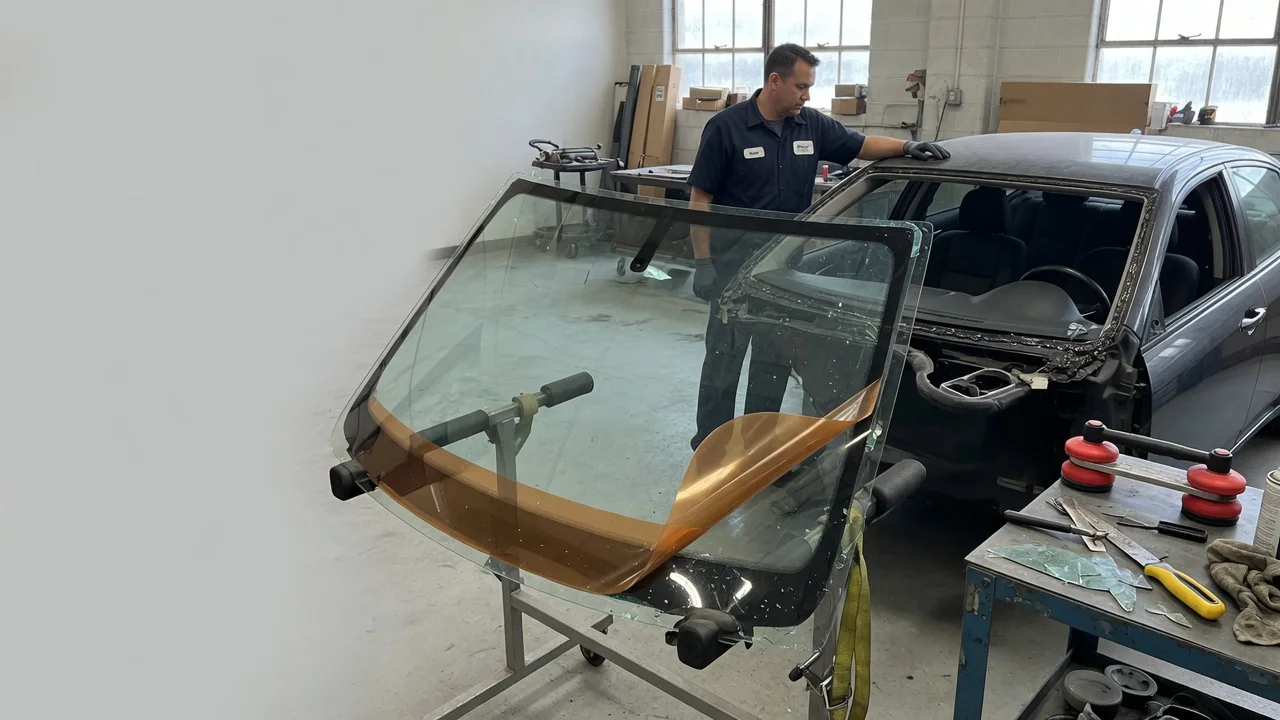
A windshield looks like one sheet of glass, but it is a laminate: two glass layers bonded to a thin plastic film between them. That film is usually polyvinyl butyral, or PVB. To understand what a windshield's PVB layer is and what it does, you need to know what the material is, how it is bonded to the glass, and how it behaves when the glass breaks. Together these explain why windshields crack the way they do, and why some damage can be repaired while other damage cannot.
Layer material: what PVB is made of
PVB stands for polyvinyl butyral, a thermoplastic resin made by reacting polyvinyl alcohol with butyraldehyde. The resin alone is fairly stiff. For laminated glass it is blended with plasticizers that make it soft and tough, and that let it stretch a long way before tearing. The compound is then extruded into a continuous sheet and supplied to glass manufacturers in rolls. In a finished windshield the interlayer is much thinner than either glass ply, yet it is the part that holds the assembly together. Its refractive index is close to that of glass, so a properly laminated PVB layer is essentially invisible to the driver. Before lamination, the sheet surface is usually given a fine texture so trapped air can escape during processing. That texture disappears once the layer is fused to the glass.
The interlayer does more than hold the glass in place. PVB absorbs a large share of ultraviolet radiation, which is why laminated windshields block much more UV than ordinary glass. Some interlayers have a tinted band along the top edge to reduce glare. Acoustic versions use a multilayer construction with a softer core that dampens sound passing through the glass. Windshields designed for head-up displays may use a wedge-shaped interlayer to prevent a doubled projected image. Which of these features a windshield has depends on the vehicle and the specific glass part, not on PVB in general.
Bonding: how the interlayer is fused to the glass
Lamination starts with two pieces of glass that are cut, edge-finished, and bent together as a matched pair so their curves align closely. After cleaning, the PVB sheet is laid between them in a room with controlled temperature and humidity. This matters because the moisture content of the interlayer directly affects how well it will stick. Excess film is trimmed at the edges. The assembly then goes through a pre-press stage, typically heated rollers or a vacuum bag or ring, which removes most of the air and seals the edges. Final bonding happens in an autoclave. There, heat and pressure soften the PVB so it flows against the glass, and any remaining air dissolves into the interlayer. The result is a clear, unified laminate.
Chemically, the adhesion comes mainly from hydrogen bonding between hydroxyl groups remaining in the PVB and silanol groups on the glass surface. Manufacturers deliberately tune this adhesion rather than maximizing it. If the bond is too weak, glass fragments can detach after a break. If it is too strong, the interlayer cannot release slightly from the glass near a crack. It then has little free length to stretch, tears more easily, and resists penetration less well. Moisture level and adhesion-control additives are the usual tools for striking that balance. This internal bond is separate from the urethane adhesive that attaches the finished windshield to the vehicle body.
Damage behavior: what happens when the glass breaks
Glass breaks in a brittle way, but in a laminated windshield the broken pieces stay stuck to the PVB. A small stone strike usually damages only the outer ply. It leaves a chip, bullseye, or star-shaped break while the inner ply and interlayer stay intact. A harder impact can crack both plies, producing the familiar spiderweb pattern of radial and circular cracks. In that case the PVB stretches between the fragments, absorbing energy and resisting penetration. This keeps sharp pieces from flying into the cabin and helps stop objects or occupants from passing through the opening. Tempered glass, used in many side and rear windows, behaves differently: it shatters into small granules and leaves an open frame.
The interlayer can also degrade without a dramatic impact. The most common problem is delamination, where the PVB loses its bond with the glass. It typically begins at the edges and shows up as bubbles, cloudy or milky patches, or areas that look slightly mirrored. Moisture entering through a damaged edge or a long crack is a frequent cause, and prolonged heat and sunlight can contribute over time. Once the interlayer has separated from the glass, it cannot be re-bonded outside a production process.
Practical implications and limits
For owners, the PVB layer explains why many chips can be repaired. Chip repair injects resin into the break in the outer ply. It does not reach or restore the interlayer. Replacement is the usual outcome when damage goes through both plies, involves the interlayer, or comes with delamination. Whether a specific chip or crack is repairable also depends on its size, its position, and the repair provider's assessment, so there is no single rule that covers every case.
When a windshield is replaced, the interlayer features have to match the original part. Acoustic damping, a shade band, and head-up display compatibility are built into the laminate and cannot be added later, so the correct part for the specific vehicle matters. Lamination also affects handling. A broken windshield does not fall apart, so installers cut it out of the frame, and recycling it takes specialized processes to separate the glass from the plastic.
It also helps to know what PVB does not do. It does not make a windshield unbreakable or chip-proof. A cracked windshield is weaker and can impair visibility, even though the pieces stay in place. The UV filtering is substantial but should not be treated as complete protection. Finally, the windshield's safety contribution depends on the whole system, including correct installation and the vehicle's design, so how a given windshield performs in a collision varies from car to car.