What Is a Wheel Hub Assembly? Bearing, Mounting, Sensors and Wear
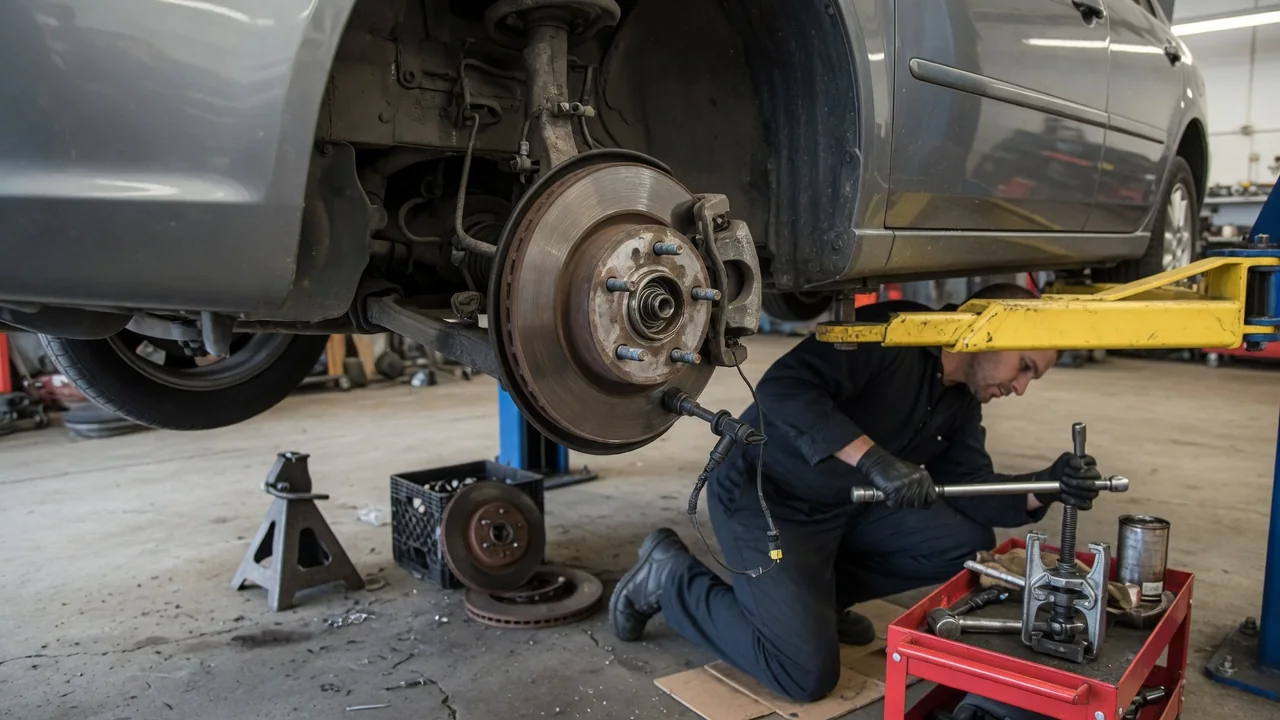
A wheel hub assembly is the pre-built unit that connects a wheel to the vehicle's suspension and lets it spin with minimal friction. On many modern cars it combines a hub flange with wheel studs, a sealed bearing and often a speed-sensing element in one replaceable part. Knowing the main wheel hub assembly parts, how the unit is mounted and how it wears helps owners understand noises, warning lights and repair recommendations.
Bearing and mounting
The core of the assembly is the bearing. It is commonly a double-row design using either angular-contact balls or tapered rollers, which lets it carry the radial load of the vehicle's weight and the axial load generated during cornering. In a typical hub unit the bearing is preloaded at the factory, packed with grease and sealed for life. Around it sits the hub flange, which carries the wheel studs or bolt holes and provides a centering pilot for the brake rotor or drum and the wheel.
Mounting arrangements differ by design. The industry often describes them in generations. In earlier layouts, a bearing cartridge is pressed into the steering knuckle or axle carrier, and a separate hub is pressed through it. Later layouts integrate one or both bearing races into the hub and flange. Many current vehicles use a bolt-on unit, where an outer flange bolts directly to the knuckle or rear axle mount. Which type a vehicle uses depends on its engineering, so the method cannot be assumed from vehicle size or age alone.
Whether the wheel is driven also matters. On a driven wheel, the hub usually has a splined center bore that accepts the outer stub of the CV axle. The axle nut retains the shaft, and in many designs it also clamps the bearing's inner races together, which helps hold the intended preload. A non-driven wheel may use a hub without splines or a unit mounted on a fixed spindle. In both cases, correct seating and clamping are essential, because the bearing's internal geometry depends on them.
Sensor integration
Vehicles with anti-lock brakes measure the rotational speed of each wheel, and the hub is a logical place to do it. There are two common approaches. One uses a toothed tone ring, also called a reluctor, that passes in front of a sensor. The other uses a magnetic encoder ring with alternating north and south poles, which is often built into the bearing's inboard seal. Depending on the design, the sensor itself may be a separate part fitted into the knuckle and aimed at the ring, or it may be integrated into the hub assembly with its own connector or short harness.
Sensors also differ electrically. Passive inductive sensors generate an alternating voltage whose frequency rises with wheel speed, and their signal becomes weak at very low speeds. Active sensors, usually Hall-effect or magnetoresistive types, are powered by the control module and produce a cleaner digital signal that can register very slow rotation. Active sensors are frequently paired with magnetic encoders. The resulting wheel speed data feeds the anti-lock, traction control and stability control systems, and on some vehicles it is also used by other functions such as indirect tire pressure monitoring.
Because sensing depends on a small, consistent gap between the sensor and the ring, the hub's mechanical condition and the speed signal are linked. Excessive bearing play, metallic debris stuck to a magnetic encoder, a cracked or damaged tone ring, or an encoder seal installed facing the wrong direction can all produce erratic or missing readings and trigger warning lights. For the same reason, a replacement hub must match the sensing arrangement of the original part.
Wear
A sealed hub bearing wears gradually, but failure is often triggered by contamination. When a seal ages or is damaged, water and grit can get inside, the grease breaks down, and the rolling surfaces begin to pit and corrode. Impacts from potholes or curbs can dent the races, a condition known as brinelling. Improper installation can also cause early failure, for example hammering on the hub, applying incorrect axle nut or mounting bolt torque, or misusing impact tools. Wheel and tire changes that alter offset or add weight change the loads the bearing has to carry.
Typical symptoms include a hum, growl or rumble that rises with road speed and may change in pitch or volume as the vehicle's weight shifts during gentle turns. Owners may also notice vibration or roughness through the steering wheel or floor, and, with the vehicle safely raised, play when the wheel is rocked by hand at the top and bottom. Advanced wear can produce grinding, and on hubs with integrated sensing it may bring on anti-lock or traction control warnings.
Wear tends to progress over time. A faint noise can become louder, and growing internal clearance produces heat and movement. That movement can increase brake rotor runout, disturb the speed sensor signal and place extra stress on surrounding components. A severely worn bearing can bind or allow excessive wheel movement, so a confirmed hub problem should be treated as a safety concern rather than a comfort issue.
Practical implications and limits
Because a hub assembly is sealed and preloaded as a unit, it generally cannot be regreased or adjusted, and the usual repair is to replace the complete assembly. Bolt-on units are typically simpler to replace, although corroded mounting bolts or a hub seized in the knuckle can complicate the job. Press-in designs require a press or dedicated tooling and a careful procedure to avoid damaging the new bearing. Torque values, whether the axle nut can be reused and any required sequence come from the vehicle manufacturer's service information, not from general rules.
Diagnosis has limits. Tire tread wear, a failing CV joint and brake problems can all sound similar to a bad bearing, and the direction of a turn does not always reliably reveal which side is at fault. A road test combined with physical checks gives a more dependable result. A scan tool that displays live wheel speed data can help separate electrical faults from mechanical ones, since a warning light may stem from wiring, a sensor or a dirty encoder rather than the bearing itself.
Part selection deserves care. Hub assemblies can vary within a single model line depending on drivetrain layout, brake package or sensing arrangement, so identifying the correct part by the vehicle's specific configuration is safer than relying on fit alone. Replacing hubs in pairs is not automatically required; the decision should rest on the measured condition of each side and the guidance for the particular vehicle.