What Is a Wheel Chock?
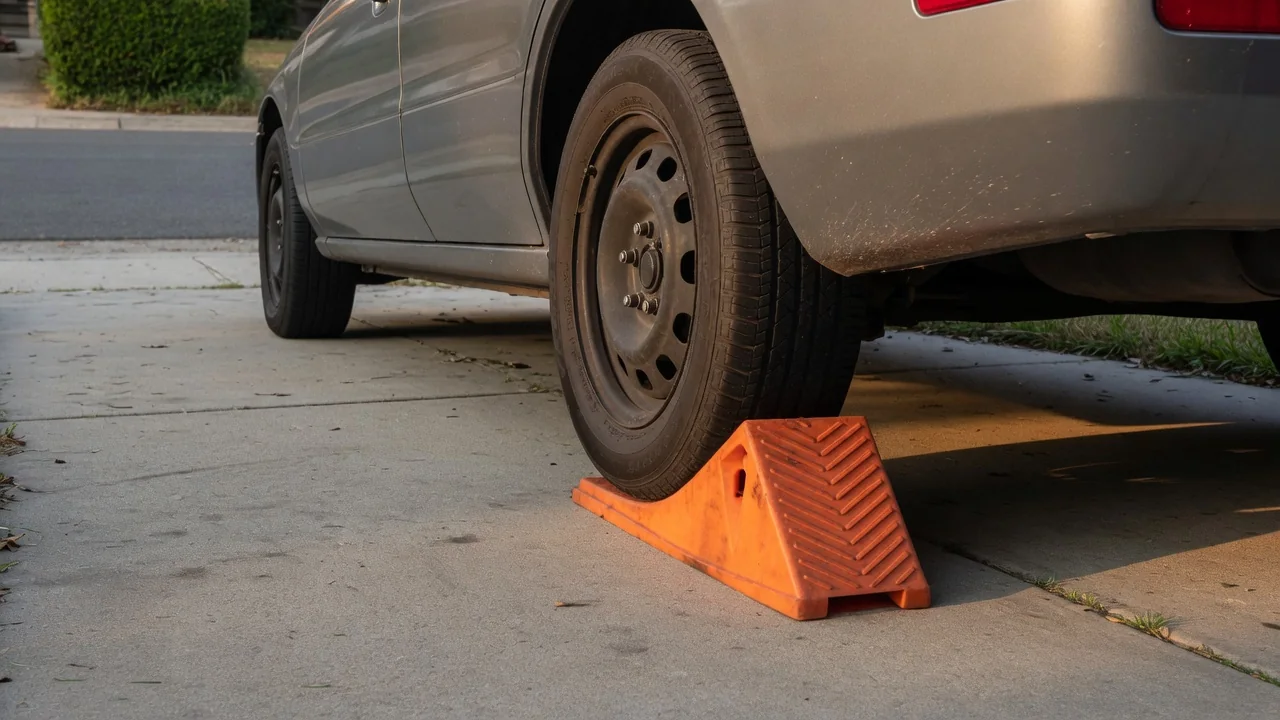
What is a wheel chock? It is a wedge of rubber, plastic, wood or metal placed snugly against a tire to keep a parked vehicle from rolling. By blocking the tire's path, it adds a physical barrier to the parking brake and transmission, which matters when a car is being jacked, a trailer is unhitched, or a vehicle sits on a slope.
Placement
A chock works by sitting on the downhill side of a tire, where gravity would otherwise pull the vehicle. On a driveway that slopes toward the street, the wedge goes against the tread face on the street side, centered on the tire and pushed in until it meets the rubber squarely. On ground that looks level, chocking both the front and back of a wheel covers movement in either direction, since slight grades are hard to judge by eye.
Which wheels to chock depends on what is happening to the vehicle. When one end is raised with a jack, the wheels staying on the ground are the ones to block, because lifting the rear can take the parking-brake wheels off the pavement on many cars. Trailers are usually chocked on both sides before unhitching. Owner's manuals and trailer documentation often state preferred positions, and dual-wheel trucks, tandem axles and motorhomes can call for different arrangements than a compact sedan.
Parking surface
The ground under the chock matters as much as the chock itself. A wedge depends on friction between its base and the surface, so dry concrete or asphalt gives it the best grip. On wet, oily or painted floors, icy pavement or loose gravel, a chock can slide ahead of the tire instead of holding it. Rubber chocks with ribbed bases tend to grip smooth surfaces better than hard plastic, while some designs add teeth or cleats intended for softer ground.
Slope changes the load considerably. On a gentle driveway, a chock may only resist a light nudge, but on a steep boat ramp or hillside campsite the vehicle's full tendency to roll presses into it. Soft soil, grass and sand let a loaded wedge sink or tilt, which reduces its contact with the tire. A quick look shows whether the chock sits flat with its entire base on the ground; a rocking or half-buried chock is a sign the surface is not supporting it properly.
Limits
A wheel chock is a supplement, not a substitute for the parking brake, the Park position in an automatic, or leaving a manual transmission in gear. It resists slow rolling from rest; it is not designed to stop a vehicle already moving, and a tire with momentum can climb over a small wedge or kick it aside. Size matters too: a chock that is short relative to the tire's diameter gives the tire an easier ramp to ride up, which is why large truck tires need taller chocks.
Capacity depends on the product and the vehicle. Manufacturers generally rate chocks for particular tire sizes, vehicle weights and grades, and those ratings vary enough that the markings or packaging on the specific chock are the right reference rather than any general rule. Material condition also sets limits: rubber that has cracked or hardened, plastic that has split, or a wooden block with a rounded edge will not hold as designed. Improvised bricks or scrap lumber can crumble or shoot out under load.
Everyday Use and Observations
Chocks show up in many ordinary situations: changing a flat tire at the roadside, leveling a travel trailer at a campsite, storing a car over winter with the parking brake released, or leaving a boat trailer in a driveway. Many drivers of heavy vehicles and RVs chock as routine whenever they park, and commercial fleets and loading docks often require it. Some cars carry a small folding chock with the spare tire kit, though supplied equipment differs by make and market.
A properly set chock is easy to check. The tire's tread should touch the angled face with no visible gap, and the chock should sit straight rather than cocked to one side. If the vehicle settles slightly when the brake is released or a trailer tongue is lowered, the tire presses harder into the wedge, which is normal. A chock that has shifted, squeezed out sideways or left a scuff trail on the pavement suggests the surface is too slick or the chock too small.
Limits and Next Steps
Chocks prevent rolling but do not support a raised vehicle. Anyone working under a car still needs properly rated jack stands on firm ground, and the jack alone should never be relied on. Removal deserves equal attention: driving off over a forgotten chock can damage the wedge, a tire or bodywork, so pairs joined by a rope or molded in a bright color are easier to remember. A chock that feels jammed usually means the vehicle has settled its weight against it.
Choosing the right pair starts with the tire size and loaded weight of the vehicle or trailer, checked against the chock maker's rating and any guidance in the owner's manual. Keeping them within reach, such as in the trunk or a trailer storage box, makes regular use more likely, and an occasional inspection catches cracks or wear. If a parked vehicle creeps even with the parking brake set and the transmission in Park, the parking brake system merits inspection by a qualified technician.