What Is a Wheel Arch Liner?
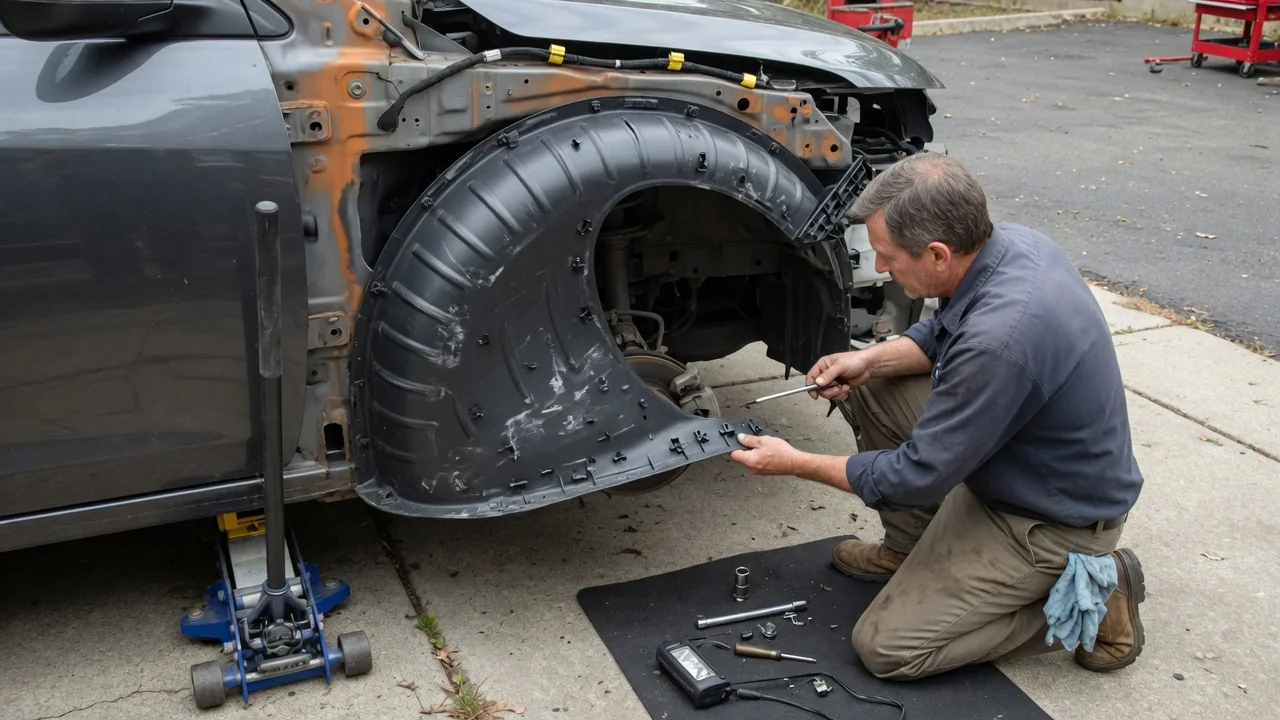
What is a wheel arch liner? It is the shaped panel fitted inside the wheel opening, between the tire and the body structure, often called a fender liner or inner fender. Its job is splash protection: it catches water, mud, road salt and grit thrown up by the rotating tire before that spray reaches metal seams, wiring, lamps and other components tucked behind the fender.
Materials
Most liners are molded from a semi-rigid thermoplastic such as polypropylene or polyethylene, chosen because it shrugs off water, resists road salt and flexes rather than cracking when a stone strikes it. The plastic is formed to follow the curve of the arch closely, leaving clearance for suspension travel and steering lock. Looking into the wheel opening, this type appears as a smooth or lightly textured black shell, sometimes with molded ribs that add stiffness and channels that steer water downward and away from the body.
Many newer vehicles use a fibrous, felt-like liner instead, made from compressed synthetic fibers. It looks and feels like stiff carpet, and its main advantage is acoustic: the soft surface absorbs the hiss of water spray and the patter of gravel that hard plastic tends to reflect into the cabin. The trade-off is that fabric-style liners can hold moisture and packed dirt for longer. Some cars combine both, with plastic at the front arches and textile at the rear, so the material you find depends on the model and trim.
Retainers
A liner is held in place by a mix of small fasteners rather than a single fixing. Common types include plastic push-pin clips that expand in a hole, quarter-turn fasteners, small screws threading into clip-on nuts along the fender lip, and plastic nuts on studs. They sit around the arch edge, along the bumper seam and deeper inside toward the suspension tower. The exact number, style and location differ between manufacturers, and even between front and rear arches on the same car.
Retainers matter because the liner only works when it sits snug against the body. A missing clip leaves a gap where spray is driven behind the panel at speed, and the loose edge can flutter in the airflow. Plastic clips become brittle with age and often break when removed, so they are usually treated as replaceable items. Because head shapes and hole sizes vary, replacements should be matched to the specific vehicle; a clip that looks similar may not grip securely or sit flush.
Damage signs
The clearest warning is noise. A scraping or rubbing sound that changes with steering angle or over bumps often points to a liner that has sagged against the tire, while a flapping sound at highway speed suggests a loose edge catching the wind. Visual checks help too: turn the front wheels fully to one side and look for shiny rub marks, torn sections, cracks around fastener holes, or a panel hanging lower than its counterpart on the opposite side of the car.
Less obvious signs show up over time. Mud packed onto areas the liner should shield, damp wiring connectors, a washer fluid reservoir coated in grime, or rust starting along the inner fender lip can all indicate that splash protection has been compromised. Damage commonly follows curb strikes, deep snow or ice buildup, road debris, a tire failure, or previous bodywork where clips were not refitted. A drooping front bumper corner may also trace back to liner fasteners, since the two parts often share mounting points.
Everyday Use and Observations
In normal driving the liner works unnoticed. On a wet road, each tire flings a steady stream of water and grit upward and forward; the liner intercepts it and lets it drain back down. Behind the front liners, many vehicles house items such as the washer reservoir, fog lamp wiring, horn, headlamp connectors or intake ducting, while the rear liners shield body seams and sometimes the fuel filler pipe. What sits back there varies by design, which is why the consequences of a missing liner differ from car to car.
Routine care is simple. When washing the car, rinsing inside the arches removes salt and mud that would otherwise sit against the liner and its edges, which is especially worthwhile after winter driving. Textile liners may stay dark and damp for a while afterward, which is normal. Drivers in snowy regions may notice slush freezing into heavy lumps inside the arch; letting it thaw or clearing it gently is kinder to the liner and clips than letting the tire grind it away.
Limits and Next Steps
A liner is a shield, not a seal. It reduces how much water and debris reaches the body and components, but some moisture still gets behind it, and it cannot stop corrosion that has already begun or protect against a serious impact. It also hides things: dirt and wet leaves can collect out of sight behind the panel. A liner that looks intact from outside is therefore reassuring but not proof that everything behind it is clean and dry.
If a liner is loose, torn or missing, having it dealt with promptly is sensible, because a panel that contacts the tire can be dragged in and torn away, and exposed components face constant spray. A loose section caused by a lost clip is often a minor fix, whereas a cracked or shredded panel generally calls for replacement with a part shaped for that exact vehicle and arch position. A workshop or parts supplier can confirm the correct liner and fasteners using the vehicle's details.