What Is a Weld Flange on a Vehicle?
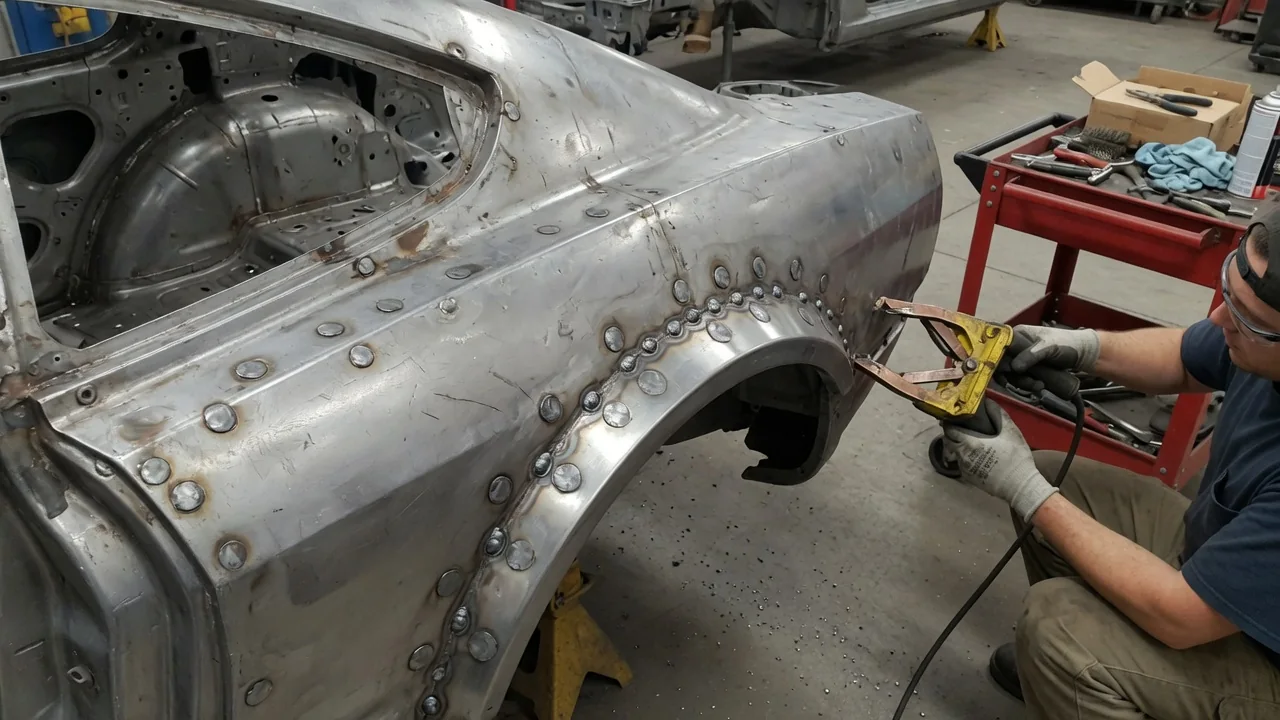
A weld flange is a narrow strip of sheet metal along the edge of a body panel. It is formed so that it lies flat against a matching strip or surface on another panel. The two are joined, usually with spot welds, to create a seam. Every car body weld flange works on the same basic principle, although its location, width, and treatment differ between vehicles. Understanding the flange explains why body seams look the way they do and why they matter in maintenance and repair.
Overlapping sheets that form the flange
Most modern passenger vehicles use a unibody structure built from stamped steel panels, and some use aluminum. A stamped panel rarely joins its neighbor edge to edge. Instead, the press forms a bent lip along the panel's edge, and that lip is shaped to sit flat against a corresponding lip or surface on the next panel. The overlapping area is the weld flange. The resulting connection is a lap joint: two or more layers of metal stacked face to face rather than butted together.
Overlap has practical advantages for mass production. It tolerates small variations in panel position, because the sheets can shift slightly within the overlap without opening a gap. It gives the welding equipment a flat, accessible surface to clamp. It also adds stiffness, because the bent edge acts like a small rib along the panel. Some joints stack three sheets, such as an outer panel, a reinforcement, and an inner panel, all captured in a single flange.
Many flanges are easy to find once you know what to look for. Common examples include the pinch weld along the bottom of the rocker panel, the lip around a door opening that holds the rubber weatherstrip, and the seams inside the trunk and engine compartment. Other flanges are hidden behind trim, inside closed cavities, or under the floor, and their exact layout depends on the vehicle's design.
Spot weld placement along the flange
Factory weld flanges are usually joined by resistance spot welding. Two copper electrodes squeeze the overlapping sheets from opposite sides and pass a high electrical current through them. Resistance at the contact surfaces heats the metal until a small fused zone, called a nugget, forms between the layers. The result is a row of small round marks or shallow dimples along the flange rather than a continuous weld bead.
Placement follows from how the process works. The electrodes need access to both sides of the joint, so flanges are designed wide enough for the tips to land on flat metal. That spot should be away from the outer edge and away from the curved bend where the flange meets the panel. Welds placed too close to the edge or on the bend can produce weak or distorted joints. Spacing along the row is chosen deliberately as well. Welds that are too far apart let the sheets separate between them. Welds that are too close together can let current flow through the neighboring weld instead of the intended spot, an effect commonly called shunting.
Manufacturers set the number and position of welds for each joint based on the loads it must carry, the materials involved, and the assembly equipment. That is why weld rows differ from one seam to another and from one vehicle to another. Collision repair procedures published by manufacturers generally specify how a replacement panel should be attached. That may involve spot welds, plug welds, adhesive, or a combination, and those instructions take priority over general rules.
Sealer at the flange joint
Spot welds hold the flange together at individual points, but the metal between the welds is only pressed together, not fused. That leaves a thin crevice along the seam where water, road salt, dust, and air could enter. Seam sealer closes that path. It is applied as a bead or a brushed coating along the exposed edge of the flange. In some locations, sealing material is also placed between the sheets before they are welded.
Sealer serves several purposes at once. It keeps moisture out of the overlap. This matters because a tight crevice is hard for paint and corrosion protection to coat completely, and slow to dry once it gets wet. Sealer also reduces wind noise and keeps water from leaking into the cabin or trunk, and it gives the seam a finished appearance under paint. Some vehicle structures go further and use structural adhesive inside the flange together with spot welds. This method is often called weld bonding, and it adds strength and stiffness in addition to sealing.
Sealers differ in chemistry and texture, and the factory bead pattern on a given seam can be distinctive. Body shops often try to match the original appearance when they repair a seam. This is partly for looks, but mainly because a correctly placed sealer bead is part of restoring the joint's corrosion protection.
Practical implications and limits
For owners, the most visible flange is often the rocker pinch weld, which many vehicles designate as a lifting or jacking location. Lifting directly on a bare flange with the wrong pad can fold or crush it, crack the sealer and coatings, and open a route for rust. Using the jacking points and any adapters described in the owner's manual helps avoid that damage. A bent pinch weld is a sign that the seam has been stressed and is worth inspecting.
Flanges are also a common starting point for corrosion. Rust bubbling out of a seam, a cracked or missing sealer bead, or staining along a lap joint can indicate moisture trapped inside the overlap. Surface cleanup does not reach the inside of the joint, so the full extent of damage is not always visible from outside. In repair work, spot welds are typically drilled or cut out to separate panels. The new flange is then prepared, protected, and joined according to the applicable procedure. Products such as weld-through primer and cavity wax are used to restore protection inside and around the new joint.
General knowledge has limits here. Flange width, weld count, sealer type, adhesive use, and approved repair methods vary by manufacturer, model, and body material. Aluminum and high-strength steel structures can have restrictions that do not apply to mild steel. For any structural repair or detailed inspection, rely on the manufacturer's repair information and a qualified body technician rather than a general description of how flanges work.