What Is a Vehicle Wake? Air Separation, Rear Pressure, and Body Shape
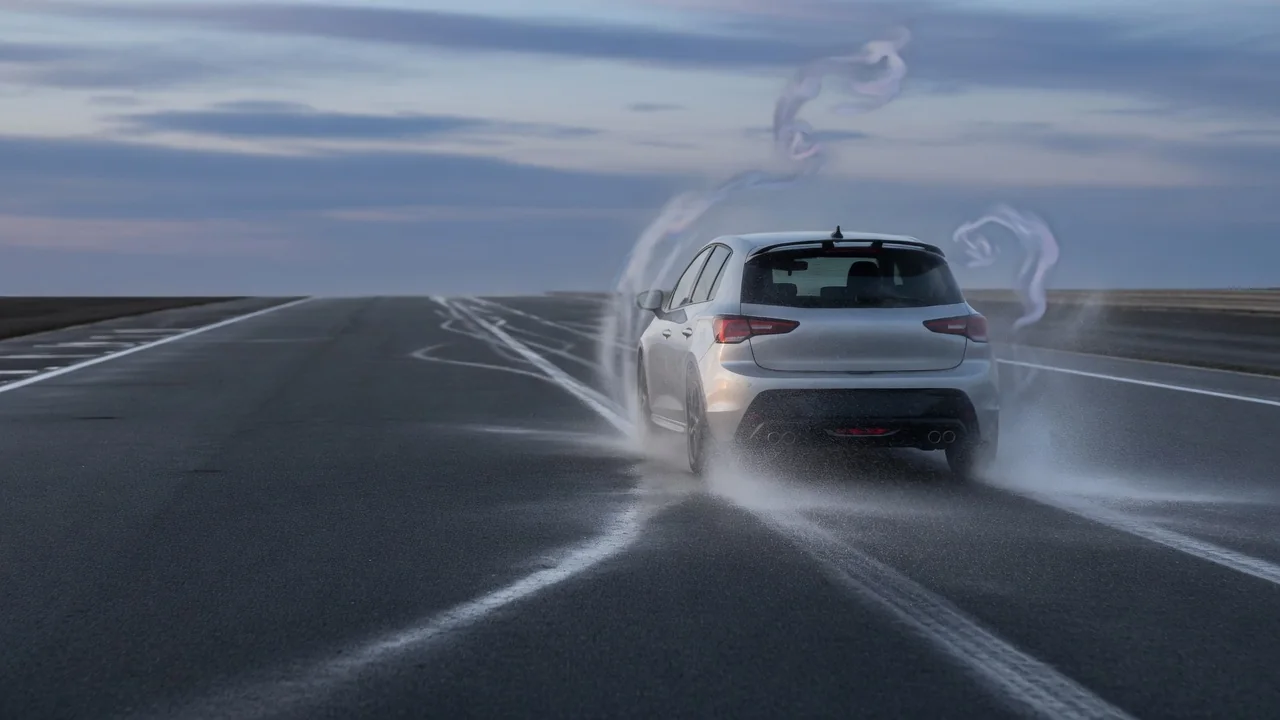
A vehicle wake is the region of disturbed, slower-moving, swirling air that trails behind a car as it drives. It forms where the airflow can no longer follow the body surface and breaks away, leaving a zone of low pressure that effectively pulls backward on the vehicle. Understanding car rear wake aerodynamics explains why the shape of a car's tail matters so much for drag, stability, and even how quickly the rear window gets dirty.
Air Separation: Where the Wake Begins
As a car moves, air flows over its hood, roof, sides, and underbody. Right against the surface sits a thin layer of air called the boundary layer, which is slowed by friction with the body panels. Along the front and middle of the car, this layer usually stays attached, following the contours of the body. Toward the rear, however, the body starts to narrow or drop away, and the air has to move from a region of lower pressure into a region of rising pressure. This adverse pressure gradient saps the energy of the already slow boundary layer.
When the boundary layer runs out of energy, it stops following the surface and detaches. This is called flow separation, and the point where it happens marks the start of the wake. On a sharp edge, such as the top of a vertical tailgate, separation occurs at a fixed, predictable location. On a smoothly rounded surface, the separation point can shift depending on speed, surface condition, and the state of the incoming flow, which makes the wake less predictable.
The rear of the body is the largest source of separation, but it is not the only one. Wheels and wheel arches, side mirrors, the underbody, and exposed components all shed their own smaller wakes. These disturbances can merge with the main wake behind the car and influence how large and turbulent it becomes.
Pressure Behind the Car
The front of a moving car pushes into the air and experiences relatively high pressure. Behind the car, inside the separated wake, the pressure on the rear surfaces, often called base pressure, is typically lower than the surrounding air. The difference between the high pressure at the front and the low pressure at the back produces a net force resisting motion. This is known as pressure drag, or form drag, and for ordinary road vehicles it is generally a much larger part of total aerodynamic drag than surface friction.
The wake itself is not a calm pocket of air. Directly behind the body there is usually a recirculation zone where air tumbles back toward the vehicle, surrounded by layers of turbulent mixing. The flow sheds and reforms unsteadily, so the pressure on the rear surfaces fluctuates rather than staying constant. As a general rule, a larger and more energetic wake means lower base pressure and more drag, because the car is continuously spending energy to stir up that mass of swirling air.
Some rear shapes also create strong trailing vortices, rotating tubes of air that stream off the corners of a sloped rear window or the edges of the body. These vortices can lower pressure on the surfaces near them, adding drag, and they can affect aerodynamic lift at the rear axle. Their strength depends heavily on the specific slope and edge geometry, which is why seemingly small styling differences can change rear-end aerodynamic behavior.
How Shape Changes Affect the Wake
Designers broadly group rear ends into a few families. A squareback or boxy tail, common on wagons, vans, and many SUVs, separates the flow abruptly and tends to leave a broad wake. A fastback, with a long sloping roofline, can keep the flow attached farther back and narrow the wake, although at certain slope angles it may generate strong trailing vortices instead. A notchback, with a separate trunk, produces a more complex flow in which air may separate from the roof and partly reattach on the trunk lid.
Several shaping techniques aim to shrink the wake or raise base pressure. Gently tapering the rear of the roof and sides, sometimes called boat-tailing, guides the air inward before it separates. A cut-off tail with a sharp edge, often called a Kamm tail, fixes the separation point cleanly while avoiding the impractical length of a fully tapered tail. Spoilers, roof extensions, crisp trailing edges on taillights, and rear diffusers under the bumper all manage where and how the flow leaves the body, influencing both the size of the wake and the balance of lift.
Every change involves trade-offs. A shape that reduces drag may increase rear lift, and a device that adds downforce may add drag. Rear styling also has to accommodate cargo space, headroom, visibility, lighting, crash structures, and cooling airflow exiting the underbody. The final shape of a production car is a compromise among all these needs, and its wake reflects that compromise rather than a single aerodynamic ideal.
Practical Implications and Limits
For drivers, the wake shows up in everyday ways. Because aerodynamic drag grows with the square of speed, wake-related drag matters most on the highway and has a noticeable effect on fuel or energy consumption during sustained high-speed driving. The recirculating air behind a blunt rear can carry road spray and dust onto the tailgate and rear glass, which is one reason vehicles with upright rear ends are often equipped with rear wipers. Roof boxes, bike racks, open cargo, and trailers all reshape the airflow and generally add drag, so consumption on long trips may rise with such loads.
The wake also affects the vehicles around you. A car following closely behind another sits in its low-pressure, slower-moving air, which reduces its drag; this is the principle behind drafting in motorsport. On public roads, the safety cost of a short following distance far outweighs any efficiency benefit, so drafting is not a sensible economy technique. The turbulent wake of large trucks and buses can also be felt as buffeting when passing or being passed, especially in crosswinds.
The general mechanisms described here hold broadly, but they cannot predict how any particular vehicle behaves. Wakes are three-dimensional, unsteady, and sensitive to small details, so manufacturers rely on wind tunnel work, computer simulation, and road testing to evaluate specific designs. Likewise, aftermarket add-ons marketed as aerodynamic improvements may help, do nothing, or make matters worse depending on the car. For load limits, roof carrier use, and towing guidance, the vehicle's owner's manual remains the authoritative reference.