What Is a Vehicle Quality Gate? Stage Checks, Defect Holds and Release
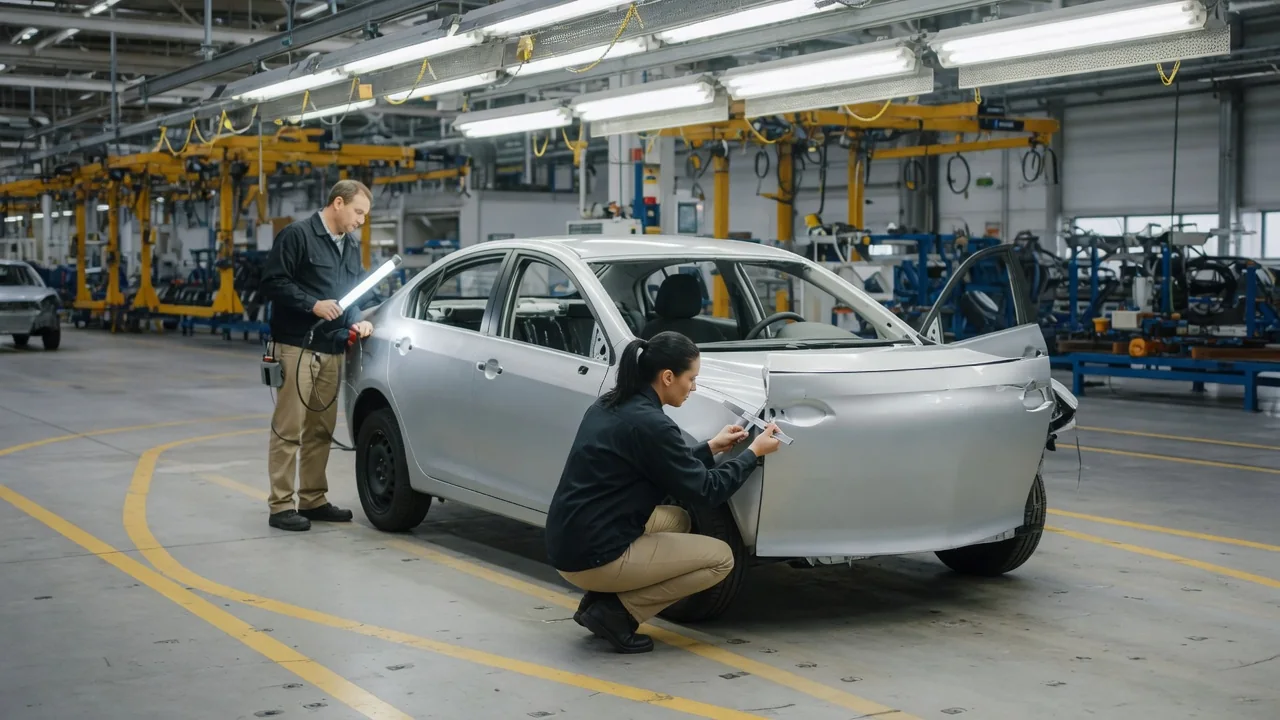
A vehicle quality gate is a defined checkpoint in the manufacturing process where a car must meet set criteria before it can move to the next stage. Instead of relying on a single inspection at the end of the line, a car factory quality gate spreads verification across the build so problems are caught close to where they start. This article explains how stage checks work, what happens when a defect triggers a hold, and how a vehicle is finally released.
Stage checks: how a quality gate verifies the build
Vehicle assembly is usually divided into major areas such as the body shop, paint shop, trim and chassis lines, final assembly and end-of-line testing. Quality gates are typically placed at the transitions between these areas, where a vehicle is about to enter work that would make earlier operations harder to reach. Each gate has a defined list of characteristics to confirm. Depending on the stage, that list can include body dimensions and panel fit, paint finish, the presence of the correct parts for the ordered configuration, the tightening of safety-relevant fasteners, electrical connections, fluid fills and the software configuration of control modules. The criteria come from engineering specifications and the plant's control plans rather than from an inspector's personal judgment.
The methods used at a gate vary by manufacturer and by stage. Common approaches include visual inspection under controlled lighting, measurement fixtures and gauges, camera-based vision systems, data recorded by electronically controlled tightening tools, and diagnostic connections to the vehicle's onboard network. Later gates often include functional tests such as water leak checks, wheel alignment, headlamp aim, brake and drivetrain checks on rollers, and a short evaluation drive. Results are generally recorded against the vehicle identification number, which builds a traceable history of what was checked, when and with what outcome.
What separates a gate from simple observation is that it produces a decision. A vehicle passes, or it is flagged with a specific nonconformance. The underlying principle is that the cost and difficulty of fixing a defect grow the further the vehicle travels. Correcting a body alignment issue before interior trim is installed is far simpler than doing it afterward. Gate findings also feed back to the upstream stations that caused them, so the process itself can be corrected rather than the same fault being repaired again and again.
Defect hold: what happens when a vehicle fails a gate
When a gate finds something outside specification, the vehicle is placed on hold. In practice a hold can be a status in the production tracking system that prevents the vehicle from being signed off at later stations, a physical diversion to a repair area away from the main line, or both. The defect is logged with its location, type and severity so that the repair team knows exactly what to address and so that patterns can be analyzed later.
A single defect does not always stay a single-vehicle issue. If the finding points to a systemic cause, such as a batch of incorrect parts, a tool that has drifted out of calibration or a wrong software file, the hold may be extended to other vehicles built during the same period or fitted with the same component lot. This step is often called containment. It is followed by root cause analysis and corrective action, so the source of the problem is removed rather than only its symptoms. Traceability records from earlier stage checks are what make it possible to identify which vehicles fall inside the suspect range.
Repair does not end the hold by itself. A repaired vehicle normally has to pass the original check again, and sometimes an additional inspection that confirms the repair did not create a new problem, such as damaged trim or a disturbed connector. Many production systems also give line workers a way to signal problems and stop work at their station, which reinforces the same idea: a known defect should not be passed forward to the next stage.
Release: clearing a vehicle to move on or ship
Release happens at two levels. Stage release means a vehicle has passed a gate and may continue to the next production area. Final release means the completed vehicle is cleared to leave the plant. For final release, every required check generally needs a recorded pass, all logged defects must be closed, and the build record must be complete. In many tracking systems, a missing result is treated as an open item rather than an assumed pass, so a vehicle with incomplete data stays on hold just like one with a known fault.
Release authority usually sits with the quality function rather than with production alone, which keeps the people measured on output separate from the people who decide whether that output is acceptable. Alongside routine gates, plants commonly run sample audits in which selected finished vehicles are evaluated in detail from a customer's point of view; their findings feed back into gate criteria. A built vehicle can also be held after assembly, for example while waiting for a part, a software update or the outcome of a containment investigation, and it is released only once that open condition is resolved.
Practical implications and limits
For car owners, the quality gate concept helps explain a few things seen after purchase. Because results are tied to each vehicle identification number, manufacturers can often define a recall or service campaign by a specific range of build dates, plants or part lots instead of an entire model line. Factory release is also separate from the pre-delivery inspection performed by a dealer, which covers transport-related items, accessory installation and final preparation before handover. Passing one does not replace the other.
Quality gates also have clear limits. A gate can only confirm what its criteria cover, so a fault outside the checklist can pass unnoticed. Some characteristics are checked on samples rather than on every vehicle. Problems that develop over time, such as wear, durability issues or intermittent electrical faults, may not exist yet when the car leaves the plant. The exact number, placement and content of gates differ between manufacturers and plants, and the term is also used in product development for reviews between design phases, which is a different process. A quality gate reduces the chance that a defect reaches the customer; it does not guarantee a defect-free car, which is why warranty coverage and prompt reporting of problems still matter.