What Is a Vacuum Wiper Motor? How Classic Car Vacuum Wipers Work
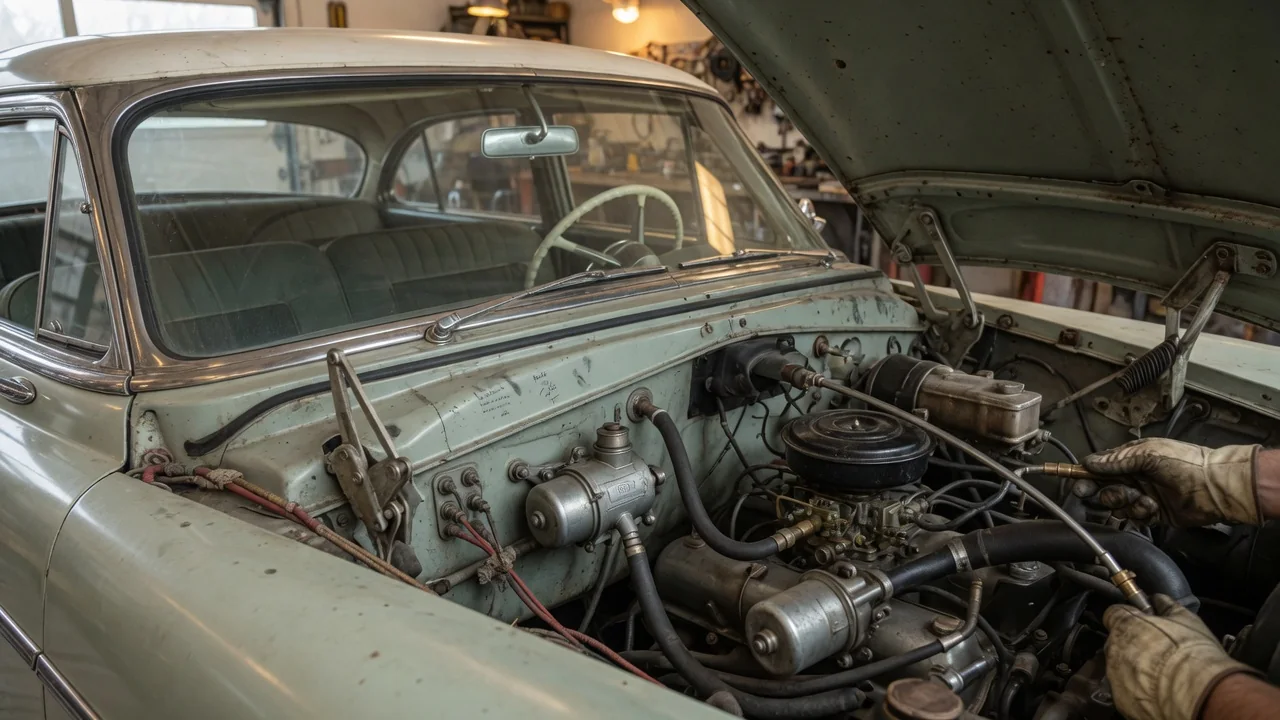
A vacuum wiper motor is a windshield wiper drive that runs on the suction created by a gasoline engine's intake manifold rather than on electricity. Many older vehicles used this design before electric wiper motors became common, so classic car vacuum wipers are still a familiar sight in restoration work. Knowing where the power comes from explains both the system's simplicity and its best-known quirk: wiper speed that rises and falls with how hard the engine is working.
Engine vacuum: where the wiper gets its power
When a gasoline engine runs with the throttle partly closed, the pistons draw air through a restricted opening, so pressure inside the intake manifold drops below outside atmospheric pressure. That pressure difference is what mechanics call engine vacuum. A vacuum wiper system taps into it with a small line running from the manifold, or from a port connected to it, to the wiper motor. Inside the motor is a sealed chamber containing a paddle or vane mounted on a shaft. A simple valve connects one side of the paddle to vacuum while the other side is open to the atmosphere. Outside air pressure pushes the paddle toward the low-pressure side, and at the end of its travel the valve switches sides, sending the paddle back the other way. This continuous back-and-forth motion is carried to the wiper arms, either directly through the motor shaft or through linkage or cables, depending on the vehicle.
Because the motor has no armature, brushes or wiring, its moving parts are few: the paddle, its seals, the switching valve and whatever control valve the driver operates. That simplicity is part of the appeal for restorers. It also means the wiper system is connected directly to the engine's air intake. Any leak in the wiper hoses, fittings or motor seals lets unmetered air into the manifold, which can affect idle quality and mixture in addition to weakening the wipers themselves.
Speed changes: why the wipers slow down
Manifold vacuum is not constant. It is generally strongest when the throttle is nearly closed, such as at idle or while coasting, and weakest when the throttle is opened wide under load, such as when accelerating hard or climbing a long grade. Since the wiper motor depends on that vacuum, the wipers tend to move briskly when the engine is lightly loaded and slow down, or even pause, when the driver presses the accelerator firmly. Once the throttle is eased, vacuum recovers and the wipers pick up speed again. This behavior is a normal characteristic of the design, not necessarily a fault, although it can be inconvenient when passing or merging in heavy rain.
The dash control on a vacuum wiper system usually works by regulating how much vacuum reaches the motor, which lets the driver set a slower or faster sweep. It can reduce speed, but it cannot create vacuum the engine is not producing, so it does not overcome the slowdown under heavy throttle. To address this, some vehicles were equipped with an engine-driven vacuum booster pump, in some designs built into the same housing as the mechanical fuel pump, to help maintain more consistent vacuum to the wipers. Whether a particular vehicle has such a pump, and how it is plumbed, is vehicle-specific and should be confirmed in its original service documentation.
Other conditions also influence wiper speed. An engine with worn piston rings, incorrect ignition or carburetor adjustment, or intake leaks typically produces less manifold vacuum, and the wipers reflect it. Mechanical drag matters too: stiff pivots, dry linkage, worn blades or a dry windshield all add resistance the paddle must overcome. Altitude plays a role as well, because lower atmospheric pressure reduces the maximum pressure difference available to push the paddle.
Restoration: bringing a vacuum wiper motor back
The most common problems in an aging vacuum wiper system involve sealing. Paddle seals, often made of leather or rubber in older units, can dry out, harden or shrink, letting air slip past the paddle. Vacuum hoses crack, fittings loosen, and internal valves wear or collect dirt and corrosion. Typical symptoms include weak or erratic motion, wipers that stop partway through a stroke, an audible hiss, or a noticeably rougher idle when the wipers are switched on.
A sensible approach is to work from the outside in. Inspect the hoses and connections first, and replace any that are hard, cracked or loose. A vacuum gauge connected at the motor inlet, compared with a reading taken at the manifold, can show whether vacuum is being lost along the way. With the motor removed, a hand vacuum pump can show whether the unit holds vacuum and cycles on the bench. Disconnecting the motor from the linkage and moving the arms by hand also helps separate a weak motor from binding pivots or cables. Many vacuum wiper motors can be disassembled and resealed, and rebuild parts and rebuilding services are available for a number of designs. Use the procedure in the vehicle's service manual and the lubrication guidance supplied with the replacement seals, because the wrong lubricant can damage some seal materials.
During reassembly, it helps to mark or photograph parts before taking them apart so the paddle, valve components and gaskets go back in the correct orientation. Housing gaskets and cover screws need to seal evenly, since a small leak can undo the benefit of new seals. If the vehicle uses a booster pump, its diaphragm and valves deserve the same inspection, because a failed pump can starve the wipers or leak into the fuel side of a combination unit. Finally, the arm sweep and resting position are usually set at the linkage or arm mounting according to the vehicle's manual.
Practical implications and limits
For anyone who drives a classic car with vacuum wipers in wet weather, a correctly restored system still behaves like the original design. Even in excellent condition, it will not match the steady, load-independent speed of an electric wiper motor. Drivers often adapt by using smoother throttle inputs in the rain and by keeping blades fresh and pivots free so the available vacuum is not wasted on friction. Engine modifications can change the picture as well: a camshaft or carburetor setup that lowers manifold vacuum also leaves less power for the wipers, and other vacuum-operated accessories sharing the same source may compete for it.
Some owners choose to convert to an electric wiper motor for more consistent operation, accepting the trade-offs of reduced originality, new wiring and possible changes to mounting or linkage. Whether a conversion fits cleanly depends entirely on the specific vehicle. More broadly, this explanation covers the general principle; motor construction, control layout and booster arrangements varied among manufacturers and years, so the original owner's manual or factory service manual remains the best reference for any individual car.