What Is a Two-Shot Molded Car Control?
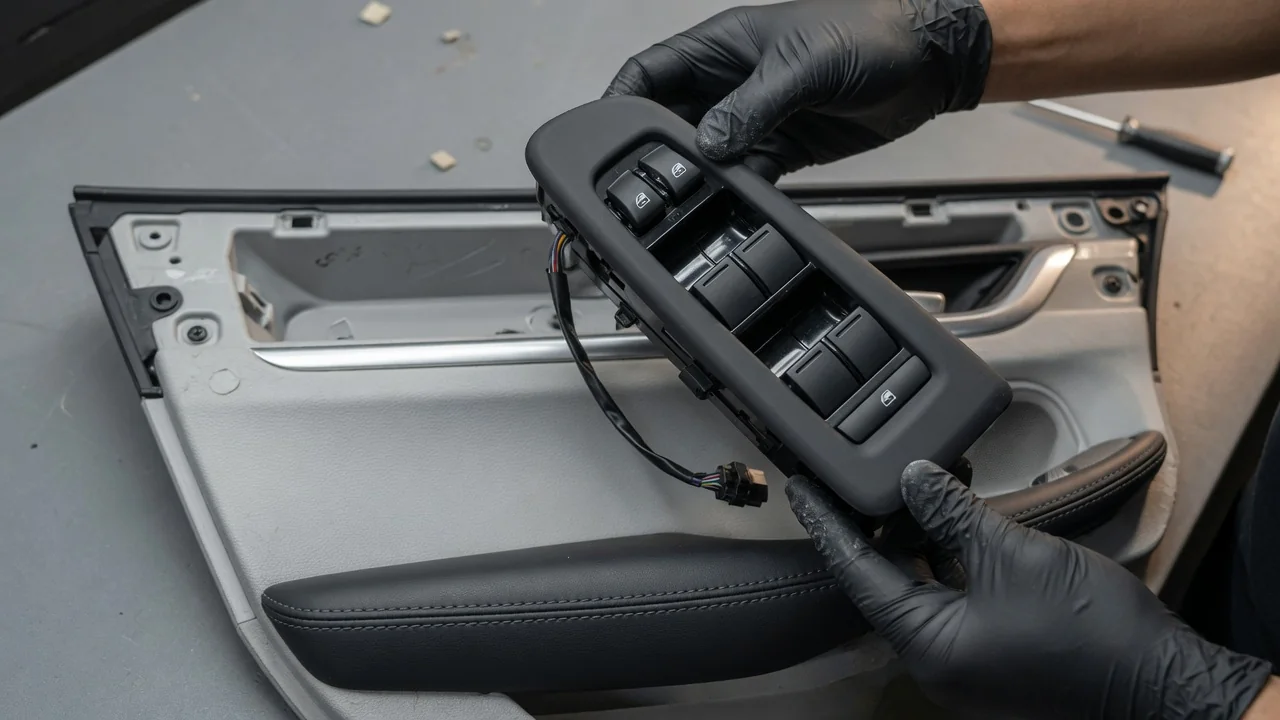
A two-shot molded car control is a knob, button, switch cap, or dial made from two different plastics injected into the same mold during one automated production cycle. The first shot forms a rigid structural body. The second adds a softer grip surface, a contrasting color, or a light-transmitting symbol. With two shot molding, car controls get their materials joined during manufacturing instead of being glued, painted, or snapped together afterward.
Two materials
The process starts when the molding machine injects the first material into a cavity, forming the base part, often called the substrate. The mold then changes shape, either by rotating the part to a second cavity or by retracting a core to open new space. A second injection unit fills that space with the second material while the substrate is still in the tool and typically still warm. Because both steps happen in one machine and one cycle, the part comes out finished. This differs from insert overmolding, where a completed first part is moved, by hand or robot, into a separate mold before the second material is added.
The first shot in a control is usually a rigid engineering thermoplastic such as ABS, polycarbonate, a PC/ABS blend, nylon, or polypropylene. It carries the clips, shafts, and mounting features that attach the control to the switch or panel behind it. The second shot falls into one of two broad groups. It may be a thermoplastic elastomer, such as a TPE, TPU, or TPV, chosen for grip and flexibility. Or it may be another rigid plastic in a different color or with different light transmission. A common example of the second type is a backlit button: a translucent shot forms the symbol, and an opaque shot surrounds it, so interior lighting shines only through the icon.
How well the two materials stay together depends on their compatibility. Some material pairs fuse at the interface because the hot second shot partly melts and bonds with the surface of the first. Where the chemistry does not bond well, designers add mechanical interlocks, such as holes, ribs, or undercuts that the second material flows through and wraps around. Many parts use both approaches. The exact pairing for a given control is an engineering choice made by the part supplier, and it generally cannot be determined just by looking at the finished piece.
Tactile areas
The soft second shot is commonly placed where fingers make contact: the outer rim of a rotary knob, the grip band on a dial, the thumb area of a rocker switch, or the sides of a selector handle. Because elastomers are available in a wide range of hardness values, designers can tune how firm or cushioned a surface feels. Textures, knurling, and grip ridges can be formed directly in the mold, so the pattern is part of the material rather than a separate layer.
These areas also serve functional purposes beyond comfort. A softer surface gives better grip with gloves or damp hands. Elastomer can damp vibration and reduce rattles between a cap and its housing. In some designs the soft shot forms a flexible lip or membrane around a button's edge, helping keep dust and spilled liquid away from the switch beneath. The boundary between hard and soft material can also act as a locating cue, letting a driver find and identify a control by touch while keeping their eyes on the road.
Tactile cues are not limited to soft material. Two rigid shots can create raised symbols, ridges, or contrasting bands that are both seen and felt. It is also worth knowing that not every soft-feeling interior surface is two-shot molded. Some are rigid parts sprayed with a soft-touch coating, which can feel similar when new but is a thin surface layer rather than a solid molded section, and it behaves differently as it ages.
Durability
The best-known durability advantage applies to symbols and legends. When an icon is formed by the second shot, the symbol runs through the thickness of the material instead of sitting on the surface. Repeated pressing and rubbing may scuff, dull, or polish the top of the button, but the symbol itself remains because there is no paint or printed layer to wear through. Painted-and-laser-etched legends, by contrast, rely on a surface coating, and on heavily used controls that coating can wear away over time.
The joint between the materials is the other key factor. When the materials are well matched and the process is correctly controlled, the interface is fused or mechanically locked, and there is no adhesive to dry out or release. Problems can still occur. A poorly matched material pair, process variation during production, or long-term stress can lead to delamination. When it happens, lifting usually begins at an exposed edge where the soft material meets the hard substrate, since that is where fingers, rings, and cleaning cloths catch.
The materials themselves also respond to their environment. Depending on the formulation, a thermoplastic elastomer exposed to cabin heat, sunlight through the glass, skin oils, hand lotion, sunscreen, insect repellent, or harsh solvents may harden, swell, fade, or turn tacky. Rigid substrates are generally more resistant to these influences but can crack under impact or concentrated stress near clips and shafts. How a specific control ages depends on its exact materials and usage, so behavior differs from one vehicle to another.
Practical implications and limits
For owners, the construction method is mostly invisible. A seamless junction between two colors or textures suggests a molded part, but it is not proof, and a backlit symbol could also be produced by other methods. The reliable way to know how a particular control is made is the manufacturer's parts or service information. General descriptions of two-shot molding explain the technology, not how any individual vehicle was built.
Care follows from the materials rather than the molding method. Interior cleaners approved in the owner's manual are the safest choice, and solvent-based products are best avoided on soft grip areas. Wiping off residue from lotions or repellents before it sits for long reduces the chance of chemical attack on elastomer surfaces. If an unfamiliar product must be used, trying it first on a hidden spot limits the risk to a visible control.
Repair options are limited. Because the two materials were joined in the mold, they cannot be separated and re-bonded at home in a way that matches the original part, so a damaged knob or cap is normally replaced as one piece. Aftermarket replacements may use a different construction, such as a painted and etched legend or a glued-on grip, which can look similar at first but age differently. Finally, the molded cap is only the outer component: a worn switch, encoder, or electrical contact underneath will still fail on its own schedule, and replacing a cap does not correct a problem in the electronics behind it.