What Is a Two-Piece Wheel? Construction, Fasteners and Service
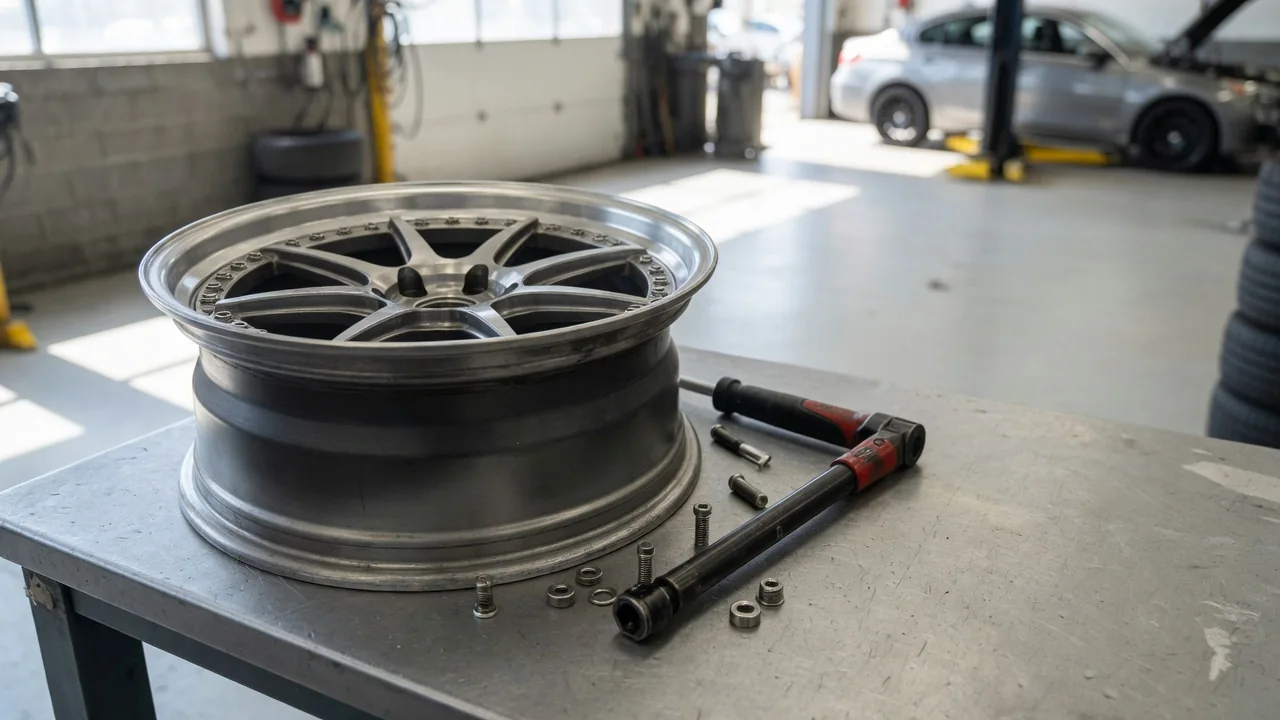
A two-piece wheel is built from two main components joined into one assembly. One is a center section that carries the spokes and mounts to the vehicle hub. The other is a rim barrel that holds the tire. A monoblock wheel, by contrast, is cast or forged as a single piece. Understanding two-piece car wheel construction explains why these wheels look the way they do, how they are held together, and what extra attention they need over their service life.
Joined sections: center and barrel
The center, sometimes called the face or disc, contains the spoke design, the hub bore and the lug holes. It determines how the wheel attaches to the vehicle, and it transfers driving, braking and cornering loads into the hub. The barrel is the cylindrical outer shell, with bead seats and flanges that locate and seal the tire. In a two-piece design the two parts are made separately, often by different processes. A center may be forged, or cast and then machined, while a barrel may be spun, rolled or forged. Because the parts are separate, a manufacturer can pair one center design with barrels of different widths. Where the center sits inside the barrel affects the wheel's offset, so the same face can be built into several fitments.
There are two broad ways to join the sections. In a bolted design, the center sits against a mounting ledge or flange inside the barrel, and a ring of assembly bolts clamps the two together. On a tubeless wheel, the bolt holes and mating surfaces are a potential leak path, so a sealant or gasket is used along the joint to keep air in. In a welded design, the center is permanently welded into the barrel. Welding removes the bolts and the sealed joint, but it also removes the option of separating the parts later. Many ordinary stamped steel wheels are technically a disc welded to a rim, but in performance and aftermarket contexts the term two-piece wheel usually means the bolted type. Three-piece wheels are a different design: there the barrel itself is split into inner and outer halves around the center.
Fasteners that hold the wheel together
The assembly bolts in a bolted two-piece wheel are not the lug nuts or lug bolts that hold the wheel to the vehicle. They hold the wheel itself together. Depending on the design, they may pass through the barrel flange and the center and be secured with nuts, or thread directly into one of the components. Materials and finishes vary by manufacturer. Steel and titanium hardware are both used, and some bolts have decorative heads that show on the face of the wheel. The wheel maker sets the number, size, grade and tightening specification of these fasteners. General rules do not cover them, so the reference is the documentation for that specific wheel.
These fasteners work by clamping force. When they are tightened correctly, friction between the clamped surfaces carries the loads, so the bolts are not relied on to resist shear by themselves. If the bolts are under-tightened, the joint can move, which can lead to fretting, air leaks and fatigue. If they are over-tightened, bolts can stretch, threads can be damaged and mating surfaces can distort. Assembly bolts are therefore normally tightened in stages, in an alternating pattern so the center seats evenly, and to a calibrated torque value. Some designs specify thread treatments, washers or thread-locking compound. Some manufacturers require new bolts or nuts after disassembly rather than allowing reuse.
Corrosion is another fastener concern. When the hardware and the wheel components are different metals, moisture and road salt can cause galvanic corrosion where they touch. Coatings, isolating washers and sealants reduce the risk, but bolt heads and the surrounding surfaces still deserve attention during cleaning and inspection.
Service and maintenance
Routine care for a two-piece wheel starts with the same checks as any wheel: tire pressure, visible damage and bent flanges. On top of that, the joint needs attention. If a tire slowly loses air and has no puncture, the leak may be at the seal between the center and barrel or around an assembly bolt. A common way to find it is to inflate the tire and brush soapy water around the bolt circle and the joint, then look for bubbles where air escapes. Loose, missing or corroded hardware should be dealt with before the wheel is driven further.
Fixing a leaking bolted joint usually takes several steps. The tire comes off and the center is unbolted. Old sealant is cleaned away, and the mating surfaces and hardware are inspected. The wheel is then reassembled with fresh sealant and tightened in the manufacturer's sequence to the specified value. The sealant usually needs time to cure before the tire is mounted and inflated. The procedure and materials differ between designs, so this work is best done by a wheel specialist, or with the manufacturer's instructions in hand, rather than improvised.
Tire fitting and balancing also call for care. Mounting machines and tire levers can strike bolt heads or the joint area, and wheel weights must sit where they do not interfere with the hardware. On the positive side, separable construction can make refinishing and repair more practical. A barrel damaged by a curb or pothole can sometimes be replaced while the center is kept, and the center can be refinished on its own. Whether a damaged part can be repaired or must be replaced is a decision for a qualified wheel repair shop.
Practical implications and limits
For an owner, a two-piece wheel trades some simplicity for flexibility. The modular layout lets makers offer many width and offset combinations and distinctive styling, and it can allow partial replacement after damage. In return, the wheel has more parts that must stay tight and sealed, and some service steps that a general tire shop may not perform routinely. Running costs can therefore depend on how often the wheels are dismounted and how easy it is to reach specialist service.
Construction type alone does not tell you whether a wheel is stronger, lighter or better than a one-piece alternative. Weight and strength depend on the materials, manufacturing method and engineering of the specific wheel. A well-made monoblock can outperform a poorly made multi-piece wheel, and the reverse is also possible. However many pieces a wheel has, it still has to match the vehicle's bolt pattern, center bore, offset, brake clearance and load requirements. If information about a particular wheel is missing, such as torque values, sealant type, bolt reuse rules or load rating, get it from the wheel manufacturer rather than borrowing figures from another design.