What Is a Tweeter in a Car Stereo?
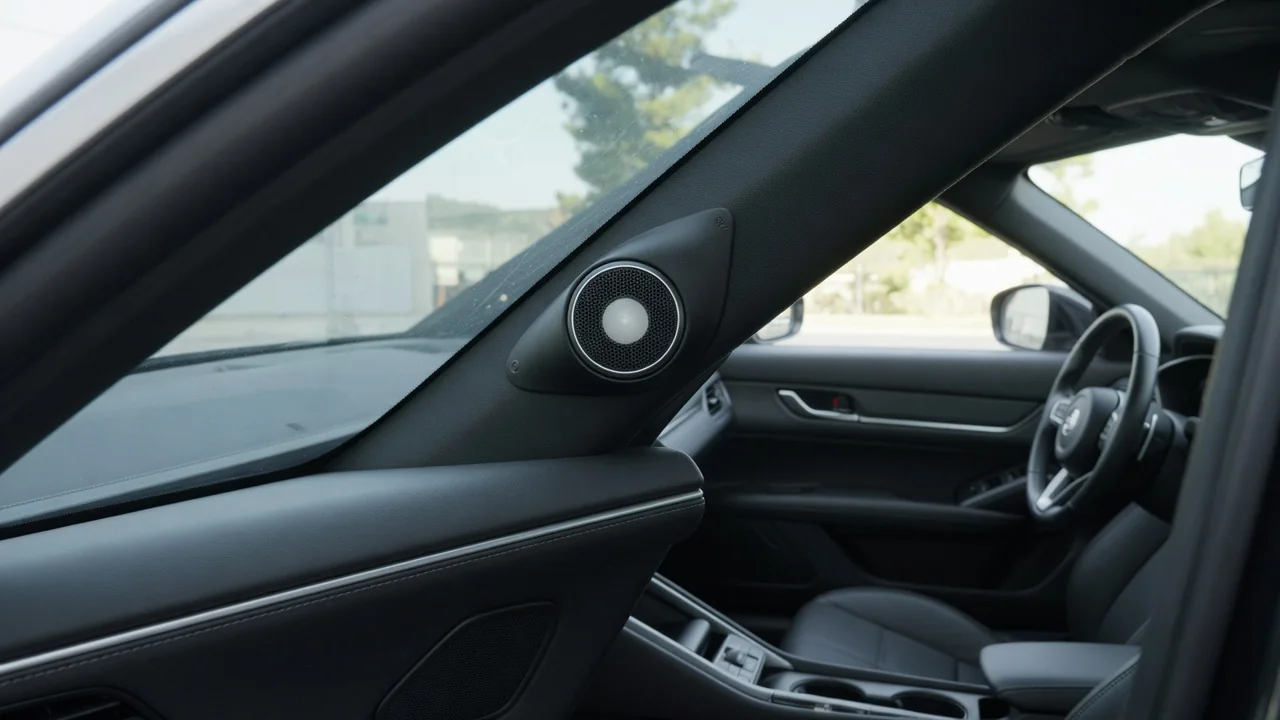
A tweeter is the small speaker in a car audio system that reproduces the highest frequencies, such as the shimmer of cymbals, the bite of a guitar string, and the crisp consonants in a voice. Larger speakers struggle to play these sounds cleanly, so the tweeter takes over the top of the range. The purpose of a car tweeter comes down to three things: the frequencies it plays, where it sits in the cabin, and how a crossover feeds it.
High Frequencies: What a Tweeter Reproduces
Human hearing is commonly described as spanning roughly 20 Hz to 20 kHz. The upper part of that range, usually called treble, carries the shimmer of cymbals, the attack of a plucked string, and the sharp consonants that make speech intelligible. A tweeter is a driver built specifically for this region. Its diaphragm is small and light, so it can start and stop moving very quickly, which rapid high-frequency vibrations demand. Most car tweeters use a dome driven by a voice coil around its edge. Soft domes made from silk or textile are often described as smooth, while metal domes are often described as brighter, though the overall design and installation matter more than the material alone.
A large woofer cone can move at high frequencies, but its size works against it. As frequency rises, a big cone starts to flex instead of moving as one piston, and its output narrows into a tight beam. Treble then sounds dull or uneven unless the listener sits directly on its axis. Handing the top octaves to a dedicated tweeter avoids that problem and lets the larger driver concentrate on the range where its surface area is an advantage.
The reverse is also true: a tweeter cannot play bass. Low frequencies require moving a large volume of air, and a small dome has neither the surface area nor the travel to do it. Feeding a tweeter strong low-frequency signal forces it beyond its mechanical limits and can overheat its voice coil, which is why tweeters are almost never connected without some form of filtering.
Placement: Where Tweeters Sit and Why It Matters
Because high frequencies are strongly directional, a tweeter's location and aim influence what you hear far more than a woofer's position does. Bass tends to fill the cabin regardless of where it originates, but treble behaves more like a flashlight beam. If a tweeter points at a seatback or a footwell, much of its detail is absorbed or scattered before it reaches the listener. Common mounting spots include the sail panel near the base of the windshield pillar, the upper corners of the dashboard, the top of the door panel, and the A-pillar itself. Factory locations vary from vehicle to vehicle, so the available options depend on the specific interior.
Placement also shapes the soundstage, the sense of where instruments and voices appear to be. Tweeters mounted high and forward tend to lift the perceived image toward dashboard height rather than leaving it near the listener's knees. A car adds a complication a home listening room does not: the driver sits off-center, closer to one side's speakers than the other, which can pull the image toward the nearer side. Angling the tweeters, choosing mounting points with more similar distances, or using electronic adjustments can help balance the stage. Reflections from the windshield and side glass also influence the result.
System type sets some of these choices. In a coaxial speaker the tweeter is mounted in front of the woofer, so both share one location, typically low in the door. Component systems separate the tweeter from the midbass driver, giving more freedom to mount it higher and aim it toward the listening position.
Crossover: Sending the Right Frequencies to the Tweeter
A crossover divides the audio signal so each driver receives only the frequencies it can handle well. For a tweeter, this means a high-pass filter that lets treble through while blocking lower frequencies. The simplest version is a single capacitor wired in series with the tweeter, an approach found on many coaxial speakers and basic add-on tweeters. Component kits usually include a separate passive crossover network built from capacitors and inductors that splits the signal between the tweeter and the midbass driver. Some of these networks also offer a tweeter level setting to lower its output relative to the woofer, and some include protection circuitry.
Two settings define how a crossover behaves. The crossover point is the frequency where the tweeter takes over from the larger driver, commonly set somewhere in the low thousands of hertz depending on what both drivers can handle. The slope, expressed in decibels per octave, describes how quickly the filter reduces output beyond that point. Gentle slopes let the two drivers overlap more, while steeper slopes cut low frequencies from the tweeter more sharply and offer more protection. Setting the point too low pushes the tweeter toward distortion or damage; setting it too high asks the woofer to cover frequencies where it may already be beaming.
Active crossovers do the same job electronically before amplification, inside a digital signal processor, an amplifier, or some head units. They require a separate amplifier channel for each driver but allow the crossover point, slope, level, and often time delay to be adjusted precisely. Some factory systems already filter the signal before it reaches the speakers, which matters when replacing them. Whether that applies depends on the specific vehicle and its audio package.
Practical Implications and Limits
For anyone considering an upgrade, the main takeaway is that a tweeter improves clarity and imaging, not bass or overall loudness. Adding tweeters to a system that sounds muddy can restore missing detail, but only if they are filtered correctly and balanced against the other speakers. A tweeter that is too loud relative to the woofers makes music sound harsh and tiring on long drives, while one that is too quiet leaves the sound flat. Differences in sensitivity between new tweeters and existing speakers are common, which is why level controls and attenuation options are useful.
There are limits to what any tweeter can deliver in a car. Road, wind, and tire noise mask fine high-frequency detail at speed, and cabin surfaces color the treble in ways that differ between interiors. Recording quality matters too: a heavily compressed file will not gain detail that was never there. Listeners also vary, since sensitivity to the highest frequencies commonly declines with age. Installation details are vehicle-specific, including trim removal, wiring, mounting depth, and factory amplifier integration. Some pillar trims also cover airbag components, so the service information for the particular model should be consulted before removing panels.
Certain symptoms can point to tweeter problems. Treble missing from one side, crackling or buzzing on sharp sounds, or distortion that appears only at higher volume can indicate a damaged tweeter, a loose connection, or a faulty crossover component. Checking connections and comparing the left and right sides is a sensible first step before replacing parts.