What Is a Tuned Mass Damper in a Car?
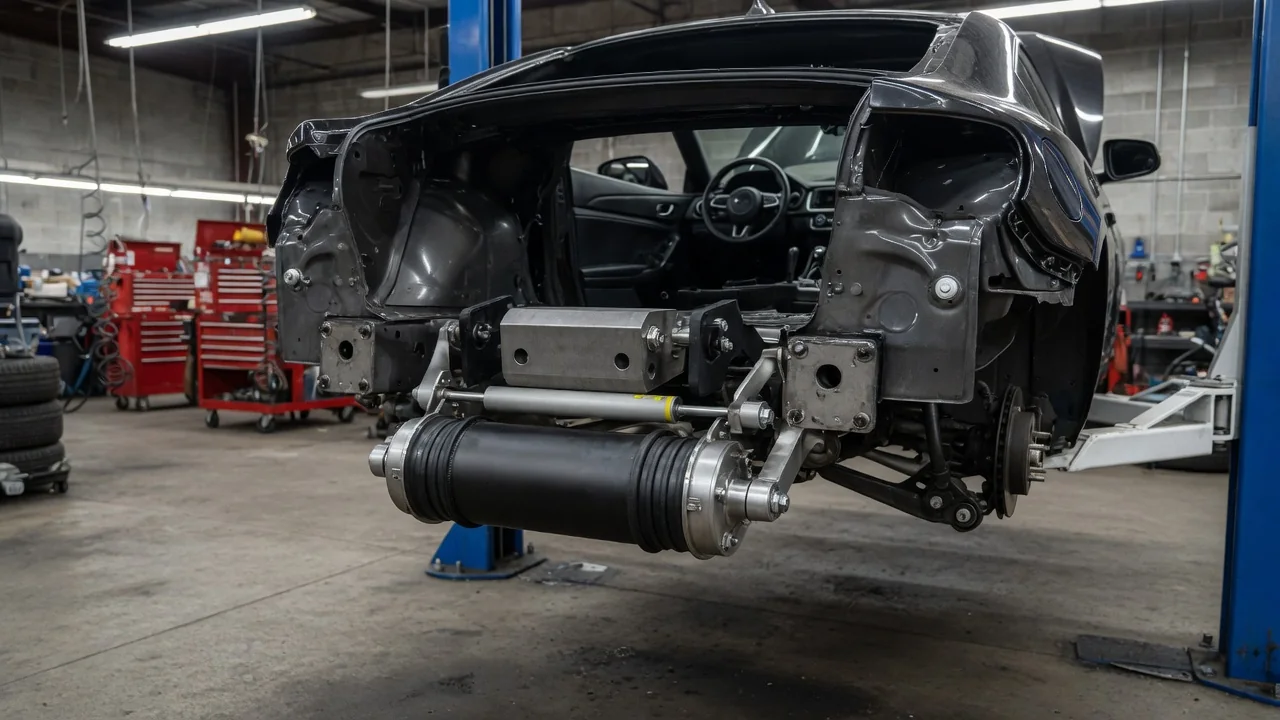
A tuned mass damper in a car is a small weight attached to a vibrating component through a spring-like element, usually rubber, and sized so it resonates at the same frequency as an unwanted vibration. Instead of stiffening the part or adding general insulation, it cancels a specific shake by moving against it. Knowing what an automotive tuned mass damper targets, how its added mass works, and where engineers place it explains some puzzling parts found on many vehicles.
Target vibration
Every structure in a vehicle has natural frequencies, which are the rates at which it tends to vibrate when disturbed. A driveshaft, a steering column, an exhaust pipe, a subframe or a large body panel each has its own set. Problems appear when a regular excitation from the engine, tires, road surface or rotating driveline lines up with one of those frequencies. At that point the part resonates, and a small input can produce a large motion that occupants feel as buzzing or shaking, or hear as a droning boom.
A tuned mass damper is aimed at one such resonance rather than at vibration in general. Engineers first identify the troublesome frequency and the location where the part moves most, typically through testing during vehicle development. The damper is then designed for that narrow band. This separates it from broadband treatments such as sound deadening mats, insulation or softer mounts, which reduce noise across a wide range but may not be enough to tame a single sharp peak. Typical targets include shimmy felt in the steering wheel at a certain road speed, a hum that appears only in a narrow engine speed range, or a boom that develops when a panel flexes like a drumhead.
Because the target is defined so precisely, the damper is a remedy for a particular combination of structure and operating condition. Change the part it is attached to, or the conditions that excite it, and the damper may no longer be addressing the right problem.
Added mass
The core of the device is a secondary mass connected to the main structure through an elastic element. In automotive use that element is commonly rubber or another elastomer, although metal springs are also possible. The combination of mass and stiffness gives the damper its own natural frequency, and designers set that frequency close to the resonance they want to suppress. A heavier mass or softer rubber lowers the tuned frequency, while a lighter mass or stiffer rubber raises it.
When the main structure vibrates at the target frequency, the attached mass oscillates too, but out of phase with the structure. Its motion pushes back on the part through the elastic link, absorbing energy and reducing the movement of the component itself. In effect, the vibration is shifted into the small mass, which can move vigorously without occupants feeling it. Internal damping in the rubber converts part of that motion into a small amount of heat, which helps keep the system from developing new sharp peaks just above and below the original frequency.
The mass is usually modest compared with the component it protects, and its effectiveness depends heavily on where it is mounted. Placing it where the structure moves the most, such as near the middle of a long shaft or at the free end of a bracket, gives the greatest effect for the least weight. That is why these dampers can look like oddly placed blocks, rings or weights that seem to serve no structural purpose.
Applications
Tuned mass dampers appear in several areas of a vehicle, although the exact use varies by design and many vehicles do not need them in every location. On driveshafts and axle shafts, a ring-shaped weight bonded to rubber may be clamped around the shaft to calm bending vibration. Steering wheels and columns sometimes carry a weight inside or behind the hub to reduce shake that drivers feel through their hands. Exhaust systems may include a damper weight on a pipe or hanger to control resonance that would otherwise travel into the body.
Other possible locations include subframes, suspension and axle components, engine or transmission brackets, and body structures such as roof panels, tailgates or seat frames, where a tuned weight can suppress a boom or buzz at a particular speed. Related designs exist for rotating parts as well. A crankshaft torsional damper, often called a harmonic balancer, uses an inertia ring on rubber to control twisting vibration of the crankshaft, applying the same principle to rotation instead of bending.
In most cases these parts are added during development to solve a problem that would be costly to fix by redesigning the structure. A small tuned weight can be lighter, cheaper and easier to package than a thicker panel, a stiffer shaft or a major change to a mount. Active systems that generate a counteracting force electronically also exist, but the passive mass on an elastic link remains the simpler and more widespread approach.
Practical implications and limits
For owners and technicians, the key point is that a tuned mass damper is part of the original vibration design. If one is removed during exhaust, driveshaft or suspension work and not reinstalled, a vibration or drone that was previously controlled can return. When a vehicle develops a new hum or shake at a specific speed after repairs, confirming that every damper weight, bracket and fastener is back in its original position is a sensible step. Replacement parts should match the design specified in the service information, because a weight of a different size or a different rubber compound will be tuned to a different frequency.
Age also affects these components. Rubber can harden, crack, swell from fluid contamination or separate from the metal mass, which shifts the tuned frequency or lets the weight rattle. A damper in that condition may stop helping or even create noise of its own. Inspecting for torn rubber, loose clamps and corrosion around the mounting is usually the practical check, since the tuning itself cannot be judged by eye.
There are also limits to what a tuned mass damper can do. It works over a narrow frequency range, so it cannot compensate for faults that cause vibration across many speeds, such as an out-of-balance tire, a bent wheel, worn joints or failed engine mounts. Modifications that change the stiffness or mass of a component, including aftermarket shafts, exhaust systems or wheels, can move a resonance away from where the original damper was tuned. Diagnosing the actual source of a vibration should come before assuming a damper is at fault or adding weights in an attempt to cure it.