What Is a Transverse Engine?
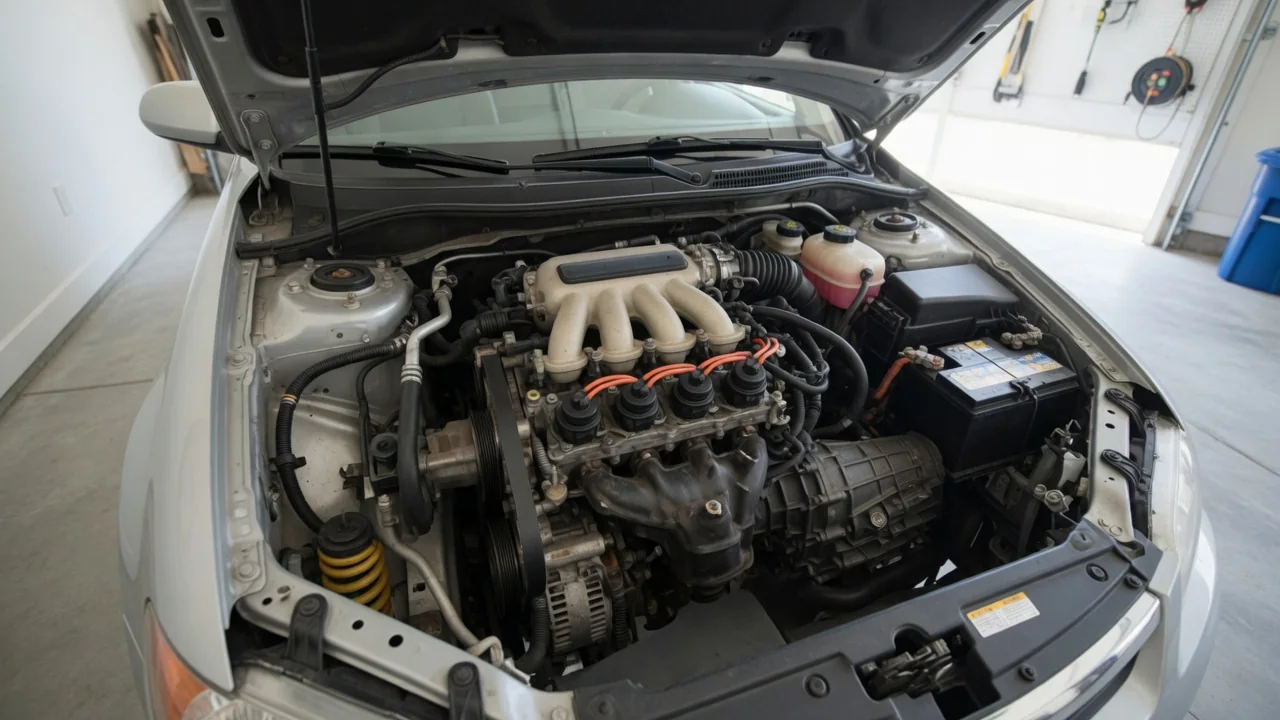
What is a transverse engine? It is an engine mounted sideways in the vehicle, with its crankshaft running across the car from left to right rather than front to back. This arrangement shapes how power reaches the wheels, how much cabin room the body can offer, and how easily components can be reached during maintenance.
Orientation
Orientation describes the direction of the crankshaft relative to the vehicle's length. In a transverse layout the crankshaft sits parallel to the axles, so the cylinders line up across the engine bay from one fender toward the other. A longitudinal engine is turned ninety degrees, with its crankshaft pointing toward the rear bumper. Opening the hood usually settles the question: if the accessory belt and pulleys face a front wheel instead of the radiator, the engine is mounted sideways.
Other visual clues support that first impression. On a transverse four-cylinder, the spark plugs or ignition coils typically form a row running side to side, and the transmission bolts onto one end of the engine near a wheel well. Plastic covers, intake ducting and battery placement can hide these landmarks, so the view differs from one model to another. V-shaped engines mounted sideways place one cylinder bank toward the radiator and the other close to the firewall, which changes what is visible.
Front-drive layouts
Transverse mounting is closely tied to front-wheel drive because the crankshaft already spins in the same plane as the front wheels. Power passes into a transaxle, a single housing that combines the transmission and differential, and then out through two half shafts to the wheel hubs. No long driveshaft is required to send torque rearward, so the whole powertrain can sit ahead of the cabin as one compact unit, which is why many small cars and crossovers use the layout.
That compactness pays off in packaging. Without a transmission tunnel carrying a driveshaft, the cabin floor can be flatter, and the shorter engine bay leaves more of the vehicle's length for passengers and cargo. All-wheel-drive versions of these vehicles usually add a power takeoff unit to the transaxle and a shaft leading to a rear differential. The half shafts are often unequal in length because the transaxle sits off center, and manufacturers handle that differently, sometimes with an intermediate shaft.
Service space
Fitting an engine and transaxle side by side between the front suspension towers fills the width of the bay, so working room tends to be tight at both ends. The belt drive and any timing components generally sit against one inner fender, leaving only a narrow gap for hands and tools. Items mounted on the back of the engine, facing the firewall, can be hard to see from above and may be easier to reach from underneath or through a wheel well.
How much this matters depends heavily on the specific vehicle. A small inline four in a wide bay can leave generous access to filters, plugs and fluid fill points, while a V6 squeezed into the same space may bury its rear cylinder bank beneath the intake manifold and cowl. Some jobs that look simple on paper involve removing surrounding parts first. The service information for the exact model shows what must come off and which tasks are better left to a trained technician.
Everyday Use and Observations
In daily driving, a sideways engine mostly shows itself through the traits of front-wheel drive. With the powertrain's weight sitting over the driven wheels, traction on wet or snowy pavement is often reassuring when pulling away. Under hard acceleration some vehicles tug gently at the steering wheel, an effect called torque steer that is linked to half-shaft geometry and suspension design. Its strength varies widely, and many modern cars keep it barely noticeable through careful engineering and electronic control.
Drivers may also notice how the engine moves on its mounts. Because a transverse engine reacts to torque by rocking forward and backward, manufacturers fit a torque strut or lower mount to restrain that motion. A worn mount can show up as a thump when shifting between drive and reverse or as extra vibration at idle, though such symptoms have other possible causes. A clicking noise in tight turns can point toward the outer joints on the half shafts and deserves a proper inspection.
Limits and Next Steps
The layout has practical limits. Engine length is restricted by the distance between the front wheels, which is why transverse installations favor compact three-cylinder, four-cylinder and narrow V6 designs rather than long inline engines. The transaxle must also fit in that width, which can constrain its size and the torque it is built to handle. Concentrating mass ahead of the front axle shifts weight forward, so vehicles aimed at balanced handling or heavy towing often use a longitudinal engine with rear-wheel drive instead.
Knowing the orientation is a starting point rather than a full description of a vehicle. Mid-engine sports cars have also placed engines sideways behind the seats, and many hybrids pair a transverse engine with electric motors inside the transaxle. For a particular car, the owner's manual and factory service information confirm the layout, the drive system and the location of maintenance items. Anyone comparing vehicles can open the hood, note which way the belts face, and ask a technician how access affects routine service.