What Is a Transmission Mechatronic Unit?
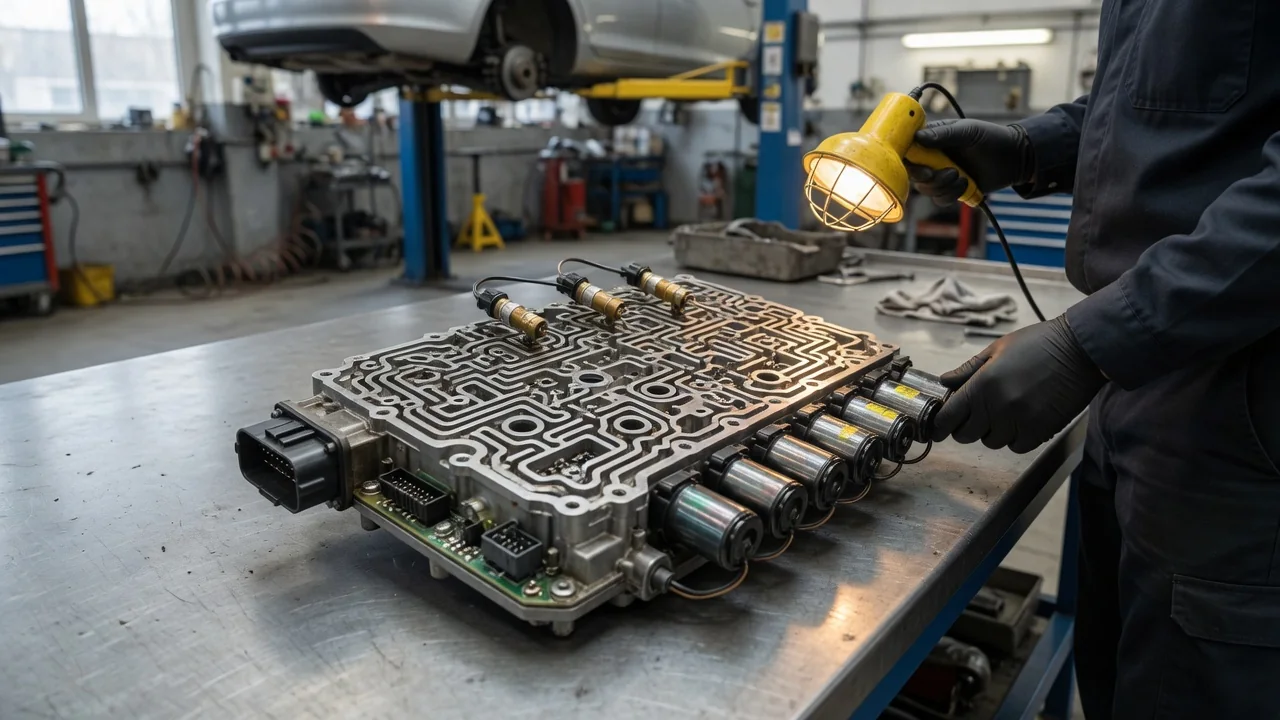
A transmission mechatronic unit is the module that combines an automatic gearbox's electronic control unit with its hydraulic valve body, solenoids, and sensors in a single assembly mounted on or inside the transmission. Instead of a separate computer wired to remote valves, a gearbox mechatronic unit keeps the decision-making electronics close to the parts that actually move fluid. Understanding how it works helps explain shift quality, fault symptoms, and why repair often involves software as well as hardware.
Electronics and hydraulics
The hydraulic side of a mechatronic unit is built around a valve body: a machined plate or casting with internal channels that route pressurized transmission fluid. A pump driven by the engine, or in some designs an auxiliary electric pump, supplies that pressure. Spool valves inside the channels direct fluid to clutches, brakes, or shift actuators, depending on the transmission type. In a conventional planetary automatic, fluid pressure engages clutch packs and brakes; in a dual-clutch gearbox it may operate the clutches and move shift forks; in many continuously variable transmissions it clamps and positions the pulleys. The common principle is that hydraulic force does the heavy mechanical work.
The electronic side consists of a control unit, often called the transmission control module, mounted directly on the hydraulic assembly. It drives solenoid valves that convert electrical signals into precise changes in fluid pressure or flow. Some solenoids act as simple on/off switches, while others are proportional or pulse-width-modulated, allowing the controller to build clutch pressure gradually rather than abruptly. Integrated sensors typically report information such as input and output shaft speed, fluid temperature, and selector position, and in some designs fluid pressure or actuator travel. Because these components share one housing, the unit is often immersed in or exposed to transmission fluid, so its circuitry must tolerate heat and vibration.
Combining both halves has engineering benefits. Short internal connections replace long wiring harnesses, reducing the number of connectors that can corrode or loosen. Manufacturers can also test and calibrate the assembled module as a unit. The trade-off is that a fault in one part may lead to replacing or reprogramming a larger, more expensive assembly than with separate components, although repair options vary by design.
Control
The mechatronic unit decides when and how to shift by combining its own sensor data with information received from other vehicle modules over the vehicle network. Inputs commonly include engine speed and torque, accelerator pedal position, vehicle speed, brake status, and the selected driving mode. The controller compares these values against stored shift maps and logic, then selects a gear and commands the solenoids accordingly. In many vehicles the transmission controller and engine controller cooperate during a shift, for example by briefly reducing engine torque so the friction elements engage smoothly.
Shift quality depends on timing as much as on gear choice. During a change, one friction element releases while another applies, and the controller manages that overlap so torque transfers without a flare in engine speed or a harsh jolt. Many units use closed-loop control: they measure how quickly shaft speeds change during engagement and adjust pressure in real time. Over repeated shifts, adaptive strategies may store correction values that compensate for clutch wear, fluid condition, and manufacturing tolerances. These learned values are one reason the same hardware can feel different after a battery disconnection, a software update, or a component replacement.
The controller also protects the drivetrain. If it detects an implausible sensor reading, excessive fluid temperature, or slipping it cannot correct, it can store diagnostic trouble codes and switch to a fallback strategy. This limp or emergency mode often restricts the transmission to a limited set of gears so the vehicle can still be moved to a safe place or a workshop. Exactly which gears remain available and how warnings appear depend on the specific transmission and manufacturer.
Service
Servicing a mechatronic unit starts with diagnosis rather than replacement. A scan tool capable of reading transmission data can retrieve stored codes, live sensor values, and adaptation status. Because similar symptoms, such as delayed engagement or rough shifts, can come from low or contaminated fluid, worn clutches, wiring faults, or the mechatronic unit itself, technicians usually check fluid level and condition and verify electrical supply and grounds before condemning the module. Service literature for the particular transmission defines the correct test procedures and specifications.
Fluid maintenance is directly relevant. Valve bodies rely on narrow passages and close-fitting spools, so debris or degraded fluid can cause sticking valves and erratic pressure control. Using the fluid type specified by the manufacturer matters because friction characteristics and viscosity affect how the controller's calibrated pressures translate into clutch behavior. Service intervals, filter arrangements, and fill procedures differ considerably among transmissions; some require a specific fluid temperature during level checks, which is often read through a diagnostic tool.
When a unit is repaired or replaced, software is part of the job. A replacement module may need coding to the vehicle, a software update, and an adaptation or relearn procedure so the controller learns clutch fill points and other characteristics. Some faults can be fixed by replacing individual solenoids, sensors, or seals, while other designs are serviced only as complete assemblies. Rebuilt and remanufactured units exist for many applications, but compatibility, calibration, and warranty terms should be confirmed for the exact transmission.
Practical implications and limits
For drivers, the main practical consequence is that transmission behavior is partly a software matter. Shift firmness, gear selection on hills, and responsiveness in different drive modes reflect calibration choices as well as hardware condition. A transmission that feels hesitant is not necessarily damaged; it may be following a conservative strategy, still relearning after service, or protecting itself from high temperature. Conversely, a smooth-feeling gearbox can still have stored faults, so warning lights and messages deserve attention rather than waiting for symptoms to worsen.
There are also limits to what general knowledge can tell you about a particular vehicle. Mechatronic units differ in layout, sensor set, serviceable parts, and programming requirements, and the same name can describe quite different hardware across manufacturers. Owner-level steps are generally limited to monitoring warnings, following the maintenance schedule, and avoiding prolonged overheating, for instance from towing beyond the vehicle's rating. Repair decisions, software procedures, and parts selection should be based on the manufacturer's documentation for the specific transmission, together with proper diagnostic equipment and data.