What Is a Transmission Dipstick?
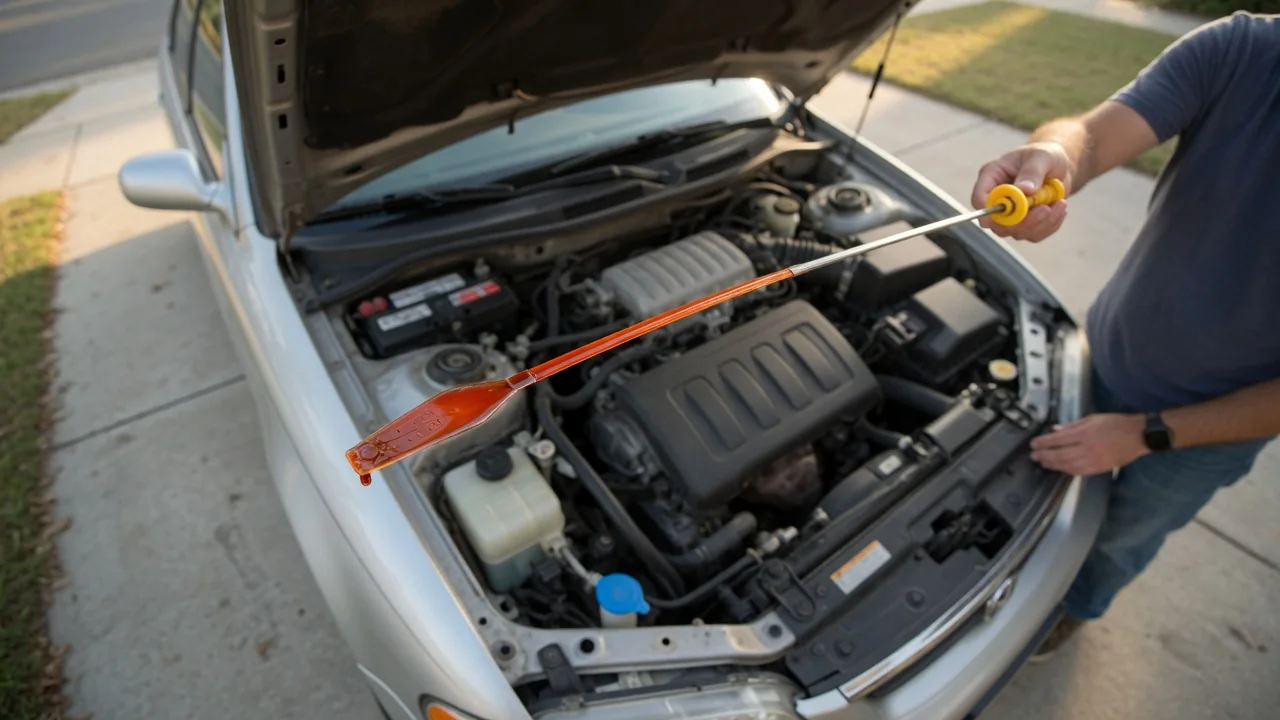
Anyone asking what is a transmission dipstick is usually looking at a long, thin metal blade under the hood and wondering what it does. It is a removable gauge that reaches into an automatic transmission so the fluid level and condition can be checked by eye. Many newer vehicles omit it entirely, using sealed designs that are checked differently.
Location
On vehicles that have one, the transmission dipstick sits in a tube that runs from the engine bay down into the transmission case. With a rear-wheel-drive layout, the handle is often found toward the back of the engine near the firewall, because the transmission sits behind the engine. With a front-wheel-drive transaxle, it tends to appear lower and off to one side, closer to where the gearbox is bolted beside the engine. The handle is frequently a different color or shape from the engine oil dipstick.
Mixing up the two dipsticks is an easy mistake, so the markings on the handle and the diagrams in the owner's manual are worth a careful look. Some handles carry a transmission symbol or wording, while others are plain. If a search of the engine bay turns up no second dipstick at all, the vehicle may have a sealed transmission, where the level is verified through a check plug or fill port on the case itself. Manual gearboxes also generally lack a dipstick and use a fill plug instead.
Proper check conditions
Transmission fluid expands as it warms, so the reading on the blade depends heavily on temperature. That is why many dipsticks carry separate cold and hot ranges, with the hot range treated as the meaningful one after a normal drive. Manufacturers commonly call for the vehicle to be parked on level ground with the engine idling, since the pump has to be running to fill the torque converter and internal passages. Checked with the engine off, the same transmission may appear overfilled.
The exact routine is not universal. Some makers specify checking in park, others in neutral, and a few want the engine switched off, so the owner's manual is the authority for a given vehicle. The usual pattern is to pull the blade, wipe it, reinsert it fully, and then read where the fluid film ends on both sides. Sealed units raise the stakes further, because their level is often set at a specific fluid temperature read through a scan tool, which is one reason they are typically left to a workshop.
Avoid contamination
The dipstick tube is a direct path into the transmission, and the valve body inside relies on small passages and closely fitted valves. A bit of grit, a thread from a shop rag, or dust knocked off the handle can travel down the tube and end up circulating with the fluid. Wiping the area around the top of the tube before pulling the blade, and using a clean lint-free cloth to wipe the blade itself, keeps that debris out of the hydraulic circuit.
Fluid type is the other contamination risk. Automatic transmissions are designed around particular fluid formulations, and continuously variable and dual-clutch units use their own distinct fluids, so topping up with the wrong product can affect shift quality and friction behavior. Any funnel used at the tube should be clean and never shared with engine oil or coolant. Seating the dipstick fully afterward matters too, since a loose handle can let moisture and dirt in and may allow fluid to escape when the transmission is hot.
Everyday Use and Observations
Beyond the level, the blade offers a quick look at fluid condition. Fresh automatic transmission fluid is commonly dyed red and looks clear and bright when wiped onto a white cloth, although some fluids use other colors. Fluid that has darkened to brown, smells burnt, or feels gritty between the fingers suggests heat or wear inside the unit. A milky or pinkish foamy appearance can point toward coolant mixing with the fluid, which deserves prompt professional attention rather than a simple top-up.
The level reading itself tells a story over time. A transmission does not consume fluid in normal operation, so a level that keeps dropping usually means a leak at a pan gasket, cooler line, or seal, and spots under the parked vehicle often confirm it. Low fluid can show up as delayed engagement, slipping, or flaring between gears. An overfull reading is not harmless either, because rotating parts can whip the excess into foam, and aerated fluid does not hold hydraulic pressure consistently.
Limits and Next Steps
A dipstick is a screening tool, not a full diagnosis. It cannot show clutch wear, internal pressure, solenoid operation, or the condition of the torque converter, and fluid that looks acceptable does not rule out a mechanical or electronic fault. Likewise, a stored transmission fault code is evidence to be interpreted alongside the fluid check and a road test, not proof that a specific part has failed. Many transmission codes are manufacturer-dependent, so their meaning needs to be confirmed for the exact vehicle.
When the level is low, the sensible next step is finding out where the fluid went before adding more, using only the fluid specified for that transmission. Burnt, contaminated, or foamy fluid, or shifting problems that persist with a correct level, call for inspection by a qualified technician. Owners of sealed transmissions should not assume the absence of a dipstick means the fluid never needs attention; the level and service requirements still exist, and the maintenance schedule for that vehicle explains how and when they are handled.