What Is a Transmission Cooler?
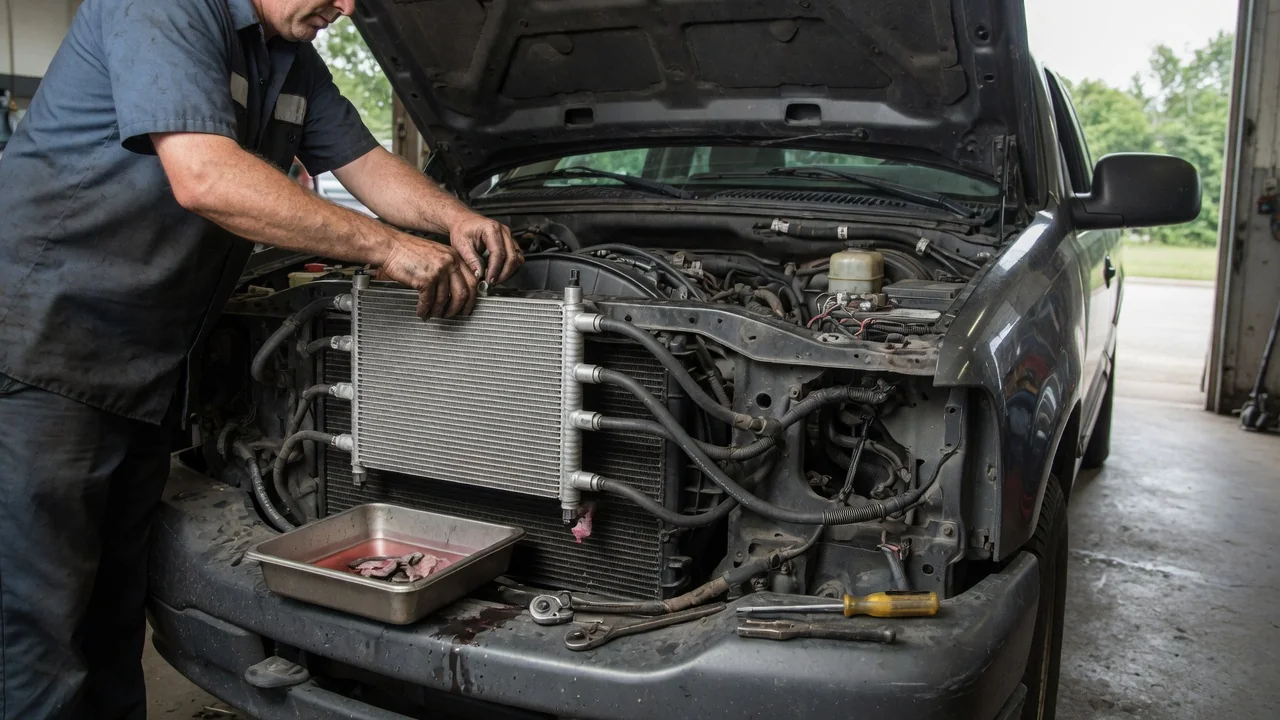
What is a transmission cooler? It is a heat exchanger that removes heat from transmission fluid before that fluid returns to the gearbox. By keeping fluid temperature in a workable range, it helps the fluid keep lubricating, transmitting hydraulic pressure and protecting clutches and seals. The design, location and capacity differ between vehicles, so the details below describe general principles rather than one model's layout.
Heat generation
An automatic transmission makes heat simply by doing its job. The torque converter couples the engine to the gearbox through moving fluid, and whenever its two halves spin at different speeds, the churning turns engine power into heat. Clutch packs and bands add more each time they slip briefly during a shift, and gears, bearings and the pump contribute friction of their own. All of that heat ends up in the fluid, which is why the fluid needs somewhere to shed it.
The amount of heat changes with how the vehicle is driven. Creeping through stop-and-go traffic, climbing a long grade, or pulling away repeatedly with a heavy load keeps the converter slipping for longer than steady highway cruising, where a lockup clutch typically reduces that slip. Continuously variable and dual-clutch transmissions create heat in different ways, through belt or chain friction or clutch engagement, and some manual gearboxes have no dedicated cooler at all. A driver rarely feels this directly; a gauge or warning message, where fitted, is the usual window.
Cooling path
The cooling path is a loop. Hot fluid leaves the transmission through a line, passes through the cooler, gives up heat, and returns through a second line to the case, where it rejoins the supply in the pan. A common arrangement places a small heat exchanger inside one tank of the engine radiator, so engine coolant carries the heat away. This layout also helps warm cold fluid after a winter start, because the coolant heats up faster than the transmission does.
Other vehicles use a separate air-cooled unit, which looks like a miniature radiator mounted ahead of the main radiator or air conditioning condenser, where airflow through the grille passes over its tubes and fins. Some combine both types in series, and some use a compact fluid-to-coolant exchanger bolted to the transmission itself, often with a thermostat that limits flow until the fluid warms. Looking behind the grille or tracing the metal and rubber lines from the transmission forward usually shows which arrangement a particular vehicle has.
Towing context
Towing is where a transmission cooler earns the most attention. A trailer adds weight and aerodynamic drag, so the engine delivers more torque for longer periods, the converter spends more time unlocked on grades, and shifts happen under heavier load. Each of these raises the heat going into the fluid faster than a system sized for light duty may remove it. Fluid that runs too hot for too long oxidizes, loses its friction properties, and can leave varnish on valves and harden seals.
For that reason, many trucks and SUVs are offered with a factory towing package that includes a larger or additional cooler, and aftermarket auxiliary units exist for vehicles without one. Whether a specific vehicle has such equipment, and how much trailer weight it is rated for, depends on the build and should be confirmed in the owner's manual or with the manufacturer's information for that exact configuration. Using a tow/haul mode, where provided, also helps by changing shift behavior so the transmission hunts between gears less often.
Everyday Use and Observations
In ordinary commuting, the cooler works silently and most drivers never think about it. Some instrument clusters include a transmission temperature gauge or a menu readout, and watching it shows a pattern: the reading climbs slowly after a cold start, settles during steady driving, and rises in heavy traffic on a hot day or on a mountain pass. What counts as a normal reading differs by design, so the manufacturer's stated range for the vehicle is the only meaningful reference.
The parts themselves give visible clues. Reddish or brownish fluid spots under the front of the vehicle, dampness at line fittings, or a cracked rubber hose section can point to a leak in the cooler circuit, and low fluid reduces cooling as well as lubrication. Bent fins or a layer of bugs and road debris on an air-cooled unit restrict airflow. Fluid that smells burnt or looks very dark on a dipstick, where the transmission has one, suggests it has seen high temperatures, though it does not identify the cause.
Limits and Next Steps
A cooler manages heat; it does not cure the source of excess heat. A slipping clutch, low fluid level, a restricted line, a failing cooling fan or an overloaded vehicle can all push temperatures up regardless of cooler size. Bigger is not automatically better either, since fluid that stays too cold in winter can shift poorly and affect efficiency, which is why some systems include a thermostatic bypass. An internal failure of a radiator-mounted cooler can also let coolant and transmission fluid mix, which needs prompt professional attention.
When a temperature warning appears, the sensible response is to ease the load, pull over safely when possible and follow the guidance in the owner's manual rather than pressing on. A stored transmission temperature fault code is evidence that a sensor reported something out of range; it does not prove which part is at fault, and code meanings can vary by manufacturer, so vehicle-specific diagnosis is needed. Adding an auxiliary cooler or changing fluid type is best decided with a qualified technician who can check the service information for that transmission.