What Is a Trailing Arm Suspension? Pivot, Wheel Path and Uses
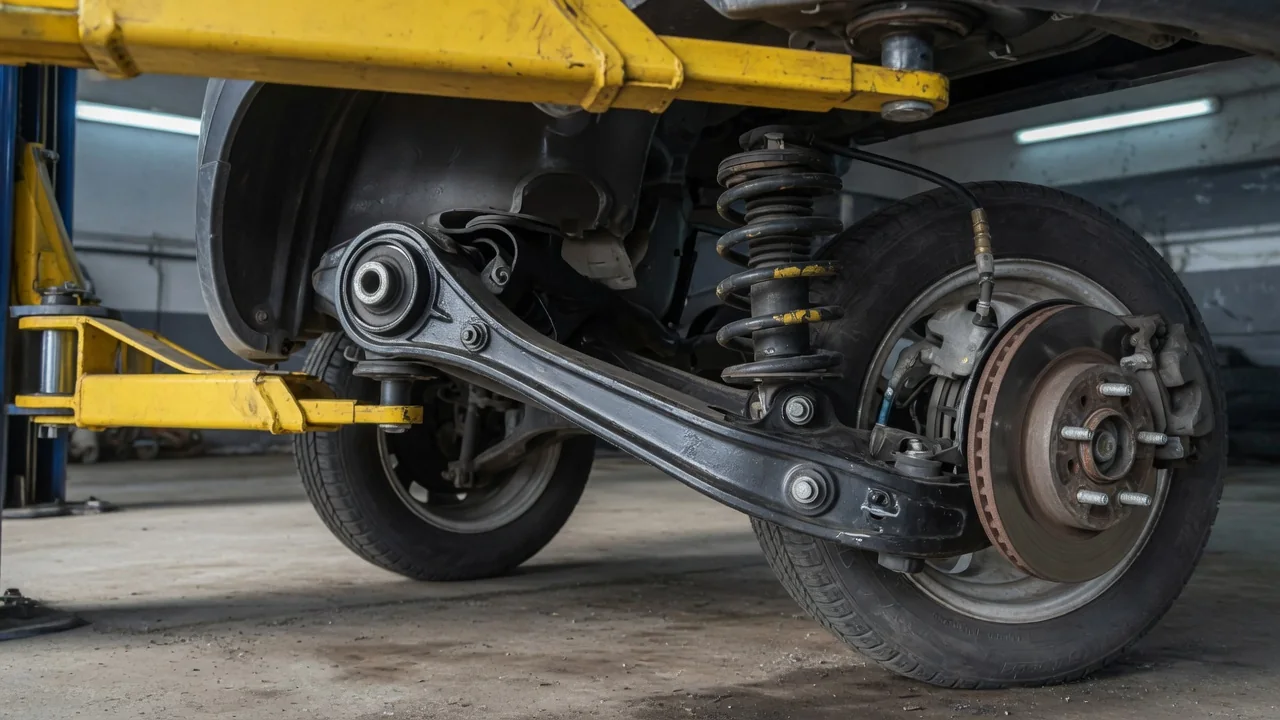
A trailing arm suspension locates a wheel with an arm that pivots on the body or a subframe ahead of the wheel and extends rearward to the wheel carrier. Because the arm trails behind its pivot, the wheel moves up and down along an arc set by that pivot. This basic car trailing arm design appears in many forms, from simple independent rear setups to beam axles, and its behavior depends heavily on which way the pivot axis points.
Pivot direction
In a pure trailing arm, the pivot axis runs straight across the car, perpendicular to the vehicle centerline and parallel to the ground. The arm therefore swings in a vertical plane that lines up with the direction of travel, much like a door hinged along a transverse line. Its mounting bushings sit forward of the wheel, and the arm reaches back to carry the hub, either as a separate forged or stamped part or as part of a larger assembly.
A semi-trailing arm uses the same basic idea but angles the pivot axis in plan view, and sometimes in rear view as well. The arm then swings in a plane that is neither purely longitudinal nor purely transverse, so its motion falls between that of a pure trailing arm and a swing axle. A leading arm is the reverse arrangement: the pivot sits behind the wheel and the arm extends forward. The terminology describes geometry, not a single standardized part.
Pivot direction matters because the pivot axis is the line the wheel rotates around as the suspension moves. Its angle determines how much the wheel tilts or steers during travel, while its height relative to the wheel center influences how braking and acceleration forces push the body up or down. Engineers choose the pivot location to balance these effects against packaging, cost and comfort targets for a particular vehicle.
Wheel path
With a pure trailing arm, the wheel center follows an arc in side view centered on the pivot. Because the arm swings only in a longitudinal plane, the track width stays constant, and camber and toe remain unchanged relative to the body as the wheel moves through bump and rebound. The wheel does shift slightly forward or backward as it travels; how much depends on the arm length and the angle the arm sits at when the car is at normal ride height.
The trade-off appears when the body rolls in a corner. Since the wheel's camber is fixed relative to the body, the wheels lean with the body, and the heavily loaded outside tire tilts away from its ideal contact with the road. A semi-trailing arm addresses this by building camber change into the wheel path, typically adding negative camber as the wheel moves up. The angled pivot also produces toe change during travel, which can cause roll steer, so designers tune the pivot angles carefully to keep that effect predictable.
The theoretical arc is only part of the story. Rubber bushings at the pivot deflect under cornering, braking and acceleration loads, adding small amounts of camber and toe movement that rigid geometry alone would not predict. Some designs deliberately use bushing stiffness and orientation to steer the rear wheels slightly in a stabilizing direction under load, while others try to minimize that compliance. Either way, the real wheel path reflects both the arm geometry and the behavior of its mounts.
Uses
Trailing arms are most often found at the rear of a vehicle, where their compact layout is a major advantage. Because the arms run lengthwise and take up little lateral space, they leave room between the wheels for a low cargo floor, a spare tire well, a fuel tank or an exhaust system. Springs and dampers can be mounted in several positions along the arm, which gives designers flexibility in fitting the suspension around the body structure.
The twist-beam or torsion-beam rear axle, widely used on front-wheel-drive cars, is essentially two trailing arms joined by a cross member that twists when one wheel moves relative to the other. This makes it a semi-independent system rather than a fully independent one. Semi-trailing arms have been used for independent rear suspension on rear-wheel-drive vehicles because the arms can carry the hub while halfshafts pass to the wheels. Many multi-link rear suspensions also include a trailing arm or trailing link that handles fore-aft forces while separate lateral links control camber and toe.
The same principle extends beyond passenger cars. Trucks and off-road vehicles with solid axles often locate the axle with trailing links, frequently in a four-link arrangement. Many trailers use trailing arm or torsion arm suspensions for their simplicity, and a motorcycle swingarm is a trailing arm in concept, pivoting ahead of the rear wheel and swinging in a longitudinal plane.
Practical implications and limits
For owners, the pivot bushings are usually the parts that need attention first. Worn or cracked bushings can show up as clunking over bumps, a vague or shifting feel from the rear during lane changes or braking, and irregular tire wear. A trailing arm bent by a curb strike or impact can change wheel alignment even if the car still looks normal. Many simple trailing arm setups offer little or no camber and toe adjustment, so correcting alignment may require replacing parts rather than turning an adjuster. Service procedures commonly call for tightening pivot bolts with the suspension at normal ride height so the bushings are not preloaded in a twisted position; the vehicle's own repair manual should be followed for exact specifications.
Modifications interact with the geometry in ways that are easy to overlook. Lowering springs or lift kits change the arm's angle at ride height, which alters how far the wheel moves fore and aft during travel and shifts how the body responds to braking and acceleration forces. On semi-trailing designs, a change in ride height can also change static camber and toe, which may affect tire wear and stability. Stiffer aftermarket bushings reduce compliance but can increase noise and harshness and may remove intended toe behavior under load.
Finally, the label trailing arm covers a wide range of hardware, and no single description predicts how a given car will ride or handle. Real behavior depends on the full combination of pivot geometry, bushing design, springs, dampers, anti-roll bars and tire characteristics chosen by the manufacturer. General principles explain why a design moves the way it does, but diagnosing a specific vehicle requires its own specifications and service information.