What Is a Trailer Breakaway System?
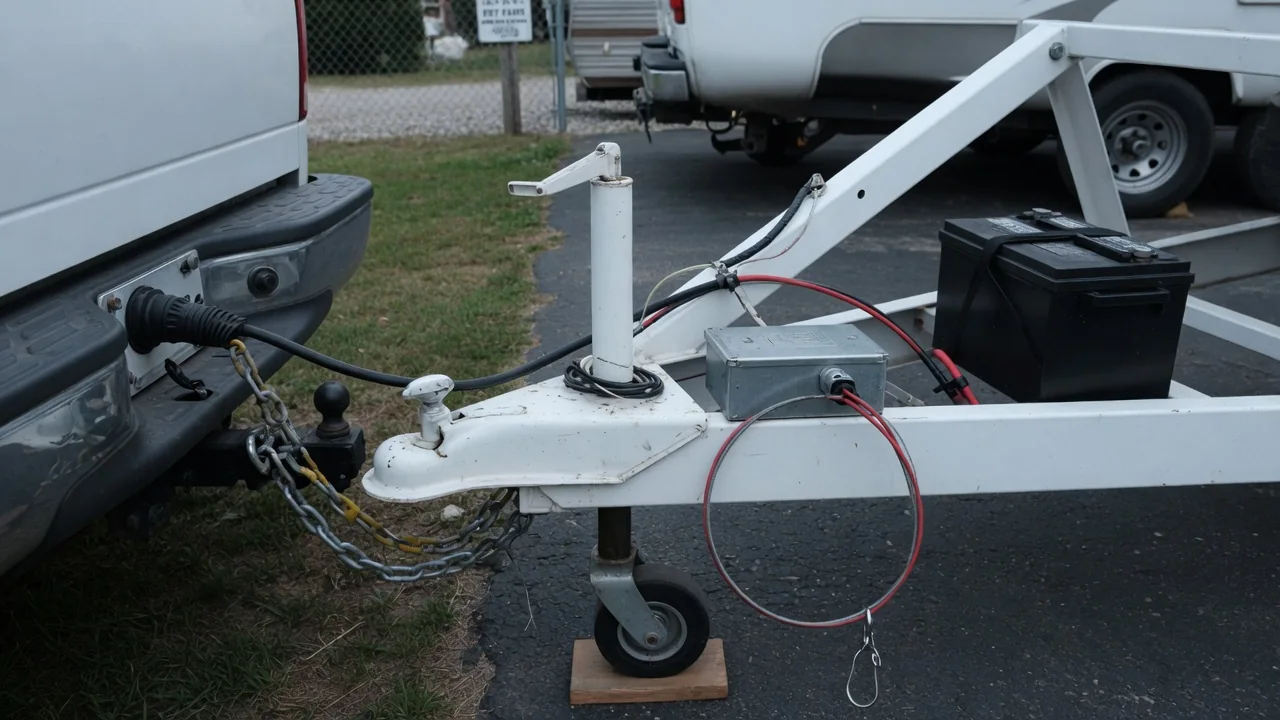
Anyone asking what is a trailer breakaway system is really asking how a trailer stops itself if it ever separates from the tow vehicle. The answer is a small emergency circuit that applies the trailer's own brakes the moment the coupling fails, slowing the runaway trailer instead of letting it roll freely into traffic.
Cable and battery
On a trailer with electric brakes, the system has three main parts: a switch mounted near the tongue, a cable or lanyard running from that switch to the tow vehicle, and a small battery carried on the trailer. The switch contains a removable pin attached to the cable. As long as the pin stays seated, the circuit is open and the battery simply waits. If the trailer separates and moves away from the vehicle, the cable pulls the pin and the switch closes.
Once the switch closes, the onboard battery feeds current directly to the brake magnets, applying the trailer brakes without any signal from the tow vehicle or its brake controller. That independence is the whole point, because the wiring plug has usually pulled apart by then. Battery arrangements vary: some trailers use a small dedicated sealed battery in a box on the frame, while campers may draw from a larger house battery. Trailers with hydraulic surge brakes use a different approach, typically a cable or chain that mechanically pulls a lever on the actuator.
Pre-trip check
A walkaround before towing should include the breakaway hardware along with the lights, coupler, and safety chains. Look at the cable for fraying, kinks, or corrosion, and confirm the pin is fully seated in the switch. The cable should attach to a solid point on the tow vehicle, and many manufacturers and jurisdictions want it connected separately from the safety chains rather than looped over the hitch ball. It needs enough slack to allow tight turns, yet it should pull the pin before the chains reach their full length.
Battery condition matters just as much as the cable. Many breakaway kits include a test button or indicator lights on the battery box that show state of charge, and others need a voltmeter reading at the terminals. Some trailers recharge the battery through the tow vehicle's charge line in the connector, but not every vehicle supplies that circuit by default, so a battery can slowly go flat even on a rig that is towed regularly. The trailer's manual explains which check applies to the equipment actually installed.
Service need
Breakaway components sit low on the tongue, exposed to road spray, salt, and sunlight, so they age even when the trailer is parked. A battery that no longer holds a charge is the usual weak point, because it may show acceptable voltage at rest and still sag when asked to power several brake magnets at once. Switches can also corrode internally, either failing to close when the pin comes out or sticking closed. A cracked switch housing, a stiff or rusted pin, or green deposits on terminals all justify closer inspection.
A functional test confirms more than a visual check can, and a trailer shop can perform one safely by pulling the pin with the trailer unplugged and verifying that the wheels resist turning. The pin should not stay out longer than needed, since continuous current drains the battery and heats the brake magnets. Wiring between the switch, battery, and brakes deserves attention too, particularly splices and ground connections. Replacement intervals and test methods differ by kit maker, so the documentation for the specific system is the right guide.
Everyday Use and Observations
In normal towing the system does nothing at all, which is exactly how it should behave. The driver brakes with the pedal, the controller in the cab sends proportional power to the trailer, and the breakaway battery stays in reserve. The only daily interaction is clipping the cable to the tow vehicle when hitching up and unclipping it when dropping the trailer. Because it is so passive, it is easy to forget, and a cable left dangling or dragging on the pavement can wear through without anyone noticing.
A few signs suggest the system is active when it should not be. A trailer that drags, resists rolling, or has unusually hot hubs after a short drive may have a partly pulled pin or a shorted switch feeding the brakes constantly. A breakaway battery that is repeatedly dead points to a charging problem or a parasitic drain. It is also worth knowing that the pin is not a parking brake; using it to hold a parked trailer runs the battery down and leaves nothing for an actual emergency.
Limits and Next Steps
A breakaway system is a last line of defense, not a substitute for a properly matched hitch, a latched and pinned coupler, and crossed safety chains. Its stopping power is limited by battery charge, brake adjustment, and the condition of the magnets and drums, and it can only hold the brakes on for as long as the battery lasts. A fully applied trailer brake on a loose trailer may lock the wheels, so the result is a controlled stop at best, not a graceful one.
Legal requirements depend on where the trailer is registered and driven. Many states require breakaway protection once a trailer exceeds a certain weight, but the thresholds and details differ, so local regulations and the trailer's weight rating should be checked together. Owners who are unsure whether their trailer has a working system, or who have bought a used trailer with unknown history, are best served by having a qualified trailer technician inspect and test it before the next loaded trip.