What Is a Traction Motor in an EV? Rotor, Stator, Torque and Cooling
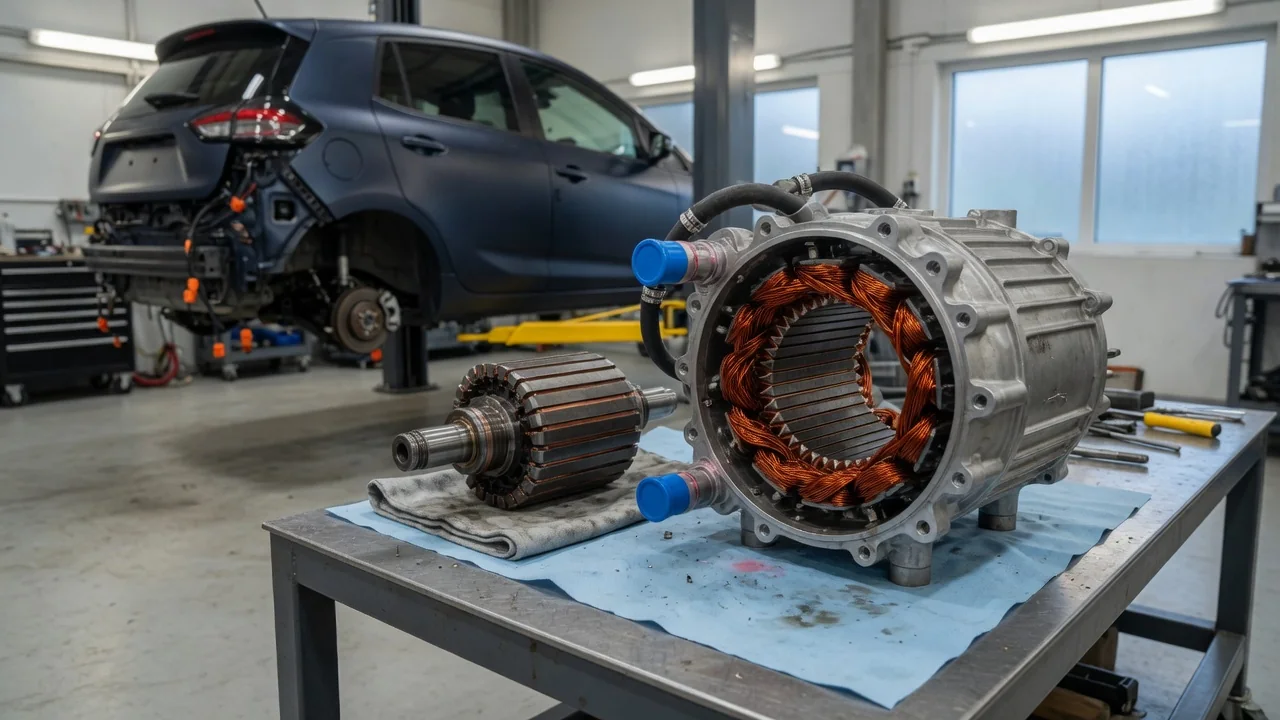
A traction motor is the electric machine that actually moves an EV. It converts electrical energy from the high-voltage battery, delivered through an inverter, into the rotating force that turns the wheels through a reduction gear. If you have wondered what a traction motor in an EV is and how it differs from the many smaller motors in a car, the answer comes down to three things: how its rotor and stator interact, how it produces drive torque, and how it stays cool under load.
Rotor and stator
The stator is the stationary outer part of the traction motor. It is built from thin, insulated steel laminations stacked into a ring, with slots that hold copper windings. Most EV traction motors use three-phase windings. The inverter switches the battery's direct current into three-phase alternating current, and when those phase currents flow through the windings in sequence, they create a magnetic field that rotates around the inside of the stator. Laminating the core rather than using solid steel reduces eddy currents, which would otherwise waste energy as heat. Some designs use round wire, while others use rectangular hairpin conductors that pack more copper into each slot.
The rotor sits inside the stator, separated by a small air gap, and is fixed to an output shaft supported by bearings. How it responds to the rotating field depends on the motor type. In a permanent magnet synchronous motor, magnets mounted on or embedded in the rotor lock onto the stator field and turn at the same speed. In an induction motor, the rotor carries conductive bars, and the moving field induces currents in them; the rotor turns slightly slower than the field, and that difference, called slip, is what creates force. Other designs use a rotor with its own electrically excited field winding, or rely on magnetic reluctance, where the rotor's shape pulls it into alignment with the field.
Because the inverter must know where the rotor is to apply current at the right moment, synchronous traction motors typically include a position sensor such as a resolver on the shaft. The inverter and reduction gear are often closely integrated with the motor, but they remain separate components with their own roles.
Drive torque
Drive torque is the twisting force the motor delivers to its shaft. It comes from the interaction between the stator's rotating magnetic field and the rotor's magnetic field, and within the motor's limits it rises with the current supplied to the windings. The inverter controls torque by adjusting the amplitude and timing of the phase currents thousands of times per second, a method commonly called field-oriented or vector control. When the driver presses the accelerator, the vehicle's control unit translates pedal position into a torque request, and the inverter shapes the current to meet it.
An electric motor can produce strong torque from a standstill, which is why EVs often feel responsive when pulling away. That torque stays roughly constant up to a point often called base speed. Above it, the voltage the spinning motor generates, known as back electromotive force, approaches what the inverter can supply. The controller then weakens the effective magnetic field so the motor can keep spinning faster, and available torque falls while power stays roughly level. This is why acceleration tends to taper at higher road speeds.
Most EVs send motor torque through a fixed reduction gear rather than a multi-speed transmission, multiplying torque at the wheels and letting the motor run at high shaft speeds. The same machine also works in reverse: during regenerative braking the inverter commands negative torque, the motor acts as a generator, and kinetic energy returns to the battery. How much regenerative torque is available depends on the battery's state of charge and temperature, as well as the vehicle's calibration.
Cooling
No motor is perfectly efficient, and every loss becomes heat. Current flowing through the copper windings produces resistive losses that grow with the square of the current, so high torque means high heat. The steel core loses energy through hysteresis and eddy currents, and these losses increase with the frequency of the magnetic field, which rises with motor speed. Bearing friction and air drag inside the housing add more. Even though traction motors convert most of their electrical input into motion, the heat generated during hard driving is substantial.
Temperature matters for several reasons. Winding insulation ages faster when it runs hot, copper resistance increases with temperature and raises losses further, and permanent magnets can lose some of their strength, potentially permanently, if they exceed their temperature limit. To manage this, many traction motors use a liquid cooling jacket around the stator, connected to the vehicle's coolant circuit and thermal management system. Others spray or circulate oil directly over the windings, sometimes sharing oil with the reduction gear, and some designs route coolant or oil through a hollow rotor shaft.
Temperature sensors in the windings, together with software models that estimate rotor temperature, let the control system protect the motor. If temperatures climb toward their limits, the controller reduces the available current, and therefore torque and power, until the motor cools. Depending on the thermal system design, waste heat from the motor may also be put to use elsewhere in the vehicle.
Practical implications and limits
Traction motors are usually described with a peak rating and a lower continuous rating. Peak output is available for short bursts, while continuous output is what the motor and inverter can sustain without overheating. In everyday driving this distinction rarely shows, but repeated full-throttle runs, sustained climbs while towing, track sessions or very hot weather can push components toward their thermal limits. When that happens, the vehicle may limit power and display a message. Exactly when and how this occurs varies by vehicle, so the owner's manual is the right reference.
From an ownership standpoint, the motor itself has few parts that wear in normal use. Bearings and seals are the main mechanical wear items, and the supporting systems need attention: coolant, and in many designs gear or motor oil, should be checked or replaced on the schedule the manufacturer specifies. A new whine, grinding noise, vibration or a drive-system warning deserves professional diagnosis. Traction motors and inverters operate at high voltage, so inspection and repair should be left to technicians trained and equipped for high-voltage work.
It is also worth recognizing the limits of a general explanation. Electric car traction motors differ in rotor type, winding design, cooling method, number of motors and calibration, and some vehicles use different motor types on the front and rear axles. Motor ratings alone do not determine range or real-world performance, which also depend on the battery, inverter, gearing, weight, aerodynamics and software. For specific figures, service intervals or fault interpretation, rely on the manufacturer's documentation for your vehicle.