What Is a Tire Uniformity Test? Force Variation, Vibration and Manufacturing
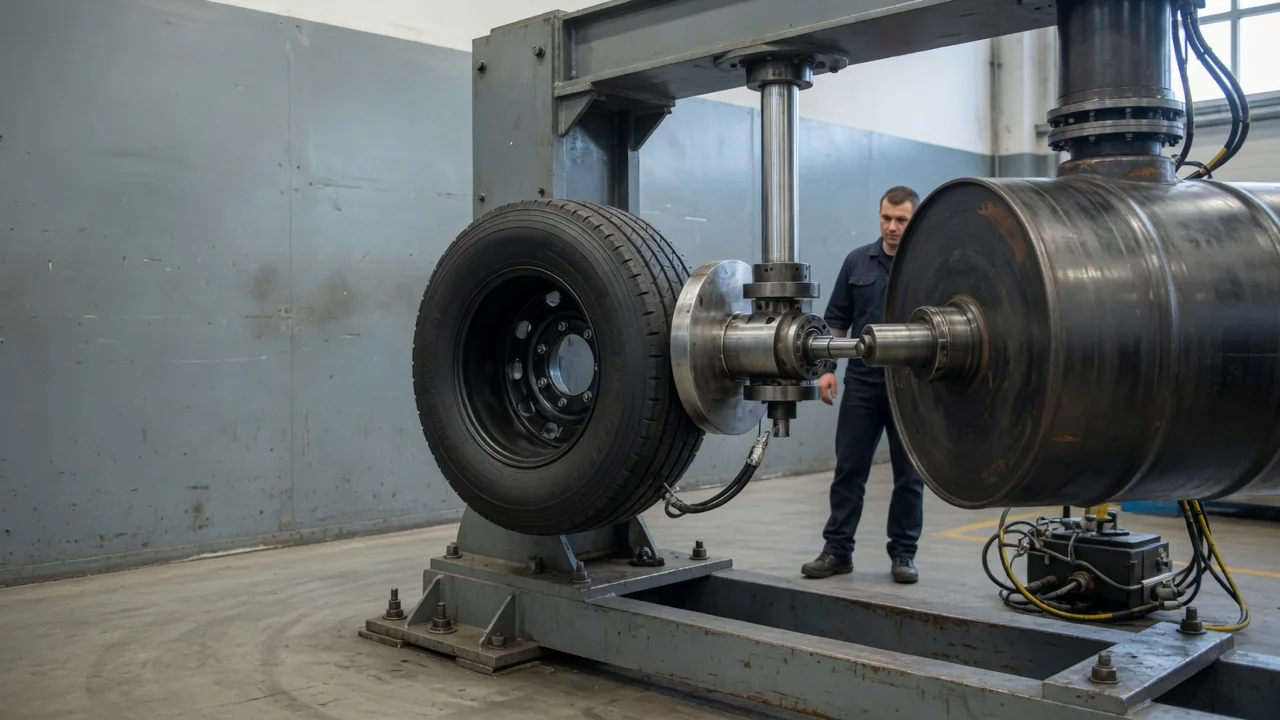
A tire uniformity test checks how consistently a tire behaves as it rolls through one full revolution. Even a well-made tire is never perfectly round, equally stiff all the way around, or perfectly symmetrical, and those small irregularities can push and pull on the vehicle as the wheel turns. Tire uniformity measurement captures these effects as forces and dimensions. Manufacturers use it to sort, correct, or reject tires, and technicians use related methods to trace vibrations that ordinary wheel balancing cannot explain.
Force variation: what the test measures
In a typical uniformity test, the tire is mounted on a precision test rim, inflated to a specified pressure, and pressed against a large rotating drum, often called a load wheel, under a controlled load. The tire is then rotated while load cells record the forces passing between the tire and the drum at many points around its circumference. Because the distance between the rim center and the drum is usually held fixed, any change in the tire's effective radius or local stiffness appears as a change in force rather than as movement. The result is a force trace for one revolution of the tire.
Several force components are evaluated. Radial force variation is the fluctuation in the vertical force pushing up and down on the axle. Lateral force variation is the fluctuation in the sideways force acting along the axle. Tangential, or fore-aft, force variation acts in the direction of travel and becomes more significant at higher speeds, so it is generally measured on specialized high-speed machines. Results are commonly reported as peak-to-peak values and broken into harmonics. The first harmonic, the component that repeats once per revolution, is usually the most important because it behaves like the tire having one high spot and one low spot.
The test also looks at the steady sideways force a tire produces while rolling straight. Part of that force comes from conicity, which acts as if the tire were shaped slightly like a cone, and part comes from ply steer, which results from the angled construction of the belts and changes direction when the rolling direction is reversed. Machines separate the two by running the tire in both directions. Many systems also measure geometry with sensors, including radial runout, lateral runout, and sidewall bulges or depressions.
Vibration: how nonuniformity reaches the driver
A tire with significant force variation delivers a repeating push into the suspension every time it rotates, so the frequency of that input rises with road speed. When it lines up with a natural resonance of the suspension, steering system, or body, the effect is amplified and can be felt as a steering wheel shake, a vibration through the seat or floor, or a rhythmic hop. Radial force variation tends to produce vertical shake, lateral force variation can contribute to side-to-side wobble, and tangential force variation can show up as a fore-aft surge. Excessive conicity is a recognized cause of a vehicle pulling to one side, one that may change sides when the tires are moved.
Uniformity is different from balance. Imbalance comes from uneven mass distribution, and its force grows with rotational speed, which is why it can be detected by spinning the wheel freely on a balancer. Force variation comes from the tire's shape and stiffness under load, so it exists only when the tire is pressed against a surface. A perfectly balanced tire can still vibrate if its radial force variation is high. That is why some service equipment presses a roller against the tire during balancing to estimate loaded radial force variation and runout.
How much a given level of nonuniformity matters depends heavily on the vehicle. Suspension design, steering sensitivity, unsprung mass, and typical driving speeds all affect whether the same tire feels smooth on one car and noticeable on another. Wheel runout and how the tire is mounted add their own variation to the final assembly.
Manufacturing: where nonuniformity comes from and how it is managed
A modern radial tire is assembled from many components, including the inner liner, body plies, beads, steel belts, cap plies, sidewalls, and tread. Each one has a splice or overlap where its ends meet, and each must be placed accurately on the building drum. Small differences in component thickness, splice location, belt placement, or bead position create local variations in stiffness and radius. The curing process can add more through mold condition, uneven heating, or how the green tire seats in the mold. The tire's final uniformity reflects how these small effects add up or cancel around the circumference.
Uniformity machines are commonly placed at the end of passenger and light truck tire production lines. Measured results are compared with limits set by the tire maker and, for original equipment tires, often by requirements agreed with the vehicle manufacturer. Tires that meet the limits are graded and shipped. Some tires that fall outside the limits can be corrected by grinding small amounts of rubber from the tread shoulders or center, then retested. Tires that still fail may be downgraded or scrapped. Test data can also be fed back to the building and curing stages to help identify recurring process problems.
Many manufacturers mark the sidewall with a colored dot or other symbol to indicate a uniformity high point, such as the location of maximum first harmonic radial force or runout. This allows the tire's high point to be aligned with the wheel's low point during installation, a practice called match mounting, which can reduce the variation of the complete assembly. Mark colors and meanings are not universal, however. Some marks indicate a weight-related location rather than a uniformity point, so the specific manufacturer's convention should be confirmed.
Practical implications and limits
For most car owners, a uniformity test is not a routine service item, and factory measurements are generally not provided with the tire. It becomes relevant when a vibration remains after careful balancing. A technician may then check wheel and tire runout, use loaded-roller equipment if it is available, rotate the tire on the rim to match mount it, or swap wheel positions to see whether the symptom follows a particular tire. Whether a tire with excessive force variation is replaced is decided by the seller's or manufacturer's warranty process, not by a single shop reading.
Factory results also have limits. They are taken on a precision rim at a standardized pressure, load, and speed, while a tire on a vehicle sits on a production wheel with its own runout, hub fit, and bead seating. A low-speed test may not fully predict behavior at highway speed. A tire's uniformity can also change during service. Temporary flat spots after a car has been parked can create a vibration that usually fades as the tires warm up, while irregular wear, impact damage, or internal structural problems can create new nonuniformity that did not exist when the tire left the factory.
Uniformity therefore describes one specific property: how evenly a tire pushes against the road during each revolution. It works alongside wheel balance, alignment, and tire condition rather than replacing them, and diagnosing a real vibration usually means considering all of them together on the specific vehicle.