What Is a Timing Chain Guide? Purpose, Wear, and Noise
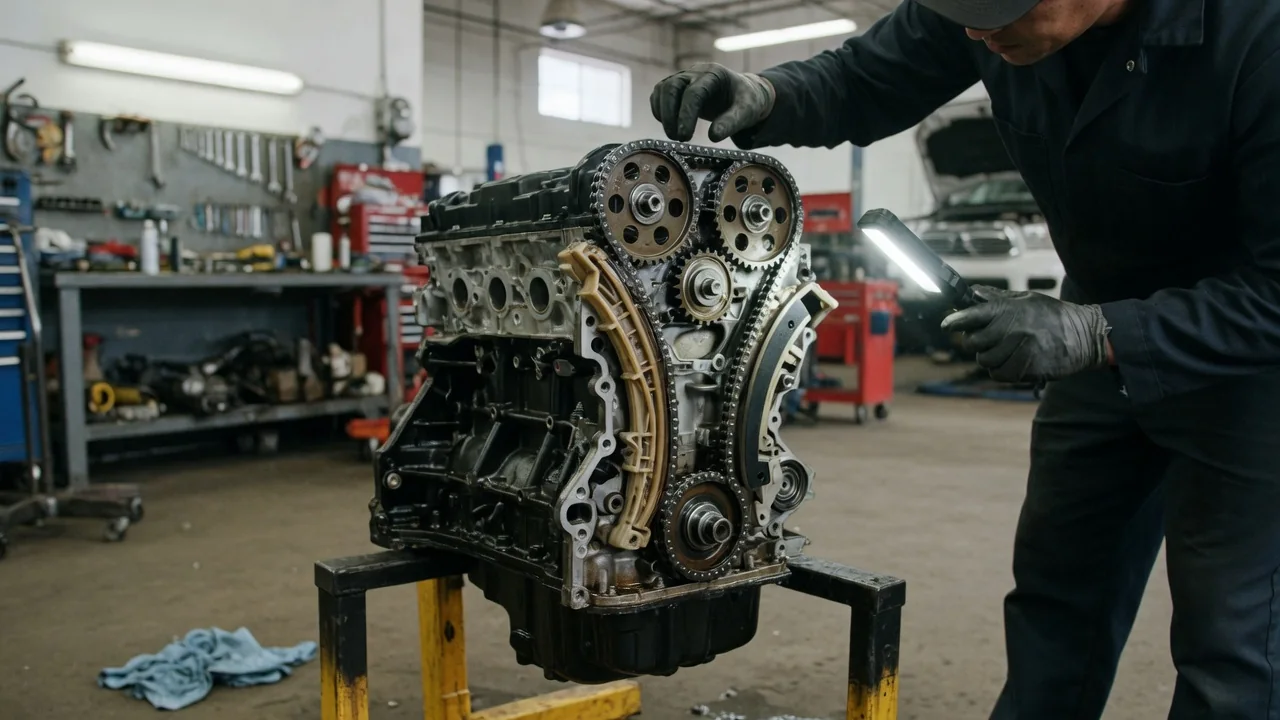
A timing chain guide is a fixed or pivoting rail that steers the timing chain along its route between the crankshaft and camshaft sprockets. Its purpose is to keep the chain from whipping, rubbing other parts, or jumping teeth, so the valves stay in sync with the pistons. Guides sit behind the timing cover and get little attention until they wear. This article explains how a guide shapes the chain path, how it wears, and which noises suggest trouble.
Chain path
In a chain-driven engine, the crankshaft sprocket pulls the chain, and the chain turns one or more camshaft sprockets in the cylinder head. The chain runs over fairly long spans, so it needs support. On the side the crankshaft pulls tight, a fixed guide usually sits close to the chain and limits side-to-side movement. On the slack side, a movable guide, often called the tensioner arm or tensioner shoe, pivots on a pin while a tensioner presses it into the chain. Together these parts hold the chain to a controlled path instead of letting it flap freely.
Most guides have a hard, low-friction plastic wear face, sometimes molded over or clipped onto a metal or reinforced backing. The chain slides directly against this face, lubricated by engine oil that is sprayed or dripped onto the drive. The guide's curve is deliberate. It spreads contact over a length of chain and keeps the links approaching each sprocket at a consistent angle, which helps the chain seat cleanly on the teeth.
Layouts vary widely. An engine with overhead cams in a single cylinder head may use one fixed guide and one tensioner arm. V-type and dual-overhead-cam designs can have several chains, intermediate sprockets, and multiple guides, including short guides between camshafts. The number, shape, and material of the guides depend on the engine, so the service manual or parts catalog for that engine is the reliable reference for its layout.
Wear
A guide is designed to wear. The chain slides across its face constantly, so the surface slowly develops shallow grooves where the link plates ride. With clean oil at the correct level, normal wear is gradual. Wear speeds up when lubrication is poor, when the oil is degraded or contaminated, or when the chain itself has elongated. On a stretched chain, the pins and bushings have worn enough to increase its effective length. The tensioner then has to extend further, and the chain can load the guides differently.
Plastic guides also age through repeated heat cycles. Over time the material can harden and turn brittle, and sections may crack or break off. Broken pieces can fall into the oil pan, collect on the oil pickup screen, and restrict oil flow. A badly worn or broken guide also lets the chain touch parts it was never meant to touch, such as the timing cover, the cylinder head, or the guide's own metal backing, and these contact points may show visible gouges.
Guide wear rarely happens on its own. The chain, sprockets, tensioner, and guides work as a system, so wear in one part often reflects or causes wear in another. For that reason, timing chain service commonly includes inspecting or replacing the guides, tensioner, and chain together rather than a single part. Whether that is necessary on a given engine depends on its condition and on the manufacturer's procedure.
Noise
Noise is often the first sign that the guides or related parts need attention. Owners commonly describe a rattle or slapping sound from the timing end of the engine. It is sometimes most noticeable for a few seconds after a cold start. On engines with a hydraulic tensioner, oil pressure helps hold the tensioner arm against the chain. Until that pressure builds, a worn system may leave enough slack for the chain to slap against the guides or the cover.
Some noises can indicate more advanced wear, such as a chain riding on a guide's metal backing or a missing guide section. These include noise that continues after warm-up, noise that changes with engine speed, and sounds like scraping or grinding. A whine can come from a chain under abnormal tension, although whining has many possible sources. Some engines also store timing-related fault codes, such as camshaft and crankshaft position correlation codes, when the chain has stretched or jumped far enough to shift cam timing.
Sound alone cannot confirm a guide problem. Valve lifters, fuel injectors, loose heat shields, accessory drive components, and exhaust leaks can all make noises that are easy to mistake for timing chain rattle. Narrowing down the cause typically takes a mechanic's stethoscope, a scan tool reading of cam timing data, and a physical inspection.
Practical implications and limits
Oil maintenance is the owner's biggest practical influence on guide life. That means using the oil type specified for the engine, changing it on schedule or sooner under severe operating conditions, and keeping the level correct. These habits do not guarantee long guide life, but they support the lubrication and tensioner function the guides depend on. Ignoring a new noise from the timing area is risky, because progressive wear can eventually let the chain skip teeth. On an interference engine, where valves and pistons occupy the same space at different moments, a skipped or failed chain can cause internal damage.
General guidance has limits. Some engines have documented design updates or revised guide parts, while others rarely need guide service, and these differences should be checked in the manufacturer's service information for the exact engine code. Access also varies. On some engines a guide can be partly inspected by removing a valve cover, while others require removing the timing cover. Replacement usually involves locking the engine at a timing reference, and mistakes can upset valve timing, so the procedure for the specific engine should be followed closely.