What Is a Timing Belt Tensioner? Function, Alignment and Failure Clues
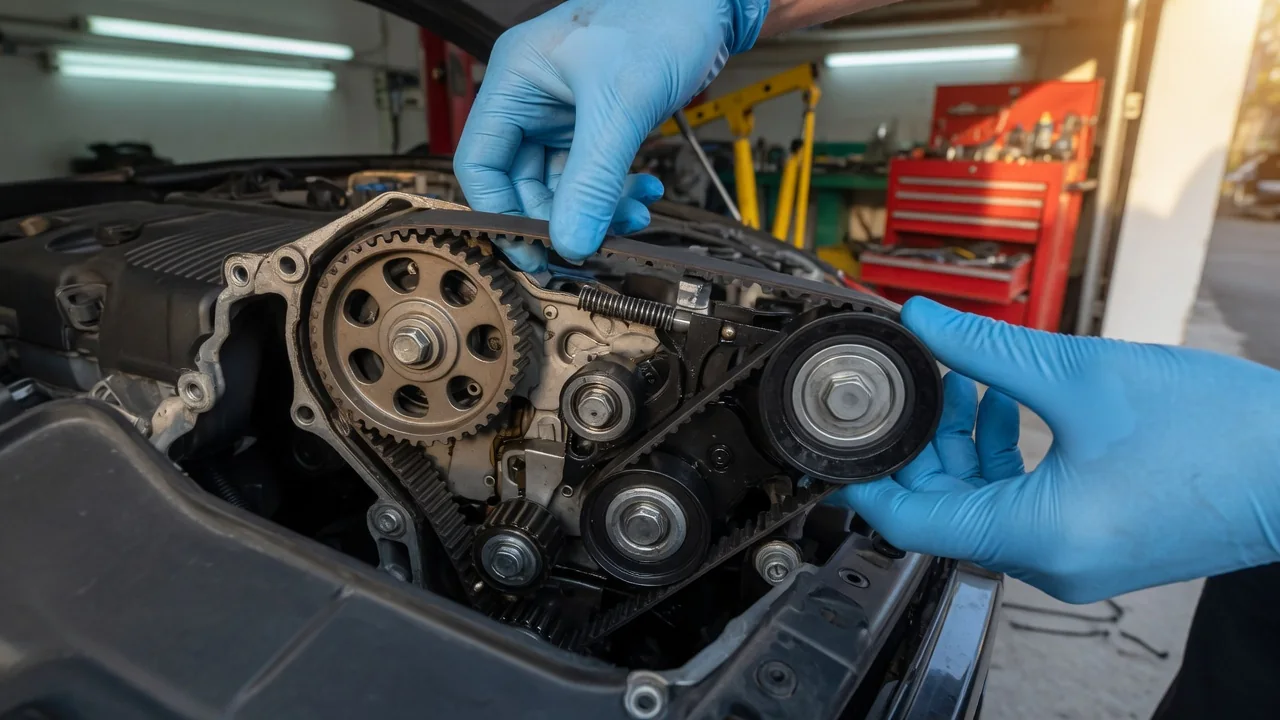
A timing belt tensioner is the component that keeps an engine's timing belt at the correct tightness while the engine runs. The belt links the crankshaft to the camshaft or camshafts, so the valves open and close in step with the pistons. If the belt is too loose, it can flap or jump teeth. If it is too tight, the belt and nearby bearings wear faster. In short, the timing belt tensioner's function is to hold that balance as temperature, wear and engine load change.
Belt load
At its simplest, a tensioner is a pulley on a sealed bearing that presses against the belt. It usually sits on the slack side of the drive, which is the run of belt that is not pulling the camshafts around. Pushing the pulley into the belt removes free play and sets the load the belt carries between its teeth and the sprockets. Designs fall into broad groups. Manual tensioners are set once during installation and locked with a bolt. Spring-loaded automatic units keep pressing on the belt. Hydraulic units use a damper to push an arm or pulley against the belt.
The load on a timing belt is not constant. Valve springs push back against the camshaft lobes, which creates torque that rises and falls with each valve opening. Crankshaft speed also fluctuates with every combustion stroke. On some engines the same belt drives the water pump or an injection pump as well. Heat expands the engine, the belt material responds differently, and a new belt settles slightly in service. An automatic tensioner follows these changes and damps vibration so the belt span does not oscillate or whip.
Getting the load right matters in both directions. Too little tension lets the belt flap and wear its teeth unevenly. At worst, the belt can skip a tooth on a sprocket. Too much tension overloads the belt and the bearings in the tensioner, the idlers and any belt-driven pump, and it can produce a persistent whine. The correct value is defined by the engine maker, not by feel.
Alignment
Alignment here means two related things. The first is mechanical. The tensioner pulley has to sit square and in the same plane as the crankshaft sprocket, the camshaft sprockets and the idlers. A worn bearing, a distorted mount or an incorrectly seated bolt can tilt the pulley, and a tilted pulley steers the belt toward one edge. The belt may then ride against a sprocket flange or the timing cover. That frays the belt edge and can push the belt partly off its path.
The second meaning is timing alignment. A timing belt is installed with the crankshaft and camshaft marks lined up, and tension is applied afterward. Because the tensioner normally sits on the slack side, taking up slack should not pull the camshaft away from its mark. An incorrect sequence can still leave the timing off by a tooth. For that reason, many procedures call for turning the engine by hand through complete revolutions after tensioning. The timing marks and the tensioner position are then checked again. Many automatic tensioners have a pointer or window that shows whether the setting is within its intended range.
Idler pulleys guide the belt around obstacles and help keep it on the correct path. A worn idler can cause the same tracking problems as a worn tensioner. This is one reason timing components are commonly sold and replaced as a set.
Failure clues
A failing tensioner usually shows up first as noise. A worn bearing can produce a whine, growl or rumble from the timing cover area, and the sound often changes with engine speed. A weak spring, or a hydraulic unit that has lost its damping, may let the belt slap against the cover. That sounds like ticking or flapping and may be louder at idle or on a cold start. These sounds can be confused with other front-of-engine noises, such as those from an accessory drive belt or a water pump.
With the covers removed, physical evidence is more conclusive. On the belt, look for frayed or polished edges, uneven or missing teeth, cracks or glazing on the surface, and dust from belt material around the drive. On the tensioner, look for an arm resting at or near the end of its travel, an indicator outside its marked range, or oil seeping from a hydraulic unit. With the belt off, a pulley that feels rough, wobbles or makes noise when turned by hand is another warning sign. Oil or coolant on the belt also matters. Contamination degrades the belt and points to a leak that should be fixed at the same time.
Running symptoms appear once the belt has slipped or the tensioner can no longer control it. If the belt jumps a tooth, valve timing shifts. That can cause rough running, reduced power, hard starting and a check engine light, sometimes with codes for camshaft and crankshaft position correlation. If the belt breaks, the engine stops. On an interference engine, the valves and pistons use the same space at different moments, so lost timing can let them collide. These clues deserve prompt attention.
Practical implications and limits
For most owners, the tensioner is hidden behind the timing covers, so it is managed by schedule rather than by observation. The owner's manual or service documentation for the specific engine states when the timing belt should be replaced, often as both a distance and an age limit. Reaching the tensioner requires much of the same disassembly as the belt. For that reason, replacing the tensioner and idlers along with the belt is common practice. Reusing an old tensioner with a new belt can shorten the new belt's life if the old unit fails first.
This explanation describes general mechanisms, and individual engines differ. Some tensioners must be locked with a pin during installation, some engines require special tools to hold the camshafts, and torque values and setting marks are specific to each design. Many engines use timing chains instead of belts, and chain tensioners, often fed by engine oil pressure, behave differently from the belt units described here. Noise or a check engine light alone does not prove a tensioner fault. Confirm the cause by inspection that follows the correct service procedure for the engine in question.