What Is a Throttle Body and What Does It Do in a Car Engine?
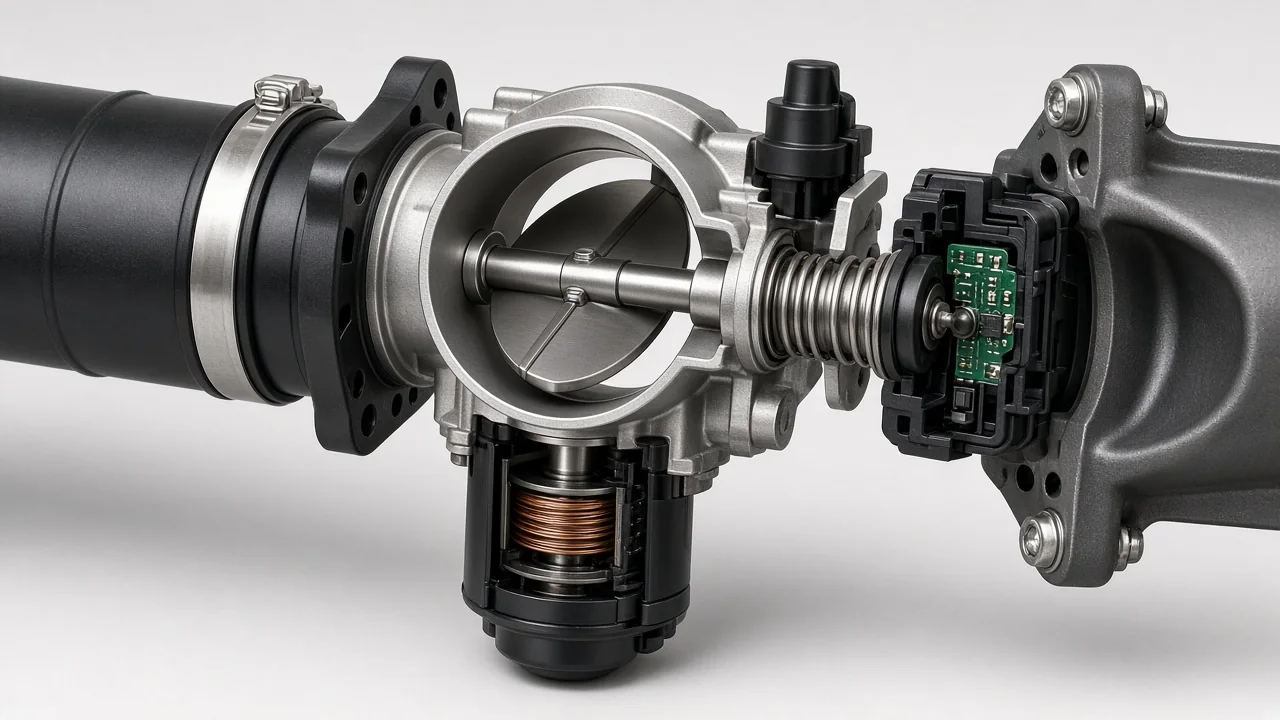
The throttle body is one of the simplest-looking parts under the hood, yet it has a direct say in how your engine idles, accelerates, and responds to your right foot. Understanding what it does, where it sits, and how its parts work together makes it easier to talk with a technician and to read drivability symptoms without jumping to conclusions about which component has failed.
What a throttle body is and the job it does in the engine
A throttle body is the valve housing that controls how much air enters the intake manifold. When you press the accelerator pedal, the valve inside opens wider and lets more intake air flow toward the cylinders. The engine computer then pairs that measured air with the right amount of fuel. The throttle body never handles fuel itself, but it still indirectly sets how much power the engine makes and how fast it spins. Depending on the manual or parts catalog, you may see it called a throttle valve or throttle housing.
Drivers familiar with older engines sometimes confuse it with a carburetor, which mixed fuel and air in one unit. A fuel-injected engine splits those jobs: injectors deliver fuel while the throttle body handles air only. At idle, the valve sits nearly closed, admitting just enough air to keep the engine turning smoothly. At light throttle it opens partway for gentle cruising. At full throttle it swings almost parallel to the airflow, letting the engine breathe as freely as the intake allows for maximum acceleration.
How the butterfly valve meters air in a modern car
Inside the bore sits the butterfly valve, also called the throttle plate. It is a round disc mounted on a throttle shaft that pivots to open or close the air path. On older cable-operated designs, the accelerator pedal pulls a cable linked to the shaft, so pedal movement moves the plate directly. Electronic throttle control, often called drive-by-wire, replaces the cable with a pedal sensor and a small electric motor. The engine computer reads your pedal input, weighs other operating conditions, and commands the motor to position the plate.
A throttle position sensor reports the plate angle back to the computer. The computer combines that signal with other inputs to calculate fuel delivery and ignition timing, and on many vehicles it also uses it to decide when the transmission shifts. As the plate opens, restriction drops, manifold vacuum falls, and more air rushes through. A mass airflow sensor upstream or a manifold pressure sensor downstream measures that change so fueling stays accurate. Control strategies vary by manufacturer and model year, so check vehicle-specific documentation to see how a particular car behaves.
Where the throttle body is located under the hood
The throttle body sits between the air intake tube and the intake manifold. It is downstream of the air filter box and, on engines that use one, the mass airflow sensor. The easiest way to find it is to follow the large intake hose from the air filter housing toward the engine. Where that hose ends, clamped over a round inlet, you will usually find a metal or composite housing bolted to the manifold. Newer designs have an electrical connector plugged into the side, while older ones have a cable linkage attached.
Layout varies with engine design. Many transverse four-cylinder engines place the throttle body near the front or top of the engine, while V-type and longitudinal engines often mount it centrally or toward the firewall. Turbocharged engines send intake air through a compressor and intercooler piping first, and some newer engines hide the throttle body beneath a plastic cover. Your owner's manual or service manual will show the exact location. Avoid disconnecting hoses or connectors while the engine is running or still hot from driving.
Parts of a throttle body explained with a labeled diagram
Picture a simple labeled diagram of the unit. The housing forms the outer body, and the bore is the round passage that air travels through. The butterfly plate sits in that bore, fixed to the throttle shaft, which pivots in the housing. A return spring pulls the plate back toward closed when the pedal is released. The throttle position sensor reads the shaft's angle. The shaft itself is turned by a cable linkage or, on electronic designs, by an actuator motor, often through a small gear set.
A gasket or seal sits between the throttle body and the intake manifold. If it cracks or shifts, unmetered air can slip in without passing the sensors and upset the air-fuel balance, especially at idle. Some designs include small coolant passages that warm the housing to help prevent icing in cold, humid weather. Some also have vacuum ports that feed emissions or crankcase ventilation components. Over time, carbon can build up around the plate edge and narrow the small idle air gap. Drivers may notice this as a lower or less stable idle.
What a throttle body assembly includes and how the idle air control valve fits in
A throttle body assembly is the complete unit sold as one piece, with the housing, plate, shaft, position sensor, and actuator already fitted and calibrated together. Buying the assembly saves you from trying to match individual components that were designed to work as a set. On some engines, the assembly also carries an idle air control valve mounted directly to the housing. On others, that valve is a separate bolt-on part installed elsewhere on the intake, so the two are bought separately.
The idle air control valve acts as a bypass. On cable-throttle engines, the plate rests closed at idle, so this valve lets a metered amount of air flow around it. That keeps the idle steady when loads such as air conditioning or electrical demand change. Electronic throttle systems usually manage idle by opening the plate itself by tiny amounts, which is why many newer engines have no separate idle valve. Before shopping, confirm the exact configuration for your engine, since fitment and included parts vary and cannot be assumed.
Signs a throttle body needs attention and when to seek professional testing
A throttle body that needs attention may cause a rough or unstable idle, hesitation when you press the pedal, stalling as you roll to a stop, or a reduced-power warning on the dash. None of these proves the throttle body is at fault. Vacuum leaks, sensor faults, ignition problems, and even a clogged air filter can cause the same complaints. If the check-engine light is on, treat any stored code as evidence to interpret rather than a final answer. Code meanings and thresholds differ between manufacturers, so the code needs confirming for your specific vehicle.
With the engine off and cool, you can safely check a few things. Make sure the intake hose is fully seated and its clamp is snug, look for cracked rubber, and confirm the electrical connector on the throttle body is firmly latched. Beyond that, professional testing is the better route. Electronic throttle bodies often need a scan tool to check live data. After cleaning or replacement, they also need a relearn procedure so the computer relearns the plate's positions. A technician can handle diagnosis and cleaning without upsetting that calibration.