What Is a Three-Piece Wheel? Construction, Sealing, and Service
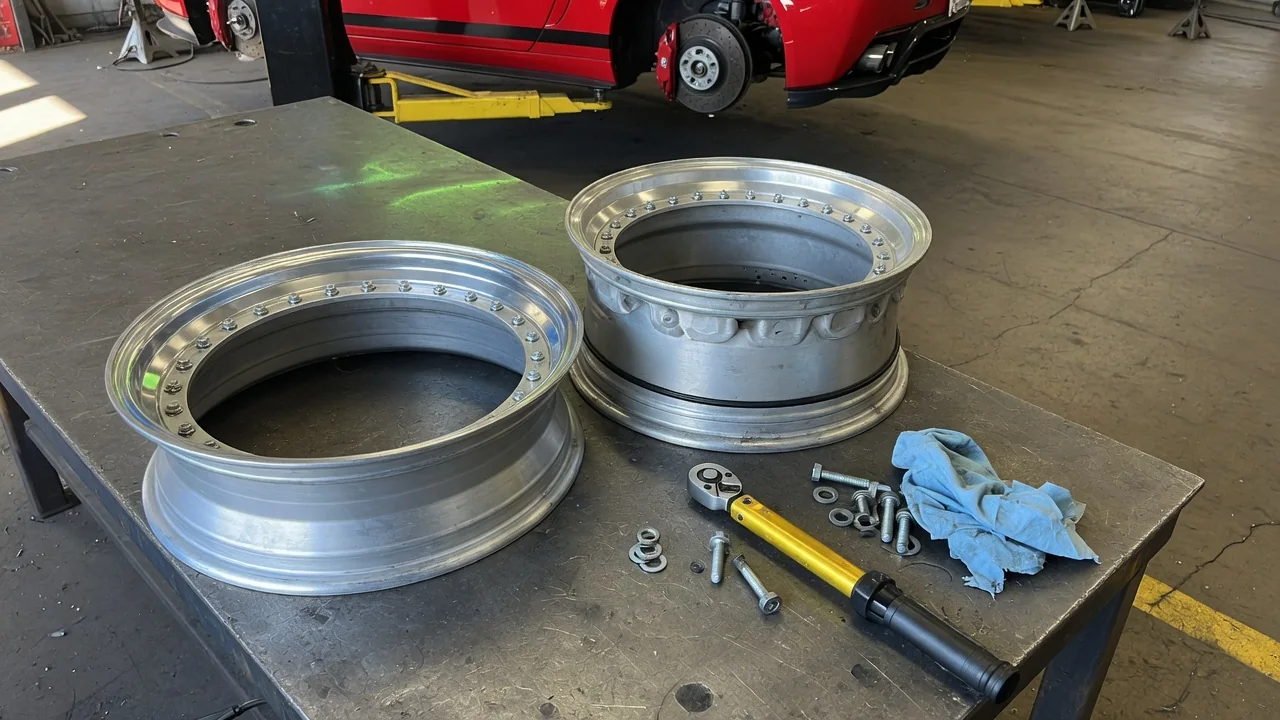
A three-piece wheel is a modular wheel built from three separate parts: a center section that carries the spokes and mounts to the hub, an inner barrel, and an outer barrel. These parts are not cast or forged as a single unit. They are bolted together and sealed so the assembly holds air like a conventional wheel. Knowing how a three-piece wheel is built explains both its fitment flexibility and the extra sealing and maintenance it requires.
Center and barrels: how the three pieces fit together
The center, sometimes called the face or disc, contains the spoke design, the bolt pattern, the center bore, and the mounting pad that sits against the vehicle's hub. Around its outer edge is a flange drilled for a ring of small fasteners, usually called assembly hardware or perimeter bolts. The two barrels together form the rim the tire mounts on, and each has a matching flange. During assembly, the center flange sits between the inner and outer barrel flanges, and the hardware clamps all three into one rigid unit. The inner barrel makes up the inboard portion of the rim. The outer barrel makes up the visible lip and the outboard portion. Between them they provide the bead seats and the drop center needed to mount a tire.
Building a wheel this way separates design from fitment. Overall width comes from the combined widths of the two barrels. Offset depends on where the center sits between them. Pairing a narrow inner barrel with a wide outer barrel moves the center inboard and creates a deep outer lip. The reverse pushes the face outward. One center design can therefore be built in many widths and offsets without new tooling for each size. Centers are commonly forged or cast aluminum and then machined, while barrels are commonly formed from aluminum sheet or blanks by spinning or rolling. Materials and methods vary by manufacturer.
This construction differs from a two-piece wheel, where the center joins a single one-piece barrel, and from a one-piece wheel, where everything is formed together. Some wheels have a ring of bolts around the face purely for appearance. If those fasteners do not actually join separate components, the wheel is a one-piece design styled to look modular, and it cannot be taken apart or serviced as a true three-piece wheel.
Sealing: keeping air inside a bolted assembly
In a one-piece wheel the rim is continuous, so the only places air can escape are the tire beads, the valve stem, and any damage. A three-piece wheel adds a circumferential joint where the barrel and center flanges meet, plus the holes for every assembly fastener. Each is a potential leak path. Most designs seal this joint with a bead of sealant applied along the seam on the air side of the rim, where the barrels meet. Some designs instead use, or add, an O-ring or gasket seated in a machined groove. In every case, the clamping force from the hardware holds the mating surfaces tight so the sealant or gasket can do its job.
When the seal fails, the usual symptom is a slow leak: a tire that loses pressure over days rather than going flat suddenly. Because valve stems, bead seats, and punctures cause similar symptoms, the source has to be located. A common method is to spray soapy water around the barrel seam and the bolt heads with the tire inflated and watch for bubbles. Seal failures can come from aged or degraded sealant, an impact that shifts or distorts the flanges, hardware that has lost clamping force, or damage to the sealant bead during a tire change. Any fresh sealant also needs its full cure time, as specified by the sealant product or wheel maker, before the tire is mounted and inflated. Otherwise the new seal may not hold.
Service: disassembly, resealing, and reassembly
The main service advantage of the design is that it can be rebuilt. If an outer lip is bent or gouged, that barrel can in principle be replaced on its own instead of replacing the whole wheel, provided matching parts are still available. Separate components also make refinishing easier. A center can be painted or powder coated while the barrels are polished or finished differently, and each part can be stripped and restored without masking the others.
A typical rebuild goes in this order: 1) Remove the tire and the assembly hardware. 2) Separate the components and clean all old sealant off the mating surfaces. 3) Inspect the flanges for corrosion, nicks, or distortion. 4) Refinish any parts that need it. 5) Reassemble with hardware that is in good condition, tightening it in a crisscross pattern and in stages to the wheel manufacturer's torque specification. 6) Apply fresh sealant to the seam and let it cure. 7) Mount and balance the tire, then leak-test the wheel. Whether the original fasteners can be reused depends on the manufacturer's guidance. Any that are stretched, corroded, or have damaged threads should be replaced.
Routine tire service also needs extra care. When mounting or removing a tire, the machine and tools must not scratch the exposed lip or disturb the sealant bead on the inner seam. It helps to tell the tire shop in advance that the wheels are three-piece. Valve stems and tire pressure monitoring sensors must also be installed where they clear the barrel joint and the hardware.
Practical implications and limits
Owning three-piece wheels means accepting a bolted, sealed joint as part of each wheel. A sensible routine includes: • Checking pressures more often. • Inspecting the seam and hardware after hard pothole or curb impacts. • Treating a recurring slow leak as a sign to inspect the wheel, not just to add air. The extra machining, hardware, and assembly labor generally make these wheels more expensive than comparable one-piece designs. Weight varies with design and materials, so a three-piece wheel should not be assumed to be lighter or heavier than a one-piece alternative.
The fitment flexibility has limits of its own. Changing width or offset moves the tire and wheel relative to the brakes, suspension, and bodywork. Clearance has to be confirmed for each vehicle, and the chosen wheel must carry a load rating suitable for that vehicle. Rebuildability also depends on the manufacturer: if a design is discontinued or replacement barrels are not offered, repairing a damaged lip may not be practical. Cracks or structural damage in the center or the flanges are not a resealing problem. A qualified wheel specialist should evaluate them, and replacement may be the only safe outcome. Finally, the guidance above covers general three-piece construction. Specific torque values, sealant types, and service intervals come from the individual wheel manufacturer and should be followed over any general rule.