What Is a Thermostat in an Engine?
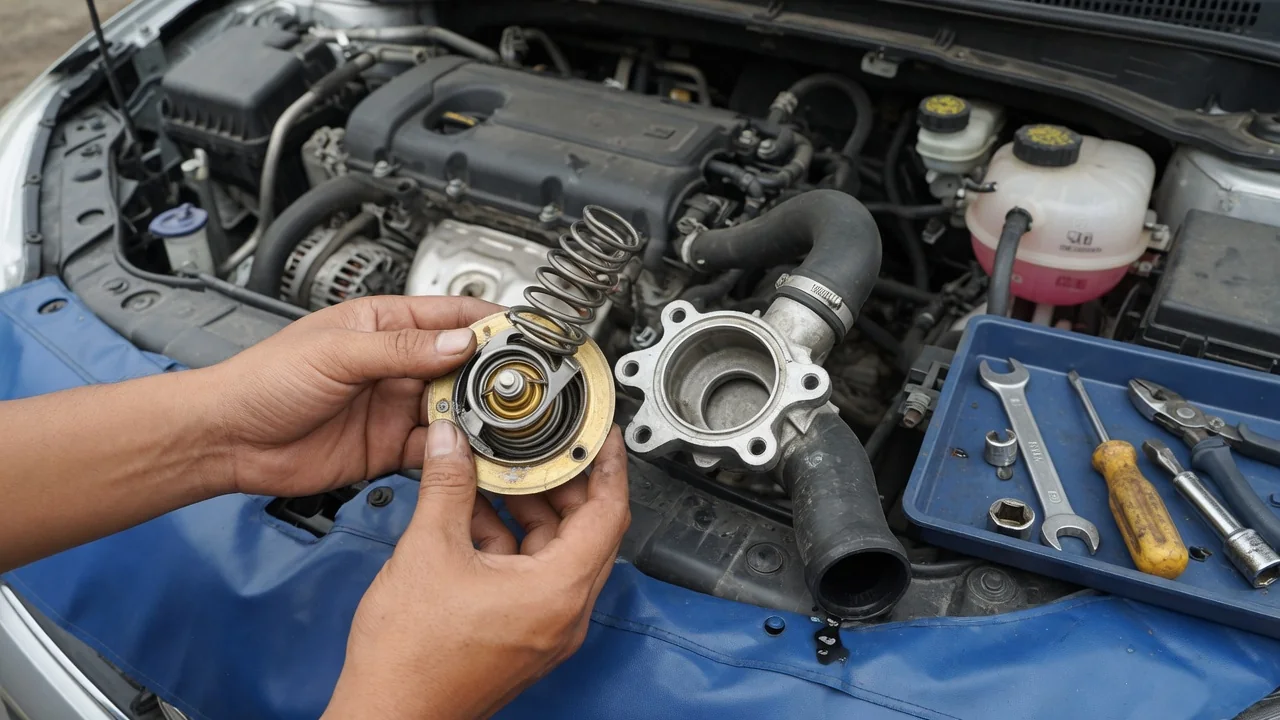
Anyone asking what is a thermostat in an engine is really asking how a cooling system decides when to start cooling. The thermostat is a small temperature-sensitive valve placed in the coolant path between the engine and the radiator. It restricts flow while the engine is cold, then opens as heat builds, helping the engine warm up quickly and stay in its intended operating range.
Closed and open operation
On a cold start, the thermostat sits closed. Coolant pushed by the water pump cannot reach the radiator, so it circulates only through the engine block, the cylinder head, and usually the heater core through a bypass passage. Because that small volume of liquid is not shedding heat to outside air, it warms quickly. In a traditional design, a sealed wax pellet inside the thermostat is what holds the valve shut, with a spring pressing the valve against its seat.
As the coolant approaches the temperature the thermostat was built for, the wax melts and expands, pushing a pin that lifts the valve against the spring. Opening is gradual rather than sudden, so radiator flow begins as a trickle and increases with heat. A driver may notice the upper radiator hose stay cool for the first minutes and then turn hot. Location and design vary: some engines place the thermostat at the coolant outlet, others at the inlet, and some newer vehicles use electronically assisted or map-controlled units.
Temperature regulation
Once warm, the thermostat does not simply stay wide open. It continually adjusts its opening to balance the heat the engine produces against the heat the radiator can reject. Climbing a long grade with a loaded vehicle creates more heat, so the valve opens further; cruising on a cold highway with strong airflow through the radiator may cause it to partly close. This constant modulation is why the temperature gauge on a healthy vehicle tends to settle in one place.
Holding a steady temperature matters for more than comfort. Engine oil flows and protects best when warm, fuel vaporizes more completely, and the engine computer can leave cold-start enrichment behind, which helps fuel economy and emissions. Metal parts also expand to their designed clearances. The thermostat works alongside the radiator fan, the pressure cap, and the coolant mixture, and the target temperature is chosen by the manufacturer, so the exact opening point and normal gauge position differ from one vehicle to another.
Fault symptoms
A thermostat that sticks open sends coolant to the radiator from the moment the engine starts. Warmup becomes slow, the gauge may sit lower than usual or drop at highway speed, and the heater may blow lukewarm air in winter. Fuel consumption can rise because the engine spends longer in its cold-running strategy. Many vehicles monitor warmup time and may set a diagnostic trouble code if the engine does not reach the expected temperature, though that code alone does not prove the thermostat is the cause.
A thermostat stuck closed or only partly opening is more serious, because heat cannot reach the radiator. The gauge may climb toward the hot zone, a warning light or message may appear, and coolant may be forced into the overflow tank. Similar symptoms can also come from low coolant, a failing water pump, an inoperative fan, a clogged radiator, a faulty temperature sensor, or trapped air, so the evidence needs to be interpreted together. Leaks around the thermostat housing or its gasket are another fault worth noting.
Everyday Use and Observations
In daily driving, the thermostat's work shows up as a predictable pattern. The gauge rises steadily after a cold start, reaches its usual position within a reasonable distance, and stays there in traffic, on the highway, and with the air conditioning running. Cabin heat arrives at about the same point in each trip. Learning this pattern for a particular vehicle is useful, because a change in it, such as slower warmup or a wandering needle, is often the first hint of a cooling system problem.
Some variation is normal. Warmup takes longer on a freezing morning, on short trips, or when the engine idles instead of being driven gently. Many modern gauges are buffered, meaning the needle holds center across a fairly wide range of real temperatures, so small changes may go unseen. Certain vehicles have no gauge at all, only a cold indicator and an overheating warning. Hybrids and vehicles with stop-start systems may also show different warmup behavior, since their engines do not run continuously.
Limits and Next Steps
The thermostat controls flow; it cannot create cooling capacity that the rest of the system lacks. It will not compensate for low or degraded coolant, a blocked radiator, a slipping pump drive, or a fan that does not run. Removing it to cure overheating is a poor idea, as the engine may run too cool and coolant routing on some designs depends on the thermostat closing off the bypass. Dashboard observations also have limits, since they cannot show how far the valve is actually opening.
If the gauge rises toward hot, the sensible response is to pull over safely, shut the engine off, and let it cool; a hot cooling system is pressurized, and the cap should never be opened until it has cooled. For slow warmup or a stored code, a technician can compare live temperature data, hose temperatures, and coolant level before condemning any part. The owner's manual and vehicle-specific service information identify the correct thermostat, coolant type, and bleeding requirements, which differ among manufacturers and engines.