What Is a Thermistor in a Car? How Automotive Temperature Sensors Work
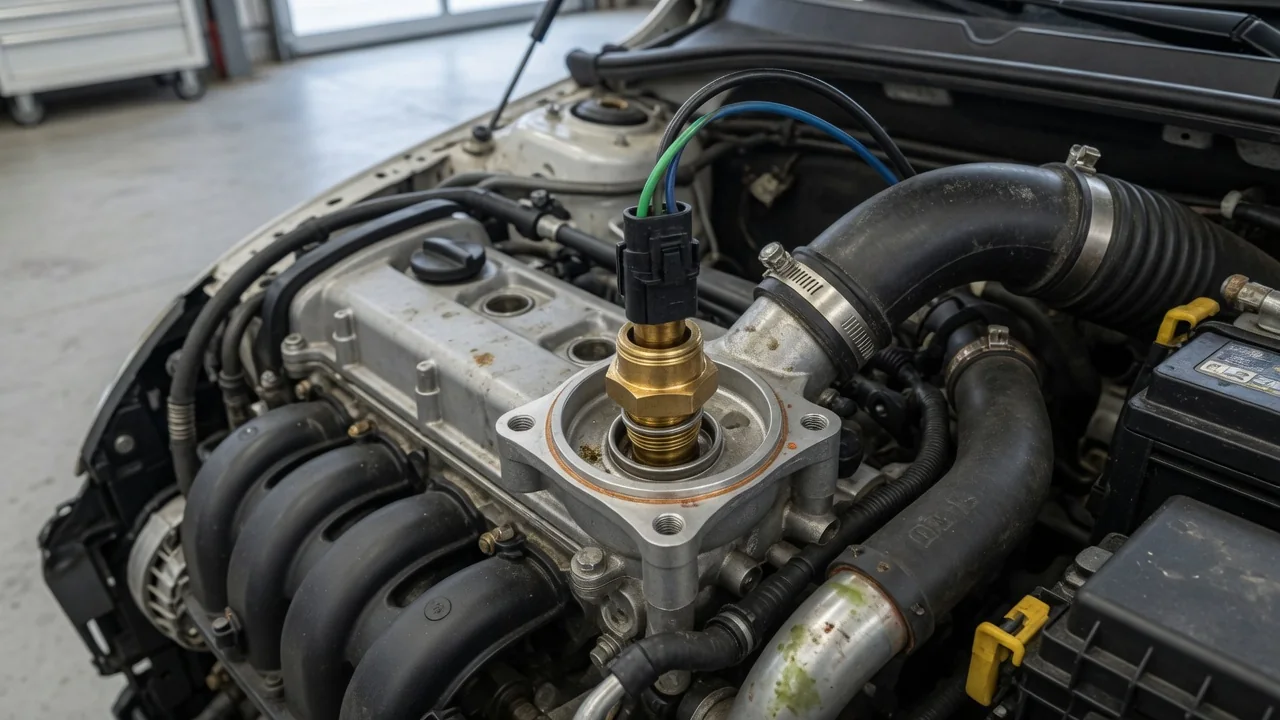
A thermistor in a car is a resistor whose resistance changes with temperature. Control modules use it to tell how hot or cold a fluid, gas or surface is, converting that change in resistance into a temperature reading. Many automotive temperature sensors, from engine coolant to intake air, are built around a thermistor. Knowing how it behaves helps explain several drivability, cooling and diagnostic problems.
Resistance and Temperature: How a Thermistor Works
The word thermistor combines thermal and resistor. A typical automotive thermistor sensor contains a small semiconducting element in a housing that threads into an engine passage or fits into an air duct. An ordinary resistor is designed to hold a steady value. A thermistor is designed to shift its resistance noticeably as its temperature changes. Most automotive temperature sensors use a negative temperature coefficient, or NTC, thermistor. Its resistance is high when cold and drops as it warms. A positive temperature coefficient, or PTC, thermistor does the opposite: its resistance rises with temperature. PTC elements appear more often in self-regulating heaters and circuit protection than in measurement sensors.
Resistance and temperature do not follow a straight line. An NTC thermistor changes resistance sharply in part of its range and more gradually elsewhere. The control module therefore uses a stored table or curve that matches each signal value to a temperature. That curve belongs to a specific sensor design, so a replacement sensor must match the original specification. Resistance-versus-temperature data is published in service information and differs between sensor types and vehicles. No single chart applies to every car.
Inputs: How Control Modules Read a Thermistor
A thermistor does not generate a signal itself. It becomes an input when the control module places it in a circuit. In the most common arrangement, the module supplies a regulated reference voltage, often 5 volts, through an internal fixed resistor. The thermistor connects from that point to ground, so the two resistances form a voltage divider. When the sensor is cold and its resistance is high, the measured signal voltage stays relatively high. As the sensor warms and its resistance falls, the signal voltage drops. The module reads that voltage, applies its stored curve and reports a temperature.
Common thermistor-based inputs include: • Engine coolant temperature; • Intake air temperature; • Ambient or outside air temperature; • Cabin temperature for automatic climate control; • Air conditioning evaporator temperature; Depending on the vehicle, thermistors may also measure transmission fluid, engine oil or fuel temperature. Many hybrid and electric vehicles use them to monitor battery temperature. Some intake air temperature thermistors are built into another component, such as a mass airflow sensor or a manifold pressure sensor, rather than housed separately.
These readings feed many decisions. The engine control module uses coolant and intake air temperature to adjust fuel delivery, ignition timing, idle speed and cold-start enrichment. They also determine when certain emissions strategies and self-tests may run. Coolant temperature commonly influences electric cooling fan operation and the dashboard temperature gauge. Transmission temperature can affect shift behavior and torque converter clutch operation. One reading may be shared across several modules over the vehicle network, so a single faulty input can cause symptoms in seemingly unrelated systems.
Failure: How Thermistor Sensors Go Wrong
Thermistor sensor problems generally fall into two groups: circuit faults and inaccurate readings. An open circuit can come from a broken wire, a loose or corroded connector, or an internal break in the element. In the common voltage-divider design, an open pushes the signal voltage close to the reference value, which the module interprets as extremely cold. A short to ground, in the sensor or the wiring, pulls the signal near zero, which reads as extremely hot. These readings fall outside the plausible range, so the module usually stores a diagnostic trouble code for a high or low circuit input. It may also substitute a default value to keep the vehicle running.
Inaccurate readings are harder to catch. A sensor can drift, respond slowly, or read consistently too warm or too cold while staying within its normal electrical range. Extra resistance at a corroded terminal can shift the measured voltage the same way. In these cases the module may set no circuit code at all. Many vehicles do run rationality checks that compare related temperature readings, such as after a long cold soak. A coolant sensor that reads too cold can cause rich running, poor fuel economy or dark exhaust smoke. One that reads too hot can cause hard cold starts or cooling fans that run when they should not.
A wrong reading does not always mean the thermistor is bad. Low coolant can leave a coolant sensor surrounded by air or steam, producing erratic readings from a healthy part. A thermostat stuck open can make the engine genuinely run cool, and the sensor will report that accurately. Coolant seeping into the connector, damaged wiring near hot components, or a weak reference voltage supply can also mimic sensor failure.
Practical Implications and Limits
For a car owner, the key point is that the thermistor reports and the control module decides. A scan tool showing live data displays the temperature the module believes, which is often more informative than a trouble code alone. Two useful checks are comparing the reading with ambient temperature after the vehicle has sat overnight, and comparing coolant and intake air readings at a cold start. Either can reveal an obvious disagreement. These checks narrow the problem but do not replace the test procedure and specifications for the specific vehicle.
An ohmmeter reading means something only when compared with the manufacturer's chart at a known temperature. The dashboard gauge is a poor test instrument, because many gauges are deliberately buffered to hold steady across a normal operating band. Inspect the connector and wiring before replacing a sensor, since a new part will not fix a corroded terminal or chafed wire. If replacement is needed, the correct part number matters: sensors with similar threads or connectors can use different curves.
Some practical limits apply. Coolant sensor removal on a recently run engine involves hot, pressurized fluid. It usually causes some coolant loss, which may require refilling and bleeding air according to the vehicle's procedure. Sensors integrated into other components may be serviceable only as part of that assembly. High-voltage battery thermistors in hybrid and electric vehicles require specific training and precautions. General principles explain how thermistors work, but sensor location, number and failure behavior vary by vehicle. Diagnosis and repair should follow vehicle-specific information.