What Is a Tailored Blank in Car Manufacturing?
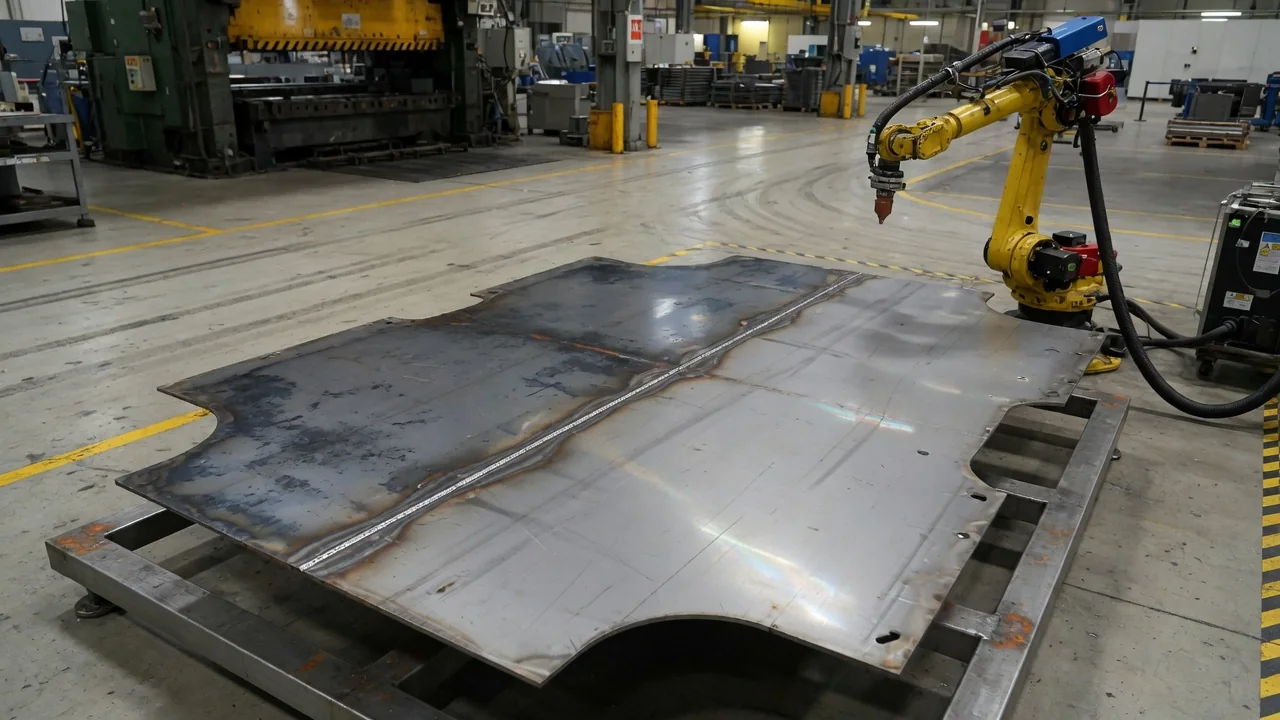
A tailored blank is a flat piece of sheet metal that is engineered to have different properties in different areas before it is stamped into a car part. Instead of cutting a part from one uniform sheet, manufacturers combine or vary the material so that thickness, strength, or coating changes where the finished component needs it. Knowing what a tailored blank is in car manufacturing helps explain why modern body parts can be lighter and stiffer than they look.
Joined sheets: how a tailored blank is assembled
The most widely used form is the tailor welded blank. Two or more sheets, each cut to a precise outline, are butted edge to edge and welded into a single flat blank. Laser welding is the common joining method because it produces a narrow seam with a small heat-affected zone, which matters when the blank will later be bent and stretched in a press. Other methods, such as mash seam resistance welding, have also been used, but laser welding is generally favored where the seam must stay thin and formable. The welded blank then goes through the press like any other sheet and comes out as one part with the seam built in.
The individual sheets in a welded blank can differ in thickness, steel grade, coating, or a combination of these. An automotive tailored steel blank might join a thicker, high-strength section to a thinner, more formable one, or pair a zinc-coated sheet for corrosion resistance with an uncoated sheet in a protected area. Some processes combine sheets of hot-stamping steel, which is heated, formed and quenched in the die to reach very high strength. When those sheets carry an aluminum-silicon coating, the coating near the weld edge is often removed before welding so it does not weaken the seam.
A related approach is the patchwork blank, where a smaller reinforcing sheet is laid over a base sheet and spot welded to it before forming. Rather than joining edges, it stacks material locally. Both methods share the same goal: putting extra material only where it is required, instead of reinforcing a part after stamping with separate brackets and welds.
Different thicknesses: why gauge varies across one part
Most car body parts do not carry the same load everywhere. A component may need to resist bending or crushing at one end while the other end mainly holds its shape or provides a mounting surface. If the whole part were stamped from the thickest gauge required anywhere on it, much of the material would be heavier than necessary. A tailored blank lets engineers specify thicker or stronger metal only in the zones that need it, which can reduce mass and material use while keeping the intended performance in the critical area.
Welded blanks create a step change in thickness at the seam. Tailor rolled blanks take a different route: the steel strip passes through rolls whose gap is varied during rolling, producing a sheet whose thickness changes gradually along its length. Because there is no weld, the transition is smooth and the material is continuous, which can help with forming and with the way loads pass through the part. The trade-off is that the thickness variation generally runs in one direction, along the rolling direction, so the possible layouts are more limited than with welded blanks, which can join sheets along various seam lines.
Varying thickness also affects how the blank behaves in the press. Thinner and thicker zones stretch differently, and a weld seam is less formable than the base metal around it. Tooling has to account for the thickness step, and engineers usually position seams away from the sharpest radii and deepest draws. The weld line can also shift during forming, so its final location in the part depends on careful die design, not just on where it sat in the flat blank.
Body structure: where tailored blanks are used
Tailored blanks are most closely associated with the body-in-white, the welded steel shell of the car before paint, trim and mechanical parts are added. Typical applications include door inner panels, where a thicker zone around the hinge area supports the door while the rest of the panel stays thin; B-pillars, which may combine very high strength in the upper section with a more ductile lower section; and longitudinal rails, floor panels, wheelhouse areas and other structural members. Exactly which parts use them, and in what configuration, varies by manufacturer and vehicle design.
In crash structures, the ability to vary properties within one part is especially useful. Engineers can design certain zones to stay rigid and protect the passenger compartment while allowing other zones to deform in a controlled way and absorb energy. A B-pillar made from a tailored blank, for example, can be designed to resist intrusion near the occupant's upper body while permitting more deformation lower down. Building that behavior into one stamped component, rather than relying on several separately welded reinforcements, can simplify assembly and reduce the number of joints in the structure.
Practical implications and limits
For owners, a tailored blank is usually invisible. Once the part is stamped, coated, sealed and painted, the weld seam or thickness transition may be difficult or impossible to see. That matters mainly when a structural part is damaged. A panel that looks uniform may contain zones of different strength or gauge, and some of those zones may be press-hardened steel that does not tolerate heat, straightening or improvised repair welding the way milder steel does.
Because of this, collision repair of structural parts made from tailored blanks should follow the vehicle manufacturer's body repair information. Those procedures typically define whether a part may be sectioned, where any cut is permitted, which joining methods are approved, and when the full component must be replaced instead. Cutting across a seam or a high-strength zone without that guidance could change how the structure behaves in a later collision. Since applications differ from one vehicle to another, general knowledge of tailored blanks is a reason to check the specific repair data, not a substitute for it.
Tailored blanks also have limits on the manufacturing side. They add steps such as precision edge cutting, welding or variable rolling, and seam quality inspection, so they are used where the weight, strength or part-consolidation benefits justify the extra processing. They do not make a vehicle safer or lighter by themselves; their effect depends on the overall body design, the materials chosen and how the parts are joined. Seeing the term in technical or repair literature signals an engineered, nonuniform part, not a particular level of performance.