What Is a Surfactant in Car Cleaner?
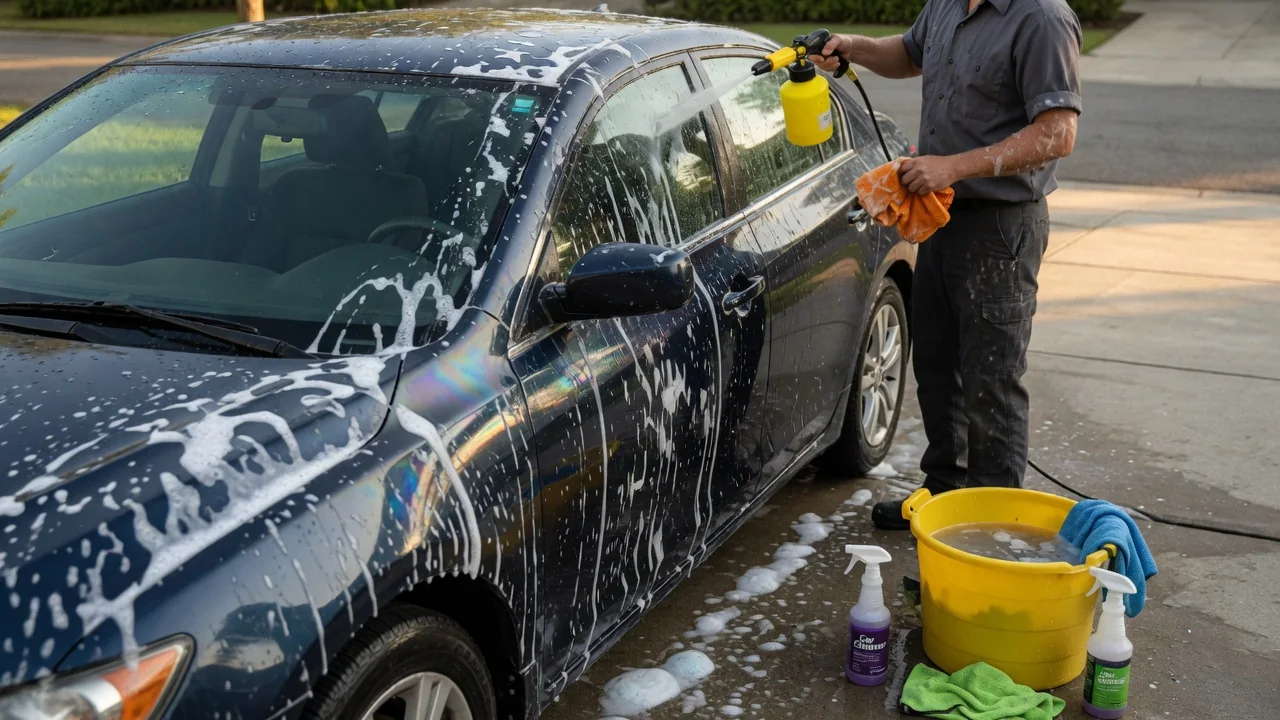
A surfactant is the ingredient that does most of the cleaning work in a typical car cleaner. The word is short for "surface-active agent," and it describes a molecule that is attracted to both water and oily substances at the same time. That dual nature lets plain water wet a dirty panel, loosen grime, and carry it away during rinsing. Understanding how a car cleaner surfactant behaves explains why washing works, why some products leave film, and why dilution matters.
Lifting dirt
Every surfactant molecule has two distinct ends. One end, often called the head, is hydrophilic, meaning it is drawn to water. The other end, a long hydrocarbon tail, is hydrophobic and prefers oils, greases, and other nonpolar materials. On its own, water has high surface tension: its molecules hold tightly to each other, so a droplet tends to bead up on a waxed or grimy panel instead of spreading out. When surfactant molecules are present, they gather at the boundary between water and air or between water and a surface, which lowers that tension. The water can then spread into a thin film, flow into fine texture, and reach the contaminants it needs to touch.
Road film on a vehicle is rarely just loose dust. It usually includes fine particles bound together by traces of oil, exhaust residue, tire material, and environmental grime. Once the solution has wetted the surface, surfactant tails orient toward those oily binders and work their way between the soil and the paint, glass, or trim beneath. This undercuts the bond holding the dirt in place, so particles can be lifted rather than scraped. That is also why contact time matters: the mechanism depends on the solution staying in contact with the soil, and a cleaner that is applied and immediately wiped gives surfactants less opportunity to get underneath it. Lifting dirt this way reduces the need for pressure from a mitt or towel, which is one reason detailing advice emphasizes lubrication and letting the product dwell within the time the label allows.
Emulsification
Lifting soil is only half the job; it also has to stay suspended so it does not resettle. Above a certain concentration, surfactant molecules group into tiny clusters called micelles. In water, the hydrophobic tails point inward and the hydrophilic heads face outward toward the surrounding water. Oily material can be drawn into the core of these clusters, effectively packaging grease inside a water-compatible shell. This process, called emulsification, lets oil and water, which normally separate, form a dispersed mixture that can be rinsed off together.
Emulsification explains why a properly diluted wash solution can remove greasy fingerprints, light oily road film, or bug residue that plain water leaves behind. Solid particles benefit too, because surfactant molecules can coat them and keep them dispersed rather than letting them clump and redeposit. Different surfactant types handle this differently. Anionic surfactants, which carry a negative charge on the water-loving end, are common in general-purpose cleaners and tend to produce noticeable foam. Nonionic surfactants carry no charge and are often used where oily soils dominate or where formulators want less foaming. Cationic and amphoteric types also exist and appear in some specialized formulas. A product's exact blend is a formulation choice, and the label or safety data sheet is the place to check what a specific product contains rather than assuming from its name or color.
Foam is sometimes mistaken for cleaning power. Foam is a visible sign that surfactants are present at the air-water boundary, but the emulsifying work happens in the liquid itself. A low-foam product is not automatically weaker, and a thick foam does not guarantee better soil removal.
Residue
The same properties that make surfactants useful can leave something behind. If a solution dries on the surface before it is rinsed, the surfactants and any dissolved or suspended soil stay on the panel. On paint and glass this can appear as streaks, hazing, or a dull film. Because surfactant residue still has an oil-attracting side, a film left on the surface can make it easier for new dust and grime to cling. Water hardness adds another factor: dissolved minerals can interact with some cleaning ingredients and contribute to spotting as the water evaporates.
Residue also matters for what goes on afterward. Waxes, sealants, and coatings generally perform best on clean, bare surfaces, so a leftover surfactant film can interfere with how evenly a protective product spreads or how well it bonds. On interior surfaces, surfactant left in fabric or carpet fibers can feel slightly tacky and attract soil faster, which is why upholstery cleaning typically involves extraction or blotting with clean water. Thorough rinsing on exterior surfaces and removing the loosened soil from interior materials are the main ways to keep the cleaning agent from becoming the next layer of contamination.
Practical implications and limits
Knowing the mechanism makes product directions easier to interpret. Dilution ratios exist because surfactant performance depends on concentration: too little and there may not be enough to wet and suspend the soil, too much and there is more material to rinse away, with a greater chance of film or streaking. Working in shade on a cool surface and rinsing one section at a time gives the solution time to work without drying in place. Using separate wash and rinse water, or regularly rinsing the mitt, helps keep suspended grit from going back onto the paint.
Surfactants also have limits. They are effective against oily binders and loosely held soil, but they are not designed to dissolve mineral deposits, embedded iron particles, hardened tree sap, or etching that has already damaged the clear coat. Those problems generally call for different chemistry or mechanical correction, chosen for the specific contaminant. Surfactant content is also not the only variable in a cleaner. The pH, solvents, and other additives blended alongside the surfactants strongly influence whether a product is gentle enough for routine washing or aggressive enough to remove existing wax or sealant.
General chemistry does not predict exactly how a particular finish, trim material, or interior fabric will respond. Coatings, plastics, and upholstery vary from vehicle to vehicle, so the owner's manual and the cleaner's label remain the authoritative guidance for that combination. Testing a new product on a small, inconspicuous area before wider use is a simple way to check for staining, dulling, or residue on the specific surface being cleaned.