What Is a Supercharger?
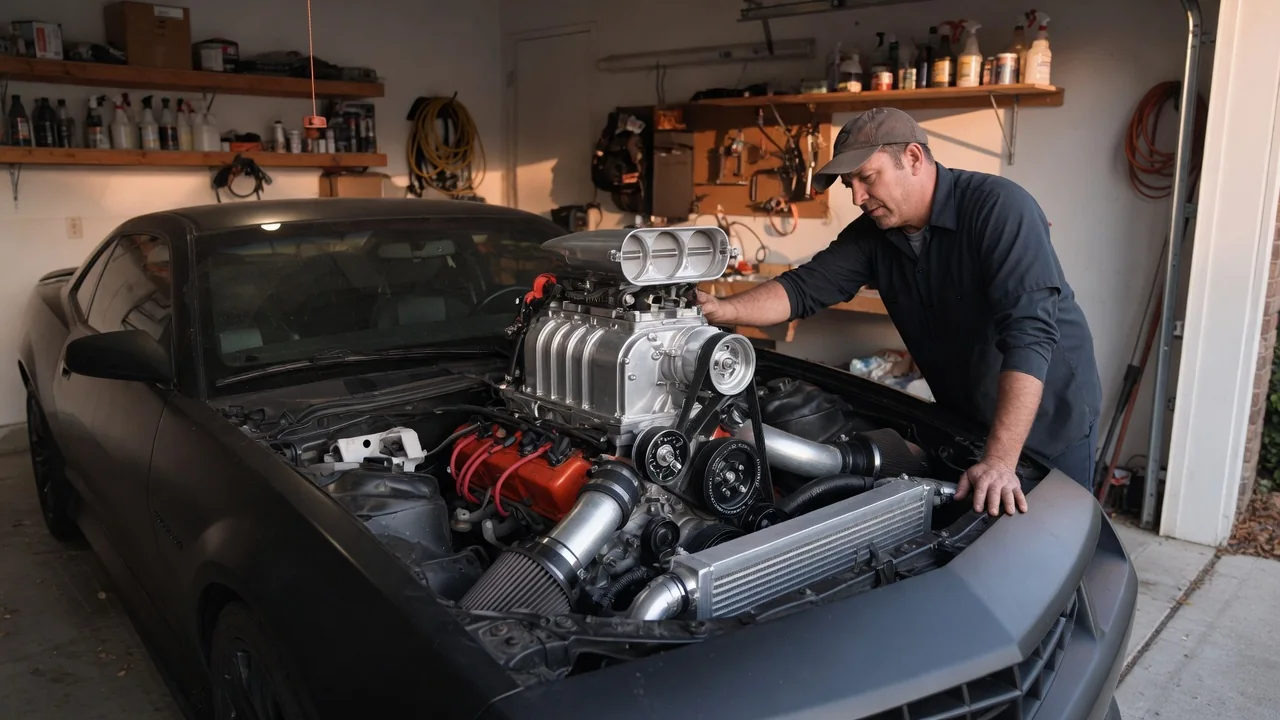
What is a supercharger? It is an air compressor driven mechanically by the engine itself, forcing more air into the cylinders than the engine could draw in on its own. More air allows more fuel to be burned, which raises power output. This guide explains how the device is driven, how air moves through it, where it sits, and what owners typically notice.
Drive source
A supercharger takes its power directly from the crankshaft, most often through a ribbed accessory belt and a pulley on the compressor's nose. Because the connection is mechanical, compressor speed rises and falls with engine speed, so boost is available almost as soon as the throttle opens. That is the key difference from a turbocharger, which relies on exhaust gas energy and needs a brief moment to build speed before it delivers meaningful pressure.
Designs differ in the details. Some use a dedicated belt, others share the serpentine belt with the alternator and water pump, and a few use gears or an electromagnetic clutch that disconnects the compressor during light cruising. Electrically driven compressors also exist on some newer vehicles. Opening the hood usually reveals the arrangement: look for a belt running to a pulley on a housing mounted on or beside the intake manifold. The pulley's diameter relative to the crankshaft pulley sets how fast the compressor spins.
Airflow
Air enters through the filter and throttle body, then passes into the compressor. Roots and twin-screw units are positive displacement designs, using meshing rotors to move a fixed volume of air each revolution, which gives strong pressure at low engine speed. Centrifugal units use a fast-spinning impeller that flings air outward, building pressure progressively as revs climb. In each case, the intake manifold ends up holding air above atmospheric pressure when the driver asks for power.
Compressing air heats it, and hot air is less dense and more likely to cause detonation. Many supercharged engines therefore route the charge through an intercooler, either an air-to-air core at the front of the car or an air-to-water unit built into the manifold. A bypass valve commonly recirculates air around the compressor at part throttle, reducing the work it does when boost is not needed. Whether these parts are fitted, and where, depends on the manufacturer's design.
Packaging
Positive displacement superchargers typically sit on top of the engine, nestled in the valley between the cylinder banks of a V6 or V8, where they double as the intake manifold. This keeps the air path short but adds height, which is why some supercharged cars have a raised hood or a visible bulge. On inline engines, the unit may instead be mounted along the side of the cylinder head, with short runners feeding each intake port.
Centrifugal superchargers resemble the compressor half of a turbocharger and usually bolt to a bracket at the front of the engine, alongside the other belt-driven accessories. Ducting then carries pressurized air to the throttle body, often through a front-mounted intercooler. Space under the hood shapes everything: belt routing, coolant hoses for a charge cooler, and room for a larger intake tract all vary between vehicles, so two engines with similar compressors can look quite different.
Everyday Use and Observations
From the driver's seat, a supercharged engine tends to feel like a larger naturally aspirated one. Response to the accelerator is immediate, and torque builds smoothly rather than arriving in a sudden surge. Many units produce a distinctive whine that rises with engine speed, more pronounced on some rotor designs than others. A boost gauge, where fitted, shows manifold pressure climbing above atmospheric under hard acceleration and dropping back into vacuum at a steady cruise.
Because the compressor draws power from the crankshaft, fuel consumption typically increases when boost is used frequently, although gentle driving with an active bypass can keep the penalty modest. Many supercharged engines call for premium fuel to resist knock, so the owner's manual and fuel-door label are worth checking. Some units carry their own oil supply, sealed separately from the engine's, while others are lubricated by engine oil; the correct fluid and any service schedule are specific to the vehicle.
Limits and Next Steps
A supercharger cannot add power for free. Driving it consumes some of the output it helps create, known as parasitic loss, and the extra heat and cylinder pressure place greater demands on pistons, head gaskets, cooling and fueling. Engines designed for boost from the factory account for this with stronger internals and matched calibration. Adding a kit to an engine built without one requires careful attention to tuning, fuel delivery and the emissions rules that apply where the car is registered.
Symptoms such as a slipping or squealing belt, rattling from the compressor nose, reduced boost or a warning light deserve prompt attention. A stored fault code related to boost or airflow is a starting point for diagnosis rather than proof that the supercharger itself has failed, since leaks, sensors and bypass controls can produce similar readings, and some codes are manufacturer-specific. A qualified technician with vehicle-specific service information can confirm the cause before any parts are replaced.