What Is a Subwoofer in a Car? Bass, Enclosures and Power Explained
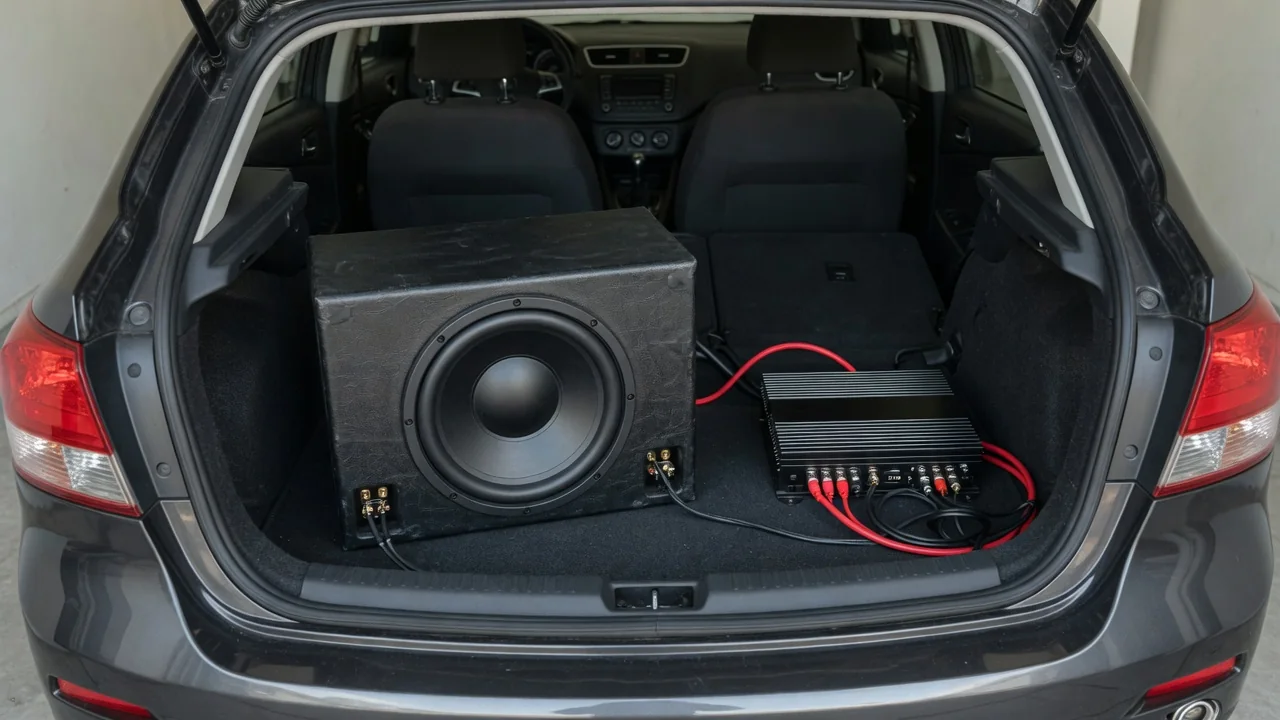
A subwoofer in a car is a loudspeaker dedicated to the lowest notes in music and soundtracks: kick drums, bass guitar, synthesizer bass lines and low rumble in film audio. Regular door and dash speakers cover the rest of the spectrum, but they are usually too small to move the air that deep bass requires. The car subwoofer's purpose comes down to three linked topics: the low-frequency sound it reproduces, the enclosure it sits in, and the power that drives it.
Low-frequency sound
Sound travels as pressure waves, and the lower the frequency, the longer the wave and the more air a speaker must displace to make it audible at a given level. Human hearing extends down to roughly 20 Hz, and the bottom octaves carry much of the physical weight of music. A small driver can only move a limited volume of air, so a typical full-range door speaker loses output as frequencies fall. A subwoofer uses a larger cone, a long-travel suspension and a sturdier moving assembly so it can push and pull enough air to reproduce those notes cleanly.
In a properly configured system, a subwoofer does not play everything. A low-pass filter, part of what is called a crossover, sends it only the bass below a chosen point, while the other speakers receive a high-pass filter that keeps the deepest content away from them. This division of labor is the main reason to add one: the main speakers no longer strain on bass they cannot reproduce, so they can play cleaner and louder in the midrange, while the subwoofer handles the band it was designed for. Crossover points are set by the installer or the equipment and vary with the speakers involved.
Deep bass is also hard to locate by ear, because its wavelengths are long compared with the distance between a listener's ears. That property lets a single subwoofer sit in a trunk, under a seat or in a cargo area while the sound still seems to come from the front, provided its level and crossover are set sensibly. The closed cabin of a car also tends to reinforce the lowest frequencies, an effect often called cabin gain, although how much it helps depends on the vehicle's size, shape and openings.
Enclosure
A subwoofer driver produces sound from both the front and the back of its cone, and the two waves are opposite in phase. Without a barrier between them, the rear wave wraps around and cancels much of the front wave at low frequencies, so a bare driver sounds thin. The enclosure, or box, separates the two and also acts as an air spring that helps control how the cone moves. Its design therefore shapes how much bass you hear, how deep it reaches and how controlled it sounds.
The common enclosure types each make a different trade. A sealed box is airtight; it is usually compact and gives a gradual roll-off with tight, accurate bass, but it needs more power for a given loudness. A ported, or vented, box adds a tuned opening that reinforces output around its tuning frequency, gaining efficiency at the cost of a larger box and a steeper drop below that tuning. Bandpass designs place the driver inside chambers and release sound only through a port, concentrating output in a narrower range. Some installations instead mount the driver in a panel so the trunk itself serves as the enclosure, an approach usually called infinite baffle or free air.
Whatever the type, the box has to suit the specific driver. Manufacturers publish recommended enclosure volumes and electromechanical parameters, often called Thiele/Small parameters, that designers use to calculate a suitable size and port tuning. A box that is too small, leaky or poorly braced can make even a good driver sound boomy or weak, and a flexing panel wastes energy as vibration. Prefabricated boxes and ready-made enclosed units trade some optimization for convenience.
Power
Reproducing deep bass at levels that match the rest of the system takes much more electrical power than reproducing midrange, because the driver has to move a lot of air and many subwoofers are relatively inefficient. The small amplifiers built into most head units are not designed for that load, so a subwoofer is normally driven by a dedicated external amplifier, often a single-channel unit optimized for low frequencies. A powered subwoofer combines the driver, enclosure and amplifier in one package, which simplifies installation but limits flexibility.
Matching an amplifier to a subwoofer involves a few key figures. Continuous power, usually listed as RMS, is the meaningful rating; peak or maximum figures describe brief bursts and are not directly comparable. Impedance, measured in ohms, affects how much power an amplifier delivers into the load, and drivers with dual voice coils can be wired in different ways to present different impedances. Running an amplifier into a lower impedance than it is rated for can cause overheating or protective shutdown. An amplifier pushed into clipping also sends a distorted signal that can damage a subwoofer even when the amplifier's rated power is modest.
That power comes from the vehicle's electrical system. A subwoofer amplifier needs a correctly sized power cable from the battery with a fuse close to the battery terminal, plus a solid ground connection to the chassis. Heavy bass notes draw current in bursts, and with larger systems this can cause voltage to sag or lights to dim. Alternator capacity and electrical design differ between vehicles, so wiring and current demands that are adequate in one car may not be in another.
Practical implications and limits
For most owners, the goal is integration rather than maximum output. A modest subwoofer that blends with the main speakers usually improves the sound more than an oversized one turned up too far. Level, crossover and phase settings decide whether bass sounds like part of the music or a separate boom behind the seats. Many factory audio systems use built-in amplifiers or signal processing, so adding a subwoofer may require a line-output converter or an interface that accounts for existing equalization; the right approach depends on the specific system.
Space and practicality also set limits. An enclosure takes up cargo room and adds weight, and strong bass can reveal rattles in trim panels, license plates and hatch components that were never noticeable before. Body style affects how bass reaches the cabin; in a sedan, the rear seat and parcel shelf sit between the trunk and the listener. A subwoofer will not fix distorted or poorly installed main speakers, and it cannot add bass that a recording does not contain.
Finally, consider the people in and around the car. Prolonged exposure to high sound levels can harm hearing, and many places regulate vehicle noise, with rules that vary by locality. Playing a powerful system for long periods with the engine off can also drain the battery. Used with sensible settings, a subwoofer simply completes the frequency range so the whole system sounds fuller, more balanced and less strained.