What Is a Strut on a Car?
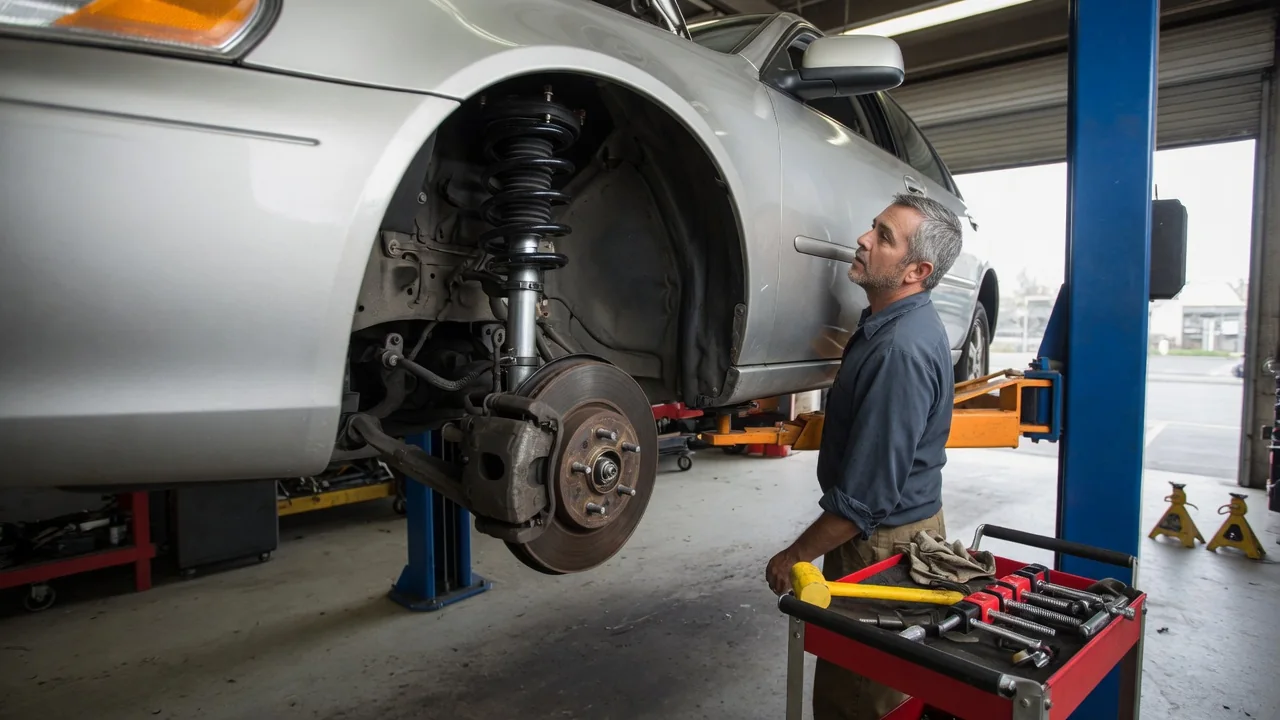
If you have ever wondered what is a strut on a car, the short answer is that it is a suspension component doing two jobs at once. A strut supports part of the vehicle's weight as a structural member while also damping the bouncing motion of the spring. Understanding that combined role makes ride quality, handling, and repair decisions much easier to follow.
Strut assembly
A strut assembly packages several parts into one unit. At its core is a damper, a sealed tube containing a piston and hydraulic fluid that resists motion and turns spring energy into heat. Around it sits a coil spring resting on a welded seat, carrying the weight of that corner of the vehicle. On top is a mount that bolts to the body, often with a bearing, and the lower end attaches to the steering knuckle or hub carrier.
What separates a strut from a plain shock absorber is the structural duty. A shock only controls motion and could be removed without the suspension collapsing, whereas a strut holds the wheel in position and replaces the upper control arm found in other designs. Looking into the wheel well, you can usually see a thick vertical tube wrapped by the spring. Layouts vary, though: many vehicles use struts in front and separate shocks and springs in the rear, and some use no struts at all.
Steering geometry
Because the strut is bolted to the knuckle, it forms part of the steering axis on the common MacPherson layout. When the steering wheel turns, the entire strut body rotates with the wheel, pivoting on the bearing in the upper mount and the ball joint in the lower control arm. That means the strut's angle directly sets alignment values such as camber and influences caster, which affect tire contact, straight-line stability, and how the steering returns to center.
This geometric role explains why strut condition shows up in steering feel. A worn upper bearing may produce a binding sensation, a creak, or a clunk while turning at parking speeds, and a bent strut after a pothole or curb strike can leave the car pulling to one side. On some vehicles the strut-to-knuckle bolts allow camber adjustment, while others have fixed positions, so the available adjustment depends on the specific design. Disturbing those connections generally calls for an alignment check afterward.
Replacement context
Struts wear gradually as internal seals and valving age, so replacement is usually driven by condition rather than a single universal mileage figure. Typical evidence includes oil streaking down the strut body, a damaged dust boot, a corroded spring seat, or a broken coil. Shops commonly replace them in pairs across an axle so both sides damp equally, since mismatched damping can make the car behave unevenly under braking or over bumps. The maintenance guidance for your particular vehicle is the best reference.
There are two broad approaches. One reuses the original spring and mount on a new damper, which requires compressing the spring with specialized equipment; that spring stores considerable energy and can cause serious injury if handled improperly, so the task is best left to trained technicians. The other uses a complete preassembled unit with a new spring, mount, and bearing, which simplifies the labor. Part designs, availability, and pricing differ by make and model, and vehicles with electronically controlled dampers add further considerations.
Everyday Use and Observations
In daily driving, a healthy strut works unnoticed. Over a speed bump the spring compresses and rebounds, and the damper settles the body in about one motion rather than letting it bob repeatedly. Under braking, the front struts resist nose dive; in a corner, they slow body roll and keep the tire pressed against the pavement. That steady tire contact matters for more than comfort, because grip for stopping and steering depends on the tread staying planted on uneven surfaces.
As damping fades, the changes tend to creep in slowly enough that drivers adapt. You might notice a floaty feeling on the highway, extra bouncing after dips, more lean in turns, or the nose dropping sharply when you brake. Tires can develop cupped, scalloped wear patches, and knocking sounds may appear over rough roads. None of these signs is exclusive to struts, however; worn sway bar links, bushings, ball joints, or tire problems can produce similar symptoms depending on the vehicle.
Limits and Next Steps
Simple observations only go so far. Pushing down on a corner and watching the rebound can hint at very weak damping, but it will not reveal moderate wear, and a visual check cannot show what is happening inside a sealed unit. A light film of oil may be normal seepage, while active wetness suggests a leak. Vehicles with adaptive or air suspension may also store fault codes, which point toward a circuit or system to investigate and do not prove any part has failed.
A sensible next step is to confirm what your vehicle actually has, since the owner's manual or a look underneath will show whether each axle uses struts, shocks, or another arrangement. If ride or steering behavior has changed, a professional inspection on a lift can check the mounts, springs, and surrounding joints together and separate strut wear from other causes. Mention when the symptoms occur, such as during turns, braking, or over bumps, and ask about alignment if any components are replaced.