What Is a Steering Stop? Travel Limits, Tire Clearance and Inspection
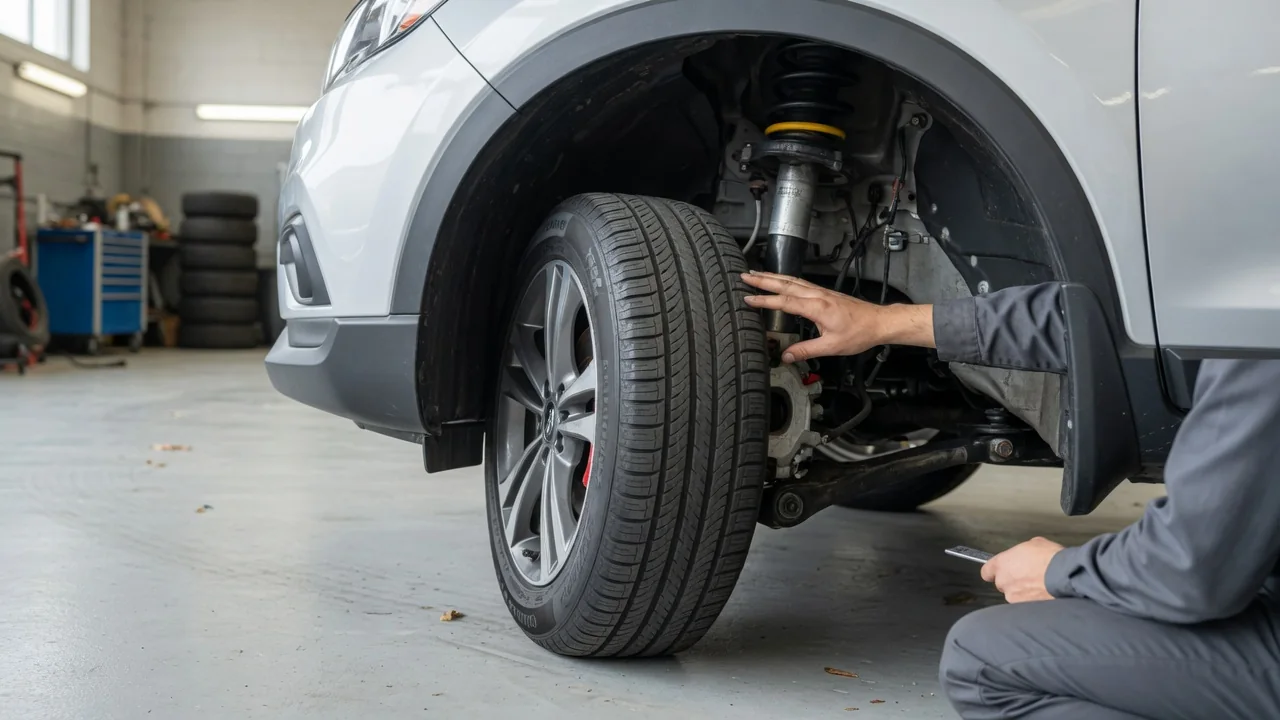
A steering stop is the mechanical limit that defines how far the front wheels can turn in each direction. When you turn the steering wheel to full lock and it will not go any further, a stop has been reached. The car steering stop purpose is protective: it keeps tires, wheels and steering parts from hitting the body, frame or suspension, and it prevents joints and the steering gear from being forced past their intended range.
Travel limit
Every steering system has a maximum angle the wheels are designed to reach, and the steering stop is what enforces it. Where that stop sits depends on the design. On many vehicles with rack-and-pinion steering, the limit is internal: the rack can only slide so far inside its housing before a shoulder, the inner tie rod joint or a dedicated stop surface meets the housing. On other designs, especially some trucks, older vehicles and many solid front axle layouts, the limit is external, typically a bolt or machined boss on the steering knuckle that contacts a pad on the axle or a suspension arm at full lock. Some external stop bolts are adjustable with a lock nut, while others are fixed.
The travel limit is chosen as a compromise. More steering angle gives a tighter turning circle, which helps in parking lots and on narrow roads. Too much angle, however, can bring the tire into contact with nearby parts, overextend constant velocity joints on driven front wheels, stretch brake hoses or ABS sensor wiring, or push suspension ball joints toward the edge of their range. The engineer sets the stop so the wheel reaches a useful angle while every part in the area keeps a working margin.
Steering assist adds another layer. In hydraulic power steering, holding the wheel firmly against full lock can drive system pressure up to the relief valve, which generates heat and load in the pump and fluid. For that reason, many owner manuals advise against holding the wheel at full lock for long periods. Some electric power steering systems use software to soften or reduce assist as the wheel nears the end of travel, but whether and how a particular vehicle does this is specific to that design.
Tire clearance
Clearance is the most visible reason steering stops exist. At full lock, the front tire swings close to the inner fender liner, the frame rail, the sway bar, tie rod ends and the lower control arm. The factory stop position assumes the original wheel and tire size, wheel offset and ride height. Within that combination, the tire should not touch anything at full lock, even as the suspension compresses over bumps or during a sharp turn into a driveway.
Clearance is not fixed through suspension travel. As a wheel moves up and down, its position relative to the body changes, and so does the space around the tire. A tire that clears at normal ride height may rub when the suspension is compressed at full lock. This is why clearance has to be judged across the full range of steering and suspension movement, not only with the car parked on level ground.
Changes to the vehicle can erase the margin the stop was meant to protect. Wider or taller tires, wheels with a different offset, wheel spacers, lowered or lifted suspension and tire chains can all move the tire closer to surrounding parts. On designs with adjustable external stops, limiting steering angle is one way some installers restore clearance, at the cost of a wider turning circle. On rack-and-pinion systems, some designs allow travel-limiting spacers on the rack, while others have no practical adjustment. Any such change should follow the vehicle or parts manufacturer's guidance.
Inspection
A basic check starts with the tires and the area around them. Turn the wheel to full lock in each direction and look for fresh rub marks on the tire sidewall or tread shoulder, scuffs or cuts in the fender liner, polished spots on the frame or sway bar, and signs that a brake hose or sensor wire is pulled tight. Rubbing noises, a scraping sound when turning sharply over a bump, or a clunk at full lock are reasons to look more closely.
Where the vehicle uses external stops, inspect the stop bolts and their contact pads. Look for a bent, broken or missing bolt, a loose lock nut, heavy peening or mushrooming of the contact faces, or a stop that is not making contact while some other part is. On rack-and-pinion systems the internal stop cannot be seen directly, so the inspection focuses on what surrounds it: torn or leaking rack boots, play in the inner tie rod joints and any knocking felt through the wheel at full lock. Hard contact that did not occur before may point to worn or damaged steering components.
Comparing left and right helps too. If the car turns noticeably tighter in one direction than the other, the cause may be an off-center steering rack, a bent tie rod or knuckle, an incorrectly adjusted stop bolt, or a previous repair that changed geometry. Checking full-lock behavior after an alignment, a steering repair or a wheel and tire change is a sensible habit. Exact stop settings, steering angles and inspection procedures are model-specific and belong to the service manual for that vehicle.
Practical implications and limits
For everyday driving, a steering stop is something you reach rather than something you work against. Turning to full lock while parking is normal, but there is no benefit to forcing the wheel hard against the limit or holding it there. Easing off slightly once the wheel stops reduces strain on the steering gear, the assist system and the stop itself, and it makes no difference to how tightly the car turns.
The stop only protects against conditions its designers anticipated. It cannot guarantee clearance once the tire size, offset or ride height has changed, and it does not prevent rubbing caused by a bent component or worn suspension that moves the wheel off its intended path. Grinding down or removing a stop to gain extra lock is risky: it can lead to tire damage, overextended joints, damaged hoses or a steering gear that is repeatedly loaded at the end of its travel.
It is also worth separating mechanism from vehicle behavior. The general principle, a hard limit set to protect clearance and components, applies broadly, but the type of stop, whether it can be adjusted, how the power steering behaves near the limit and what clearance is acceptable all vary by design. When a modification or a repair touches steering angle, the vehicle's service information or the parts manufacturer's instructions are the right reference, not a general rule.