What Is a Steering Intermediate Shaft? Function, Joints and Noise
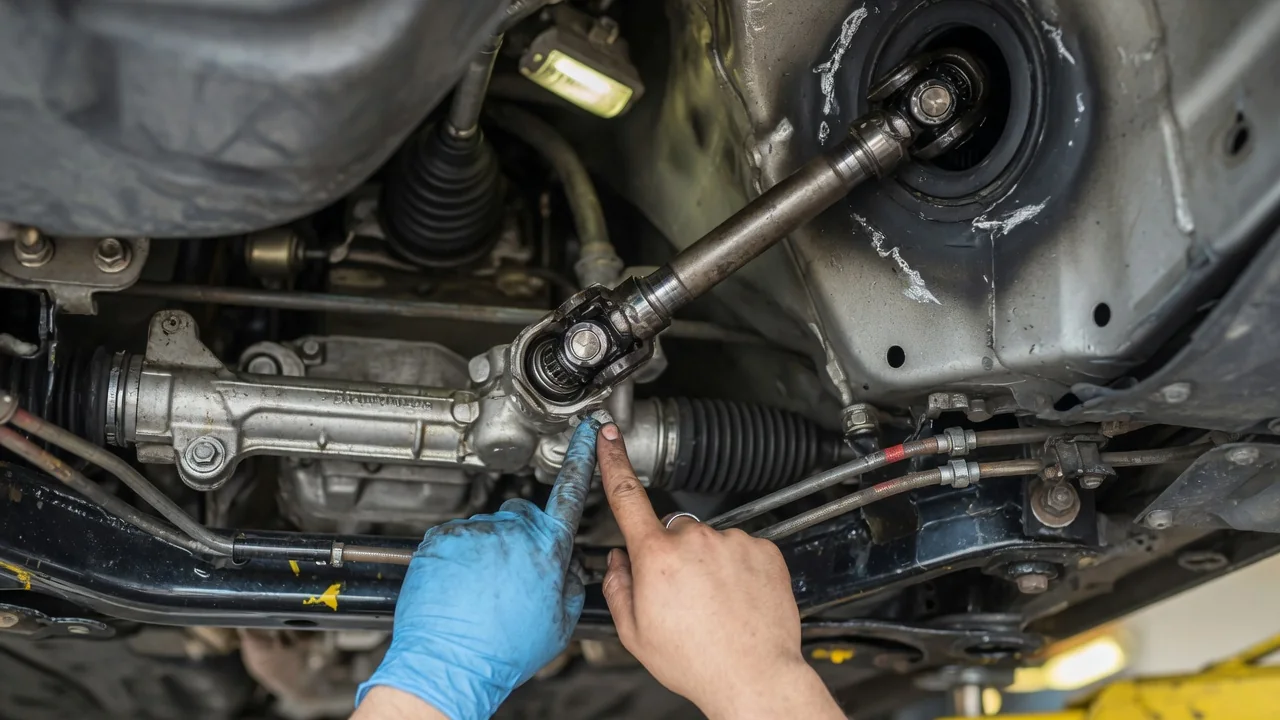
A steering intermediate shaft is the short linkage that carries steering input from the bottom of the steering column to the steering gear. It is usually tucked behind the pedals or near the firewall, so most owners never notice it until it starts to clunk or feel notchy. Knowing what the intermediate steering shaft does, how its joints work, and why it can make noise helps you describe symptoms accurately and understand repair recommendations.
Column to Rack: Where the Intermediate Shaft Fits
When you turn the steering wheel, you rotate a shaft that runs inside the steering column, which is mounted to the structure behind the dashboard. The steering gear sits much lower, attached to the subframe or frame near the front axle line. On most modern cars that gear is a rack-and-pinion unit; some trucks and older designs use a recirculating-ball gearbox instead. The column and the gear almost never share a straight axis, so the intermediate shaft bridges the gap. It connects the lower end of the column to the input shaft of the steering gear, typically passing through the firewall or bulkhead along the way, often through a boot or seal that keeps out water, noise and engine-bay fumes.
A single straight shaft is rarely practical. The engine, pedal assembly, brake booster, exhaust and other components occupy the space between the driver and the steering gear, so the shaft has to route around them at an angle. The body and the subframe also move slightly relative to each other on their rubber mounts, and the shaft must tolerate that movement without binding. Crash safety is another factor: many intermediate shafts are designed to telescope or collapse so that, in a frontal impact, the steering gear being pushed rearward is less likely to drive the column toward the driver. How this is achieved varies by design.
The type of power steering affects what the shaft carries. With hydraulic or rack-mounted electric assist, the assist is applied at the steering gear, so the intermediate shaft mainly transmits the driver's own input torque. With column-mounted electric assist, the motor adds torque above the intermediate shaft, so the shaft carries the combined, assisted load. Which arrangement a given vehicle uses is something to confirm in its service information rather than assume.
Joints: How the Shaft Handles Angles and Movement
Most intermediate shafts use universal joints, usually of the Cardan type: a cross-shaped center piece with needle-bearing caps that ride in two yokes. This arrangement lets rotation pass through an angle while staying tight enough to keep steering precise. A common layout has one universal joint at each end of the shaft, though the number and placement of joints depends on how far the shaft must deviate from a straight line.
A single Cardan joint operating at an angle does not turn at a perfectly constant speed. Its output speeds up and slows down slightly twice per revolution, and the effect grows as the angle increases. Engineers manage this by choosing the joint angles and orienting, or phasing, the two joints relative to each other so their variations largely cancel. If a shaft is reassembled with the joints out of their intended relationship, the steering can feel uneven, becoming lighter and heavier at different points as the wheel turns. This is one reason the shaft's geometry is treated as part of the steering system design rather than a simple connector.
Between the joints, many shafts include a slip section: two splined pieces that slide into each other so the shaft length can change. This allows for assembly, body-to-subframe movement and, in many designs, collapse in a crash. The splines are often coated or sleeved with a low-friction material to keep movement smooth and quiet. Some designs also use a flexible rubber coupling to absorb vibration from the road and steering gear. At each end, the shaft usually slides onto a splined input shaft and is secured with a pinch bolt, which commonly passes through a groove or flat in the mating shaft so the joint cannot slide off even if clamping force is reduced.
Noise: What a Worn Intermediate Shaft Sounds Like
The most familiar symptom is a clunk or knock felt through the steering wheel when turning at low speed, during parking maneuvers, or when rocking the wheel back and forth while stationary. This is often traced to the slip section. When the coating wears, the lubrication dries out, or clearance develops between the splines, the two halves can shift slightly each time the load reverses direction. Because the shaft is directly connected to the wheel, the sensation is often felt as much as heard.
Problems in the universal joints tend to feel different. A dry, corroded or worn joint can make the steering notchy or sticky, produce a click at a specific point in the rotation, or keep the wheel from returning smoothly to center after a turn. A loose pinch bolt or worn splines at either end can create free play and a sharp knock, and that condition deserves prompt attention because it involves the fastening that holds the steering connection together.
Many other parts can make similar sounds, including tie rod ends, steering rack mounting bushings, upper strut mounts, column bearings, stabilizer bar links and power steering components. A common basic check is to leave the front wheels on the ground with the engine off, have one person rock the steering wheel slightly in each direction, and have another person watch and feel the intermediate shaft and its joints for any lash before the wheels begin to move. The vehicle's service information may specify its own inspection procedure, and it should take priority over a general method.
Practical Implications and Limits
Because the intermediate shaft carries every steering input, its condition matters for safety, not only comfort. A slip-section clunk often develops gradually, but owners should not assume that any steering noise is harmless. Free play at a fastener, a binding joint, or steering that feels different from one turn to the next are reasons to have the system inspected rather than wait for the noise to get worse. Depending on the design and the cause, a repair may involve lubrication, tightening, or replacing the shaft, and the manufacturer's service information determines which approach is appropriate.
Removing or replacing the shaft involves details that affect steering geometry and other systems. The steering wheel and front wheels are normally kept centered and secured while the shaft is disconnected, because letting the wheel spin freely can damage the clock spring that feeds the airbag and horn circuits. On designs without a keyed or master spline, reinstalling the shaft one spline off can leave the steering wheel visibly off center even though the wheel alignment angles have not changed. In that case the correct fix is re-indexing the shaft, not adjusting the tie rods. Pinch bolts may carry specific torque values or be designated as single-use, so reusing old hardware or guessing at tightness is not a safe shortcut.
This explanation covers general designs. Real vehicles differ in the number of joints, whether a flexible coupling or collapsible section is used, the type of spline coating, and how the shaft passes through the firewall. Symptoms alone cannot confirm that the intermediate shaft is at fault, since several nearby components produce similar noises. A physical inspection, guided by the specific vehicle's service information, remains the reliable way to identify the cause and choose the correct repair.