What Is a Stator in an Electric Motor? Coils, Magnetic Field and Heat
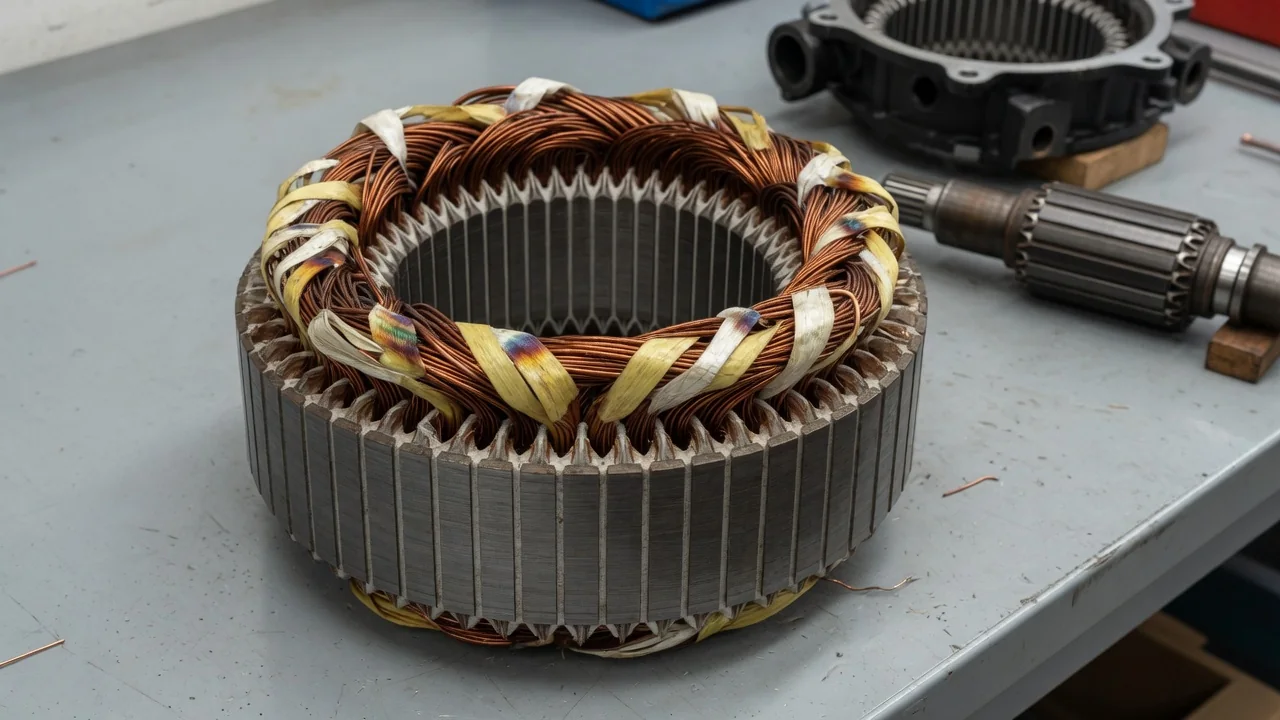
If you have wondered what a stator is in an electric motor, the short answer is that it is the stationary outer part of the motor that surrounds the spinning rotor. In an EV motor, the stator holds the copper windings that receive current from the inverter and turn it into a rotating magnetic field. That field pulls the rotor around and produces torque. The stator's coils, its magnetic role and the heat it generates explain much about how electric drive units behave.
Coils: copper windings in a laminated steel core
An EV motor stator starts with a core made from many thin sheets of electrical steel. Each sheet is coated with a thin insulating layer, and the sheets are stacked and pressed together into a hollow cylinder. The inner surface of that cylinder has slots running along its length. Copper conductors are placed in these slots to form the coils, and where the conductors leave one slot and loop back into another, they form the end turns visible at each end of the stator.
Traction motors typically use three-phase windings. The copper is divided into three groups, or phases, and each phase is made of several coils distributed around the circumference of the core. Some stators are wound with bundles of round enameled wire, while others use rectangular conductors, often called hairpins, that are inserted into the slots and joined by welding. Rectangular conductors can fill the slot space more completely, but which approach a given vehicle uses is a design decision that varies by manufacturer.
Insulation is as important as the copper itself. Conductors carry an enamel coating, slots are usually lined with insulating material, and separators keep different phases apart. Many stators are then impregnated with varnish or resin, which locks the conductors in place, helps resist vibration and improves heat transfer from the copper to the core. This insulation system has to withstand the voltage of the high-voltage battery system as well as the rapid voltage pulses produced by the inverter.
Magnetic field: how the stator makes the rotor turn
Whenever current flows through a coil, it creates a magnetic field. The steel core concentrates and guides that magnetic flux across the narrow air gap toward the rotor. The battery supplies direct current, so the inverter converts it into three-phase alternating current. Each phase reaches its peak at a different moment, and the combined effect of the three phases is a magnetic field that sweeps around the inside of the stator, even though no part of the stator physically moves.
How the rotor responds depends on the motor type. In a permanent magnet synchronous motor, magnets in the rotor lock into step with the rotating field and turn at the same speed. In an induction motor, the rotating field induces currents in conductive bars in the rotor, and the rotor turns slightly slower than the field, a difference known as slip. In both cases, the frequency of the stator currents largely sets motor speed, while the size and timing of those currents relative to the rotor's position determine torque. The control system tracks rotor position with a sensor or by calculation to time the currents correctly.
The process also works in reverse. During regenerative braking, the wheels drive the rotor, and its magnetic field induces voltage in the stator windings. The inverter manages this so the motor acts as a generator and sends energy back to the battery. Reversing the vehicle is handled by changing the order in which the phases are energized, which reverses the direction of the rotating field without a separate reverse gear.
Heat: where stator losses come from
No motor is perfectly efficient, and much of the lost energy appears as heat in the stator. Copper losses come from the electrical resistance of the windings, and because this heat rises with the square of the current, high torque demands produce disproportionately more heat. Iron losses occur in the core as the magnetic field constantly changes direction, through hysteresis and eddy currents. These losses grow with frequency, so they become more significant at high motor speeds. The thin insulated laminations exist mainly to restrict eddy currents. Fast inverter switching can add further losses on top of these.
Heat matters because it affects the motor in several ways at once. Winding insulation ages faster at high temperatures, copper resistance increases as it warms, which raises losses further, and permanent magnets in a nearby rotor can lose strength if they become too hot. For these reasons, stator temperature is one of the main factors limiting how much power a motor can deliver continuously compared with briefly.
Cooling designs vary. Some motors circulate coolant through a jacket around the stator housing, while others direct oil onto the end turns or through passages near the windings, and some combine methods. Temperature sensors are commonly embedded in or near the windings so the control unit can monitor conditions and respond before temperatures reach harmful levels.
Practical implications and limits
For drivers, the most noticeable effect is the difference between peak and sustained performance. Because the stator takes time to warm up, a motor can deliver short bursts of power above what it can maintain indefinitely. Repeated hard acceleration, extended high-speed driving, towing, steep climbs or track use, especially in hot weather, may lead the control system to reduce available power until temperatures fall. This is protective behavior, and exactly when and how it happens depends on the specific vehicle and its software.
The stator has no parts that wear in normal use and is generally not something an owner services. What an owner can influence is the cooling system that serves the drive unit: follow the coolant or drive unit fluid intervals listed in the owner's manual or service information. Stator problems such as insulation breakdown or a shorted winding usually show up as warning lights, stored fault codes, insulation or isolation fault messages, or reduced power, and confirming them requires dedicated diagnostic equipment.
Stator windings are connected to the high-voltage system, so inspection or repair belongs with trained technicians following the manufacturer's safety procedures. It is also worth remembering that motor designs differ in winding style, motor type, number of poles and cooling method. A general explanation describes the operating principle, but it cannot predict the exact behavior, ratings or service requirements of a particular vehicle. For those details, the vehicle's own documentation is the reliable reference.