What Is a Stabilizer Bar End Link? Connection, Motion, and Noise
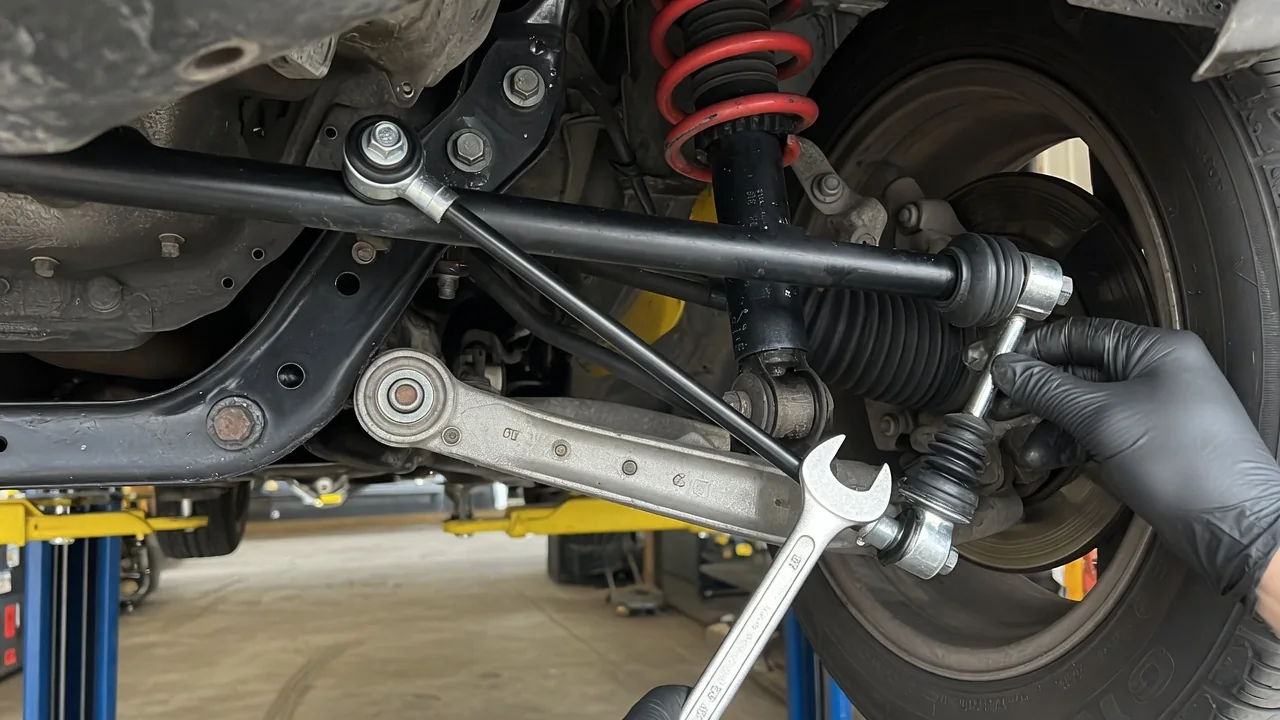
A stabilizer bar end link is the short connecting rod that joins the end of a stabilizer bar, also called a sway bar or anti-roll bar, to a moving part of the suspension. Its purpose is simple to state: it transfers force between the bar and the wheel so the bar can resist body roll in turns. This article explains how the link connects, how it moves as the suspension works, and why a worn link is a common source of clunks and rattles.
Bar Connection: How the End Link Joins the Sway Bar
A stabilizer bar is a steel bar, usually shaped like a wide U, that runs across the vehicle between the left and right wheels. Its center section is held to the body or subframe by rubber or polyurethane bushings that let it rotate. The two ends, often called arms, extend toward the wheels. Something has to tie each arm to the part of the suspension that moves up and down with the wheel, and that is the job of the end link. Depending on the suspension design, the lower end of the link may attach to a control arm, to the body of a strut, or to the steering knuckle, while the upper end bolts to the tip of the bar arm.
End links come in a few common forms. One type is a short rod with a small ball joint at each end; each joint has a threaded stud secured with a nut and a rubber boot that keeps grease in and dirt out. Another type uses a long bolt passing through the bar arm and the suspension mount, with stacked bushings, washers, and a spacer sleeve between them. Some designs combine a ball joint at one end with a bushing at the other. In all cases the link's length helps set where the bar sits relative to the suspension, which is why links of different or adjustable lengths exist for modified vehicles.
Motion: What the End Link Does as the Suspension Moves
The purpose of a sway bar end link becomes clear when you look at how the bar works. When both wheels on an axle rise or fall together, as over a speed bump taken straight on, the bar simply rotates in its bushings and the end links move with it without much load. When one wheel moves relative to the other, as happens when the body leans in a turn or one tire hits a bump, the bar is twisted. Its resistance to twisting pushes up on one side and down on the other, opposing body roll. The end links are the path for that force, carrying it in tension or compression between the bar and each wheel, and a healthy link does this with very little lost motion.
Because the bar end and the suspension mounting point travel on different arcs, the link has to tolerate changing angles throughout suspension travel. Ball joints or flexible bushings at its ends provide that freedom. On designs where the link mounts to a strut or knuckle, it may also need to accommodate rotation as the wheels are steered. Geometry matters too: a link that sits close to perpendicular to the bar arm transfers motion efficiently, while one at a steep angle converts less of the wheel's movement into bar twist. Changes in ride height, such as lowering a vehicle, can alter that angle, which is a general reason some modified setups use different link lengths.
Noise: Why Worn End Links Clunk and Rattle
End links are one of the more common sources of suspension noise, and the reason lies in the way they are loaded. The force through the link reverses direction repeatedly as the body rocks side to side and as each wheel meets uneven pavement. Once a ball joint wears and develops play, each reversal lets the stud move within its socket and strike the other side, producing a clunk, knock, or rattle. A torn boot accelerates this by letting water and grit in and grease out. Bushing-type links fail differently: the rubber can crack, compress, or lose its clamping preload, allowing the bolt and washers to shift and tap against the mounts.
The noise tends to show up at low speeds over small, sharp irregularities, such as rough patches, expansion joints, or driveway transitions, and it may seem to come from one corner. It is often described as a hollow knock or a light rattle rather than a heavy bang. However, sound alone does not identify the part. Worn sway bar bushings, strut mounts, ball joints, tie rod ends, and loose heat shields can produce similar noises. A hands-on inspection is more reliable: checking the boots for tears, looking for fresh wear marks, grasping the link to feel for play, and, where the design allows, disconnecting one end to see whether the joint moves loosely or binds.
Practical Implications and Limits
A worn end link mainly affects noise at first, but if it separates or breaks, the bar can no longer act on that side. The vehicle then tends to lean more in turns and may feel less settled in quick lane changes or on uneven roads, and a loose link can contact nearby parts. The springs still carry the vehicle's weight, so this is not the same as a spring or load-bearing ball joint failure, but handling is no longer what the suspension was designed to deliver, and a prompt repair is the sensible course.
When links are replaced, a few general practices apply across many vehicles. Ball-stud links often have a hex or Torx socket in the stud so it can be held while the nut is turned; without that, the stud can spin in its socket. Bushing-type links are usually tightened with the suspension at normal ride height so the bushings are not clamped in a twisted or compressed position. Installing links while one side of the suspension hangs lower than the other can leave the bar preloaded, which can affect side-to-side balance. Fastener torque values and any specific procedures come from the service information for the particular vehicle, not from a general rule.
It is also worth keeping the link's role in perspective. The end link is a connector, not the source of roll stiffness; that comes from the bar itself, its material, diameter, and arm length, working together with the springs and the rest of the suspension. A new link restores the bar's intended function but will not make a car corner flatter than its design allows. Link style, mounting location, and whether a vehicle has a bar at the front, rear, or both all vary by make and model, so the vehicle's own repair manual remains the reference for its exact parts and procedures.