What Is a Split Crankcase Engine? Construction, Crank Support and Sealing
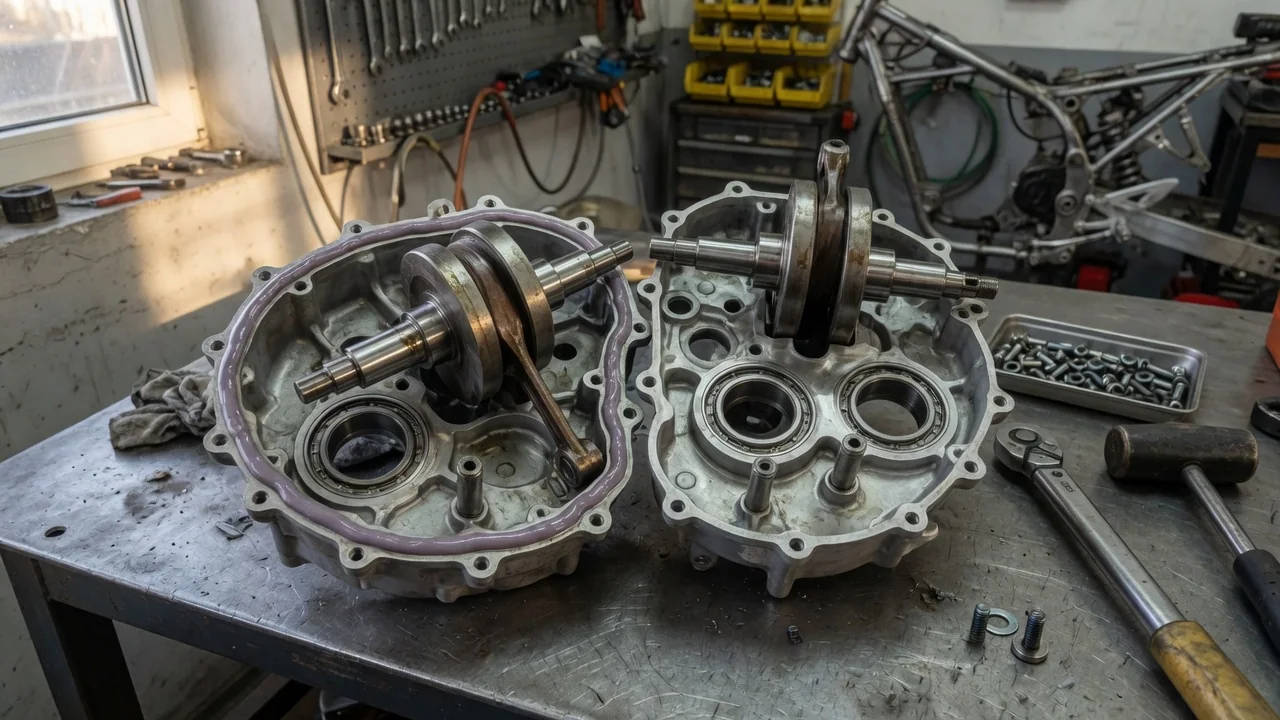
A split crankcase engine has a crankcase built from two major castings joined along a single plane. It is not formed as one piece with bolt-on bearing caps. The joint usually runs through the crankshaft centerline, so the two halves together form the main bearing bores. This article covers split crankcase engine construction in general terms: how the halves are arranged, how they hold the crankshaft, and how the seam is kept oil-tight.
Block halves: how the crankcase is divided
The defining feature of a split crankcase is its parting line, the machined plane where the two halves meet. Manufacturers orient that plane in different ways depending on the engine layout. In a horizontally opposed engine, the case is commonly split vertically down the middle, and each half carries one bank of cylinders. In many motorcycle-type layouts, the case is split horizontally into upper and lower halves, and the same castings often enclose the transmission. Some small single-cylinder and two-stroke engines split left and right through the cylinder axis, so each half carries one side of the crankshaft.
Many conventional car engines use a different approach. The block is a single casting, and individual main bearing caps are bolted to its underside. Some designs replace the separate caps with a bedplate or ladder frame, which ties all the main bearing supports into one lower casting. That arrangement shares the basic idea of a split case, because the main bores are formed between two large castings. Terminology is not fully consistent, though. Whether a particular engine is described as having a split crankcase depends on how its manufacturer and service literature define it.
Regardless of orientation, the two halves are normally produced as a matched pair. Their mating faces are machined flat, the halves are bolted together, and critical bores are then finished with the halves assembled. Dowel pins or hollow locating dowels set the alignment so the halves return to the same position each time. Because of this process, one half is generally not interchangeable with a half from a different set.
Crank support between the halves
In a split crankcase engine, the crankshaft main bearings are clamped in bores created jointly by both halves. Some engines use plain bearing shells, with one shell seated in each half. Tightening the halves together compresses the shells slightly, a condition called bearing crush, which holds them firmly in place and keeps them from spinning. Other engines, particularly many small two-strokes, use ball or roller bearings instead. Their outer races are pressed into or located by bores that straddle the joint, and the halves are drawn together around them.
Fasteners do two different jobs in this construction. Heavy through-bolts or studs placed close to each main bearing clamp the bearing area. In some designs, these fasteners also pass through the cylinders to the heads. They carry the loads that combustion and crankshaft motion put into the case. A row of smaller perimeter bolts around the edge mainly holds the rest of the seam closed. One main bearing usually also controls crankshaft end play, using flanged shells or separate thrust washers. Under load, the shape of every bore depends on both halves acting as one stiff structure, so the clamping of the joint directly affects how the crankshaft is supported.
Sealing the parting line and crank ends
Where the bearing bores pass through the joint, the seam usually has no thick gasket. A gasket of meaningful thickness would move the halves apart and change the size and shape of the bores, which would alter bearing clearance. Instead, a thin film of liquid or anaerobic sealant is applied to clean machined faces, and the faces close metal to metal. Some designs place the bearings away from the parting line and use paper or composite gaskets there. The correct choice is whatever the engine's service information specifies.
The parting line is not the only seal that depends on the halves. Crankshaft lip seals at each end sit in bores formed by both castings, so their alignment depends on how accurately the case is assembled. Oil passages that cross the joint often rely on O-rings or small dedicated seals. Internal pressure also matters. Crankcase ventilation keeps pressure near its intended level, and a restricted breather can push oil out past the seam and seals. In crankcase-scavenged two-stroke engines, the crankcase acts as a pump for the incoming charge, so it must be airtight. An air leak at the seam or at a crank seal can disturb the air-fuel mixture.
Practical implications and limits
The biggest practical consequence is service access. Separating the halves typically requires removing the engine and much of its internal hardware, and in layouts where the case also houses the transmission, that goes with it. For this reason, a light seep at the seam is often monitored rather than repaired immediately. Before blaming the seam, confirm where the oil is actually coming from. Oil from higher covers, gaskets, or tubes can run down and collect along the parting line, making it look like the source.
When a case is opened, reassembly is a precision job. Follow the specified tightening sequence and torque values, use the specified sealant, and keep the mating faces clean without gouging soft aluminum with a scraper. Sealant should not squeeze into oil passages or bearing bores. After assembly, check that the crankshaft turns freely, and check end play and clearances as the service manual directs. Serious damage to one half usually means replacing the matched pair rather than a single casting.
A split crankcase is a construction method, not a performance or reliability rating on its own. Durability, oil tightness, and noise depend on materials, machining accuracy, fastener design, operating conditions, and maintenance as much as on where the case is divided. Designs also vary widely between engine families, so this general explanation should guide understanding, while repair decisions follow the documentation for the specific engine.