What Is a Speaker Crossover Frequency? Driver Range, Slopes and Tuning
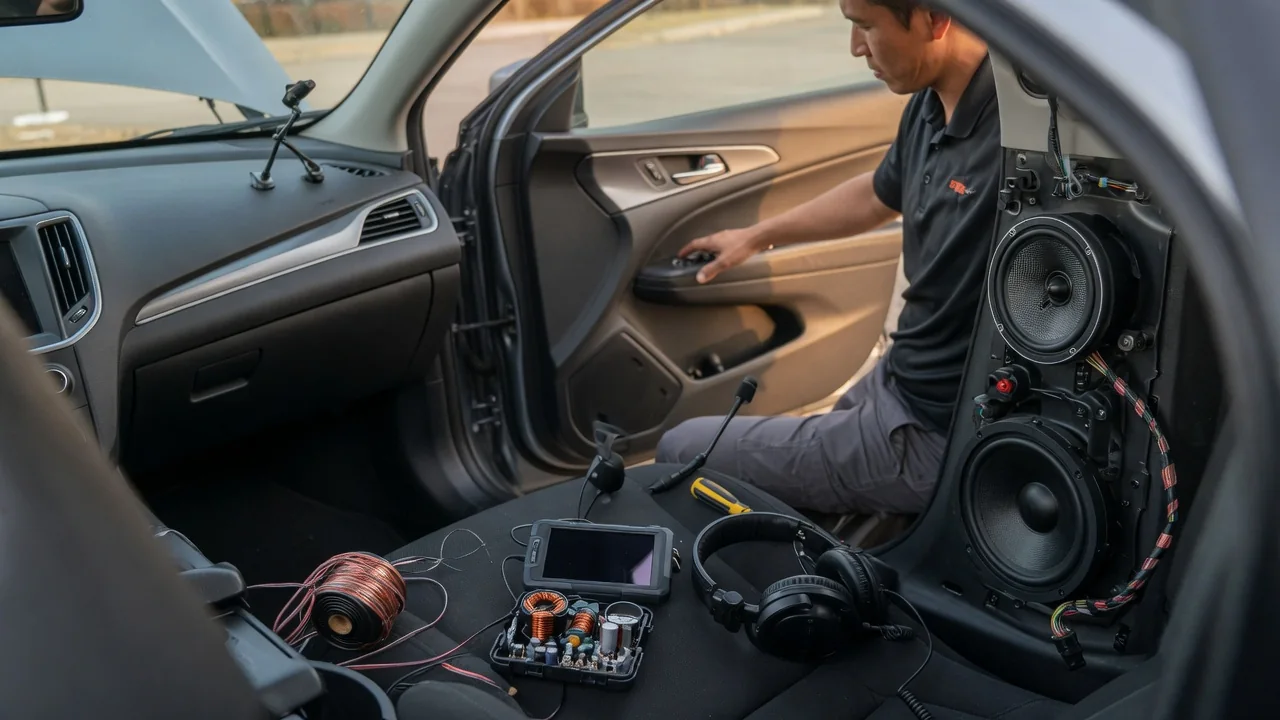
A speaker crossover frequency is the point where an audio system hands sound off from one speaker to another, such as from a woofer to a tweeter or from door speakers to a subwoofer. Around that point, a filter gradually reduces the signal sent to one driver while passing it to the next. In a car, the crossover setting affects clarity, bass impact, and how safely each speaker operates, so it helps to understand what the setting actually controls.
Driver range: why speakers need a handoff point
No single speaker reproduces the full audible range well. A subwoofer uses a large, heavy cone that moves a lot of air at low frequencies but struggles to respond quickly enough for clear upper tones. A tweeter uses a small, light diaphragm that handles high frequencies cleanly but cannot move far enough to produce bass. Feeding a tweeter strong low-frequency content forces it beyond its intended movement, which can cause audible distortion and, at higher power, damage. Large woofers asked to play very high frequencies tend to become directional and lose detail away from their axis. Each driver therefore has a usable range, and a crossover keeps it working inside that range.
The crossover frequency marks where one driver's range is intentionally rolled off and the next driver takes over. It is not a hard wall. Depending on the filter type, the output at the crossover point is typically reduced by a few decibels, and both drivers contribute sound in the region around it. As general practice, subwoofers are often crossed to the door or kick panel speakers somewhere in the lower bass region, roughly 60 to 100 Hz, and the woofer-to-tweeter point in two-way component sets commonly falls in the low thousands of hertz. These are typical ranges rather than rules; the speaker manufacturer's recommended limits for a specific driver take priority.
Systems differ in how many handoffs they use. A two-way component set has one crossover point between woofer and tweeter, a three-way set adds a dedicated midrange and therefore a second point, and adding a subwoofer creates another division at the bottom. Coaxial speakers usually include a simple built-in network for the tweeter mounted in front of the woofer.
Filter slope: how quickly the handoff happens
The crossover frequency says where the filter starts working; the slope says how fast it reduces the signal beyond that point. Slope is expressed in decibels per octave, where an octave means a doubling or halving of frequency. Each filter order adds about 6 dB per octave: first order is 6 dB, second order 12 dB, third order 18 dB, and fourth order 24 dB per octave. For example, a tweeter high-pass with a 12 dB per octave slope continues to lose roughly another 12 dB of output for each octave further below the crossover point, once well past the corner of the curve.
Gentle and steep slopes involve tradeoffs. A gentle slope creates a wider overlap where both drivers play together, which can blend smoothly, but it also lets more out-of-range energy reach each driver, a concern for small tweeters. A steeper slope protects drivers better and narrows the overlap, but it introduces more phase shift and makes the choice of crossover frequency more critical. Passive crossovers built from capacitors and inductors need more components for steeper slopes, and their behavior depends on the speaker's actual impedance. Active crossovers in amplifiers, head units, or digital signal processors can implement steep slopes without that limitation.
Filter alignment also matters. Butterworth filters are typically about 3 dB down at the crossover point, so two of them summed can create a slight peak in that region. Linkwitz-Riley filters are about 6 dB down at the crossover point, designed so the combined output sums flat when the drivers are in phase. Even-order filters shift phase in ways that may require reversing the polarity of one driver, particularly with second-order designs, to avoid a dip at the handoff.
Tuning a car speaker crossover frequency
Tuning usually starts with the driver specifications. Set the tweeter's high-pass no lower than the manufacturer recommends, set the door or midbass speakers to roll off below the range they can handle cleanly, and set the subwoofer low-pass so it covers the bass region below them. Depending on the system, these controls may live in the head unit menu, on amplifier switches and dials, in DSP software, or as fixed values in a passive network that only offers tweeter level settings.
Adjustments can be made by ear, by measurement, or both. A real-time analyzer with a measurement microphone at the listening position shows peaks or dips near the crossover region that are hard to judge by ear alone. When listening, common warning signs include a hollow or thin region where neither driver seems to carry the sound, a harsh or shouty upper midrange, and bass that sounds located in the trunk instead of in front of the listener. That last symptom often suggests the subwoofer is playing too high in frequency. Change one setting at a time in small steps, and check polarity whenever the overlap region sounds weak.
Crossover settings interact with level and timing. Moving a crossover point changes how much each driver contributes near the overlap, so relative levels often need rebalancing afterward. In a car, the listener sits much closer to some speakers than others, and processors with time alignment can delay nearer drivers so their output arrives together. Because these adjustments affect the same frequency region, it is worth rechecking the crossover blend after changing levels or delays.
Practical implications and limits
A car cabin is an unusual listening space, with reflective glass, absorbent seats, and speakers often mounted low in doors or kick panels. Reflections and panel resonances can boost or cancel certain frequencies at the driver's seat, so a crossover point that works well in one installation may need changing in another, even with identical speakers. Published ranges and manufacturer recommendations are starting points; the final values depend on the specific vehicle, mounting location, and listening position.
Crossover settings also cannot overcome hardware limitations. No filter makes a small tweeter safely reproduce deep bass, and none fixes a rattling door panel or a poorly sealed speaker mount. A crossover reduces unwanted frequencies, but excessive amplifier gain or a clipped signal can still damage a driver within its intended range. Some factory audio systems use fixed crossovers or apply their own equalization through a factory amplifier, and some head units offer limited or no adjustment, which restricts what tuning can achieve without additional processing.
When the sound still seems wrong after careful adjustment, the cause may lie elsewhere, such as reversed speaker wiring, a damaged driver, or installation issues. Crossover tuning works best as one part of a system setup, aiming for speakers that blend into a single coherent sound rather than chasing a particular number.