What Is a Spark Plug Gap?
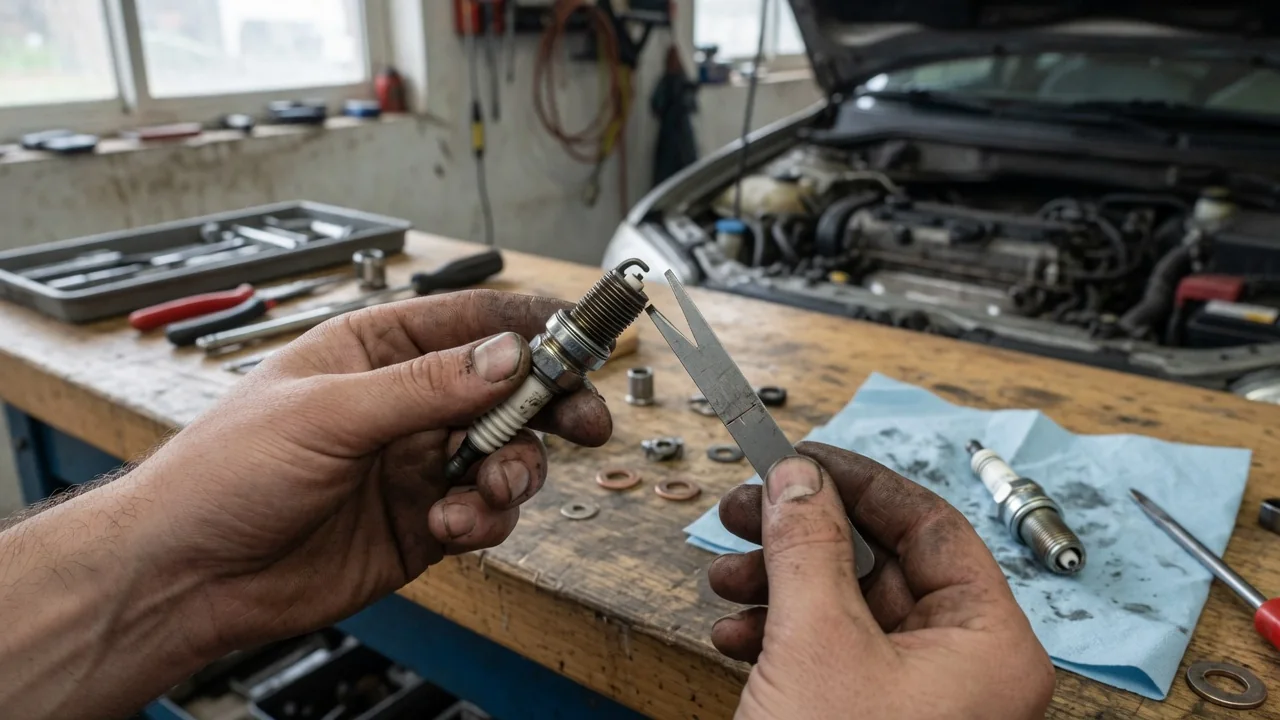
Anyone asking what is a spark plug gap is really asking about a tiny space with a big job. The gap is the distance between the center electrode and the ground electrode at the tip of a spark plug, and the ignition spark must jump across it. That spacing shapes how reliably the air-fuel mixture ignites, which affects smoothness, power, and efficiency.
Spark path
When the ignition coil releases its stored energy, voltage builds at the center electrode until it is high enough to ionize the mixture sitting in the gap. At that moment the air and fuel between the electrodes become conductive, and current arcs across to the ground electrode. That brief arc is the spark path. Its length is set by the gap, so the spacing directly determines how much of the mixture the spark touches and how much voltage the coil must supply.
A wider path exposes more mixture to the arc, which can help start a strong flame kernel, but it also demands more voltage, especially under high cylinder pressure during hard acceleration. A narrower path fires easily yet produces a smaller spark that may struggle to light a lean or diluted charge. Engine designers balance these effects against coil output, compression, and fueling strategy, which is why a turbocharged engine and a naturally aspirated one often call for different spacing.
Wear
Every spark removes a microscopic amount of metal from the electrodes. Over many thousands of miles, this erosion rounds off the sharp edges of the center electrode and wears the ground electrode, so the gap slowly grows. Sharp edges concentrate the electrical field and make it easier for the spark to form, so a worn, rounded electrode needs more voltage for two reasons at once: the distance is longer and the edges are duller.
Electrode material changes how quickly this happens. Plugs with fine-wire precious-metal tips, such as platinum or iridium, generally resist erosion far better than conventional copper-core plugs with nickel alloy electrodes. On a removed plug, wear can show up as a visibly enlarged gap, a rounded center tip, or a thinned ground strap. Deposits from oil or fuel additives can also change the effective spacing by bridging or coating the electrodes, and the pattern varies with engine design and driving habits.
Correct specification
There is no universal gap. Each engine has a specified spacing chosen by the manufacturer to suit its ignition system, combustion chamber shape, and operating pressures. The figure usually appears in the owner's manual, the service information, or on an underhood emissions label, and it is expressed in thousandths of an inch or in millimeters. Two engines offered in the same model can carry different values, so the specification should be matched to the exact engine rather than the vehicle name alone.
Many plugs arrive with a gap set at the factory, but that setting is aimed at common applications and can shift if a plug is dropped or jostled in shipping. Checking it with a suitable gauge before installation confirms that it matches the engine's requirement. Fine-wire precious-metal plugs deserve particular care, because their thin tips can be damaged by prying, and some plug makers advise against adjusting certain designs at all. Multi-ground-electrode plugs are typically not meant to be adjusted.
Everyday Use and Observations
Drivers never see the gap at work, but they can feel its results. When the spacing is right and the ignition system is healthy, the engine starts promptly, idles evenly, and pulls cleanly under load. When the gap has grown too wide, the coil may fail to bridge it under high demand, producing a stumble or hesitation during acceleration, a rough idle, harder cold starts, or a gradual drop in fuel economy that is easy to overlook.
A gap that is too small can cause its own problems, including a weak, shrouded spark and incomplete combustion that feels like a soft, uneven idle. Persistent misfires may trigger the check engine light, and a flashing light under load is commonly a sign of active misfiring that deserves prompt attention. Still, a misfire code is evidence to interpret rather than proof that plugs are at fault, since coils, injectors, vacuum leaks, and compression problems can produce the same symptoms. Code meanings can also vary by manufacturer.
Limits and Next Steps
Gap is only one piece of ignition health. A plug with perfect spacing can still misfire if its insulator is cracked, its heat range is wrong for the engine, or its tip is fouled with oil or carbon. Likewise, widening the gap in hopes of extra power rarely helps on a stock ignition system and can strain coils by forcing them to produce higher voltage on every firing event. The specified value reflects testing that a quick adjustment cannot replicate.
For next steps, start with the vehicle's own documentation to confirm the correct plug type, gap, and replacement schedule, because these vary widely by engine. If symptoms point toward ignition trouble, inspecting the plugs can reveal useful clues, though access is difficult on some engines and plugs should only be removed following the manufacturer's guidance. When the cause is unclear, or when misfires continue after new plugs are fitted, a qualified technician can test coils, fueling, and compression to find the real source.