What Is a Slip Yoke? Purpose, Splines and Service
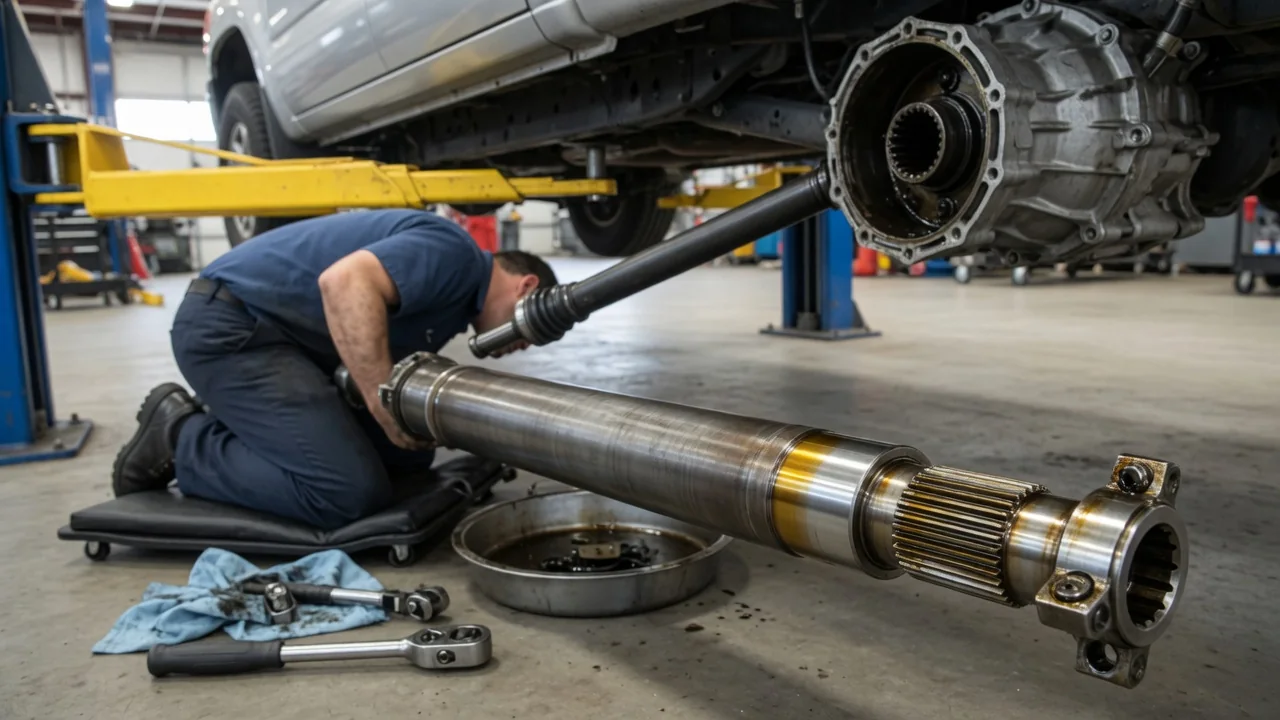
A slip yoke is the sliding, splined coupling that lets a driveshaft change length while it turns. On most rear-wheel-drive and many four-wheel-drive vehicles, it sits at the front of the driveshaft and slides over the transmission or transfer case output shaft. Knowing what a slip yoke is, and why it matters, helps explain several common drivetrain noises, leaks and vibrations. It also shows what to watch for when the driveshaft is removed or modified.
Length change: the core purpose of a slip yoke
The purpose of a driveshaft slip yoke comes down to geometry. A driveshaft connects a component mounted to the body or frame, the transmission or transfer case, to an axle that moves with the suspension. The axle moves up and down over bumps, under load, and when the vehicle squats under acceleration, and each movement changes the distance between the transmission output and the axle pinion. With a solid rear axle, the pinion swings through an arc defined by the suspension links or leaf springs, so the driveshaft must get slightly longer or shorter as it moves. A rigid driveshaft with no way to change length would try to push the transmission forward or pull the axle out of position, loading bearings, mounts and joints.
The slip yoke solves this by letting one end of the shaft telescope. Engine and transmission movement on their rubber mounts adds further small changes in length, especially when torque twists the powertrain. The universal joint at the yoke handles the change in angle, and the sliding splines handle the change in distance. These two functions are separate. A universal joint alone cannot absorb length change, and a slip yoke alone cannot accommodate an angle. For this reason, most conventional driveshafts combine at least one slip connection with two or more joints.
Splines: how the slip yoke transmits torque while sliding
Splines are the matching ridges and grooves that let the yoke slide lengthwise while staying locked rotationally to the shaft it rides on. In the most familiar design, the slip yoke has internal splines and a smooth, machined outer barrel. It slides over external splines on the transmission or transfer case output shaft. The barrel rides inside the extension housing, where a bushing supports it and a seal keeps fluid in. In this layout, transmission or transfer case fluid usually lubricates the splines. Other driveshafts place the slip joint within the shaft itself, with a splined stub shaft sliding into a splined sleeve. Those joints are often sealed with a boot or cap and may be lubricated with grease, sometimes through a grease fitting.
The splines carry the full driveline torque while also needing to slide, so friction and clearance both matter. Under heavy load, friction between the spline teeth increases, which can make the joint resist sliding until it releases suddenly. This behavior is often called spline bind. It can show up as a clunk or thump when accelerating, braking or crossing bumps. Some slip joints use coated splines to reduce friction and wear. Over time, the teeth can wear and allow rotational play. That play may be felt or heard as a clunk when shifting into gear or when switching between acceleration and deceleration.
Service: inspection, removal and installation
Slip yoke service usually starts with inspection. With the vehicle safely supported, a technician can check for rotational free play by holding the shaft and trying to turn the yoke. They can also look for side-to-side looseness, which may indicate a worn yoke barrel or extension housing bushing. The polished surface of a transmission-style slip yoke deserves close attention. Rust pitting, nicks or a groove worn by the seal lip can let fluid escape past even a new seal. A leak at the rear of the transmission may therefore point to the yoke as well as the seal itself.
To remove the driveshaft, the rear joint is usually disconnected first, and then the yoke slides straight out of the housing. Marking the driveshaft relative to the axle flange or yoke before removal helps preserve balance and joint alignment on reassembly. Slip joints located within the shaft are often indexed so the two halves go back together in the correct phase. Some vehicles lose fluid from the output housing once the yoke is out, so plugging the opening or keeping that end raised is common practice. The service manual for the specific vehicle is the authoritative source for procedure, lubricant and torque values.
On installation, the splines and barrel are typically cleaned and lightly lubricated as directed. The yoke is then slid in carefully to avoid cutting the seal lip, and it should never be hammered into place. After any work that may have disturbed fluid, checking the transmission or transfer case fluid level is a sensible final step. If the seal or the yoke surface was damaged, replacing both together helps prevent a repeat leak.
Practical implications and limits
A slip yoke has finite travel, so it works correctly only within the range of driveshaft lengths the original design anticipated. Suspension lifts, lowering, axle swaps and changes in pinion angle can shift that operating range. If the yoke extends too far at full droop, too little spline engagement remains. That increases wear and, in extreme cases, can let the yoke pull out. If the shaft compresses too far, the yoke can bottom out against the output shaft and push on transmission components. Whether a given modification causes these problems depends on the vehicle, the suspension design and the parts used. Measurements and manufacturer guidance matter more than general rules.
Slip yoke symptoms such as clunks, vibration or rear seal leaks overlap with problems from universal joints, mounts, the carrier bearing, pinion bearings and driveshaft balance. Diagnosis usually involves checking each of these components rather than assuming the yoke is at fault. Not every vehicle uses a slip yoke in the same way. Front-wheel-drive cars use plunging constant-velocity joints instead, and some driveshafts build the slip function into a different part of the assembly. A slip yoke is best understood as one part of a driveline system, and its behavior depends on how all the other parts work with it.